Question
Repeat part (a) of problem 6 if the push is applied horizontally and not parallel to the incline.

Answer


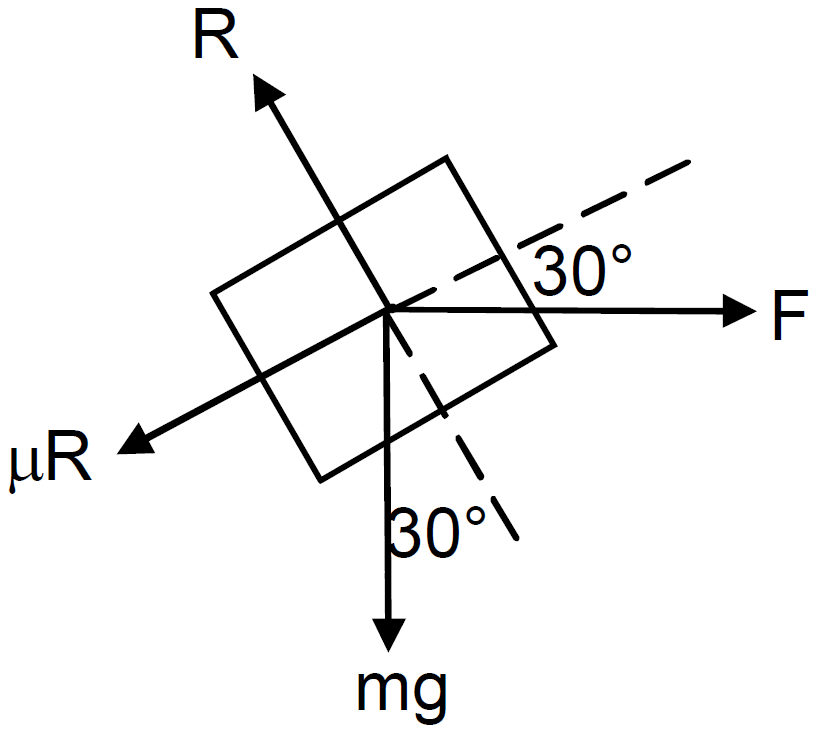
From the free body diagram
$\text{g}=10\text{m/s}^2,\text{m}=2\text{kg},\theta=30^{\circ},\mu=0.2$
$\text{R}-\text{mg}\cos\theta-\text{F}\sin\theta=0$
$\Rightarrow\text{R = mg}\cos\theta+\text{F}\sin\theta \ ...(1)$
And $\text{mg}\sin\theta+\mu\text{R}-\text{F}\cos\theta=0$
$\Rightarrow\text{mg}\sin\theta+\mu(\text{mg}\cos\theta+\text{F}\sin\theta)-\text{F}\cos\theta=0$
$\Rightarrow\text{mg}\sin\theta+\mu\text{ mg}\cos\theta+\mu\text{F}\sin\theta-\text{F}\cos\theta=0$
$\Rightarrow\text{F}=\frac{(\text{mg}\sin\theta+\mu\text{mg}\cos\theta)}{(\mu\sin\theta-\cos\theta)}$
$\Rightarrow\text{F}=\frac{2\times10\times\big(\frac{1}{2}\big)+0.2\times2\times10\times\big(\frac{\sqrt{3}}{2}\big)}{0.2\times\big(\frac{1}{2}\big)-\big(\frac{\sqrt{3}}{2}\big)}$
$=\frac{13.464}{0.76}=17.7\text{N}\approx17.5\text{N}$

Need a full question paper?

Generate a complete, print-ready paper with questions like this in minutes — across 16+ boards, with answer keys.
Start Generating Free

Similar questions

A capacitor having a capacitance of $100\mu\text{F}$ is charged to a potential difference of 24V. The charging battery is disconnected and the capacitor is connected to another battery of emf 12V with the positive plate of the capacitor joined with the positive terminal of the battery:
  1. Find the charges on the capacitor before and after the reconnection.
  2. Find the charge flown through the 12V battery.
  3. Is work done by the battery or is it done on the battery? Find its magnitude.
  4. Find the decrease in electrostatic field energy.
  5. Find the heat developed during the flow of charge after reconnection.
Four equal charges $2.0 \times 10^{-6}C$ each are fixed at the four corners of a square of side 5cm. Find the Coulomb force experienced by one of the charges due to the rest three.
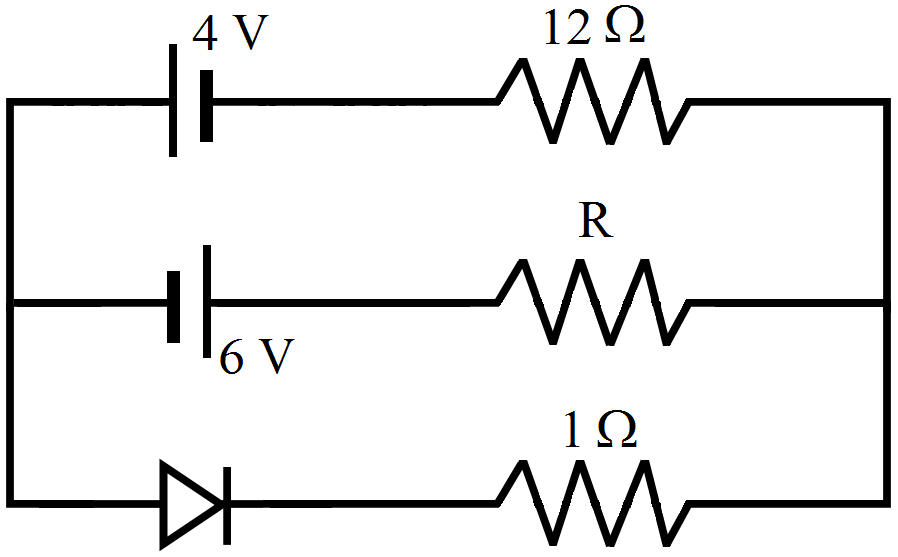
Find the current through the resistance R in figure. if.
  1. $\text{R}=12\Omega$
  2. $\text{R}=48\Omega$
$i$. An alternating voltage $V = V _{ m } \sin \omega t$ applied to a series $L - C - R$ circuit derives a current given by $I = I _{ m } \sin (\omega t+\phi)$. Deduce an expression for the average power dissipated over a cycle.
$ii$. For circuit used for transporting electric power, a low power factor implies large power loss in transmission. Explain.
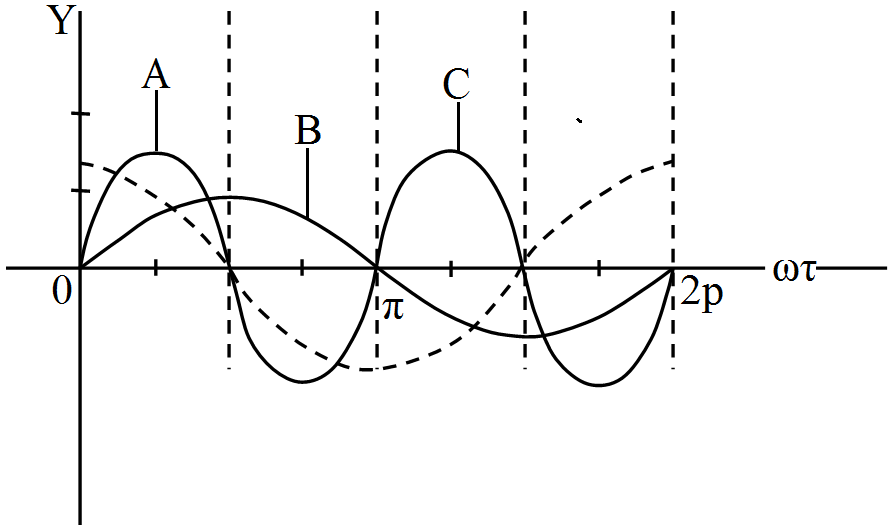
A device ‘X’ is connected to an ac source $\text{V = V}_0\sin\omega\text{t}.$ The variation of voltage, current and power in one cycle is show in the following graph:
  1. Identify the device ‘X’.
  2. Which of the curves, A, B and C represent the voltage, current and the power consumed in the circuit? Justify your answer.
  3. How does its impedance vary with frequency of the ac source? Show graphically.
  4. Obtain an expression for the current in the circuit and its phase relation with ac voltage.
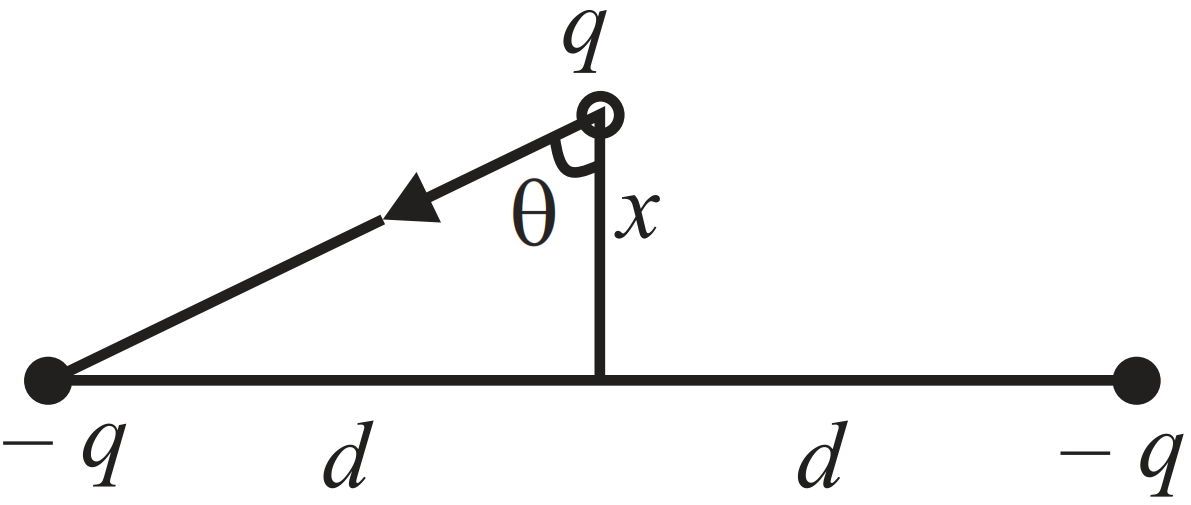
Two charges -q each are fixed separated by distance 2d. A third charge q of mass m placed at the mid-point is displaced slightly by x (x < < d) perpendicular to the line joining the two fixed charged as shown in Fig. Show that q will perform simple harmonic oscillation of time period.

$\text{T}=\Big[\frac{8\pi^3\in_0\text{md}^3}{\text{q}^2}\Big]^\frac{1}{2}$.
Can reflection result in plane polarised light if the light is incident on the interface from the side with higher refractive index?
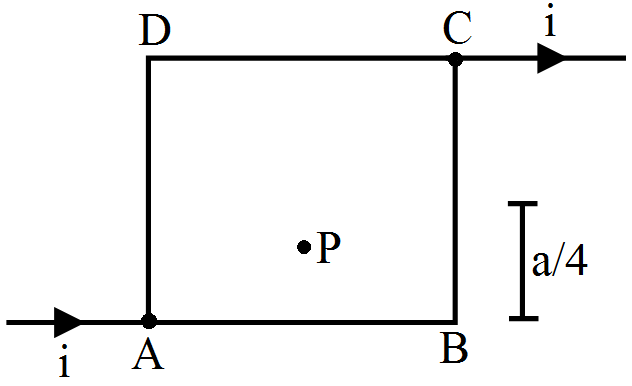
Figure shows a square loop of edge a made of a uniform wire. A current i enters the loop at the point A and leaves it at the point C. Find the magnetic field at the point P which is on the perpendicular bisector of AB at a distance $\frac{\text{a}}{4}$ from it.
A nuclide 1 is said to be the mirror isobar of nuclide 2 if $Z_1 =N_2$ and $Z_2 =N_1.$
  1. What nuclide is a mirror isobar of ${_{11}}^{23}Na?$
  2. Which nuclide out of the two mirror isobars have greater binding energy and why?
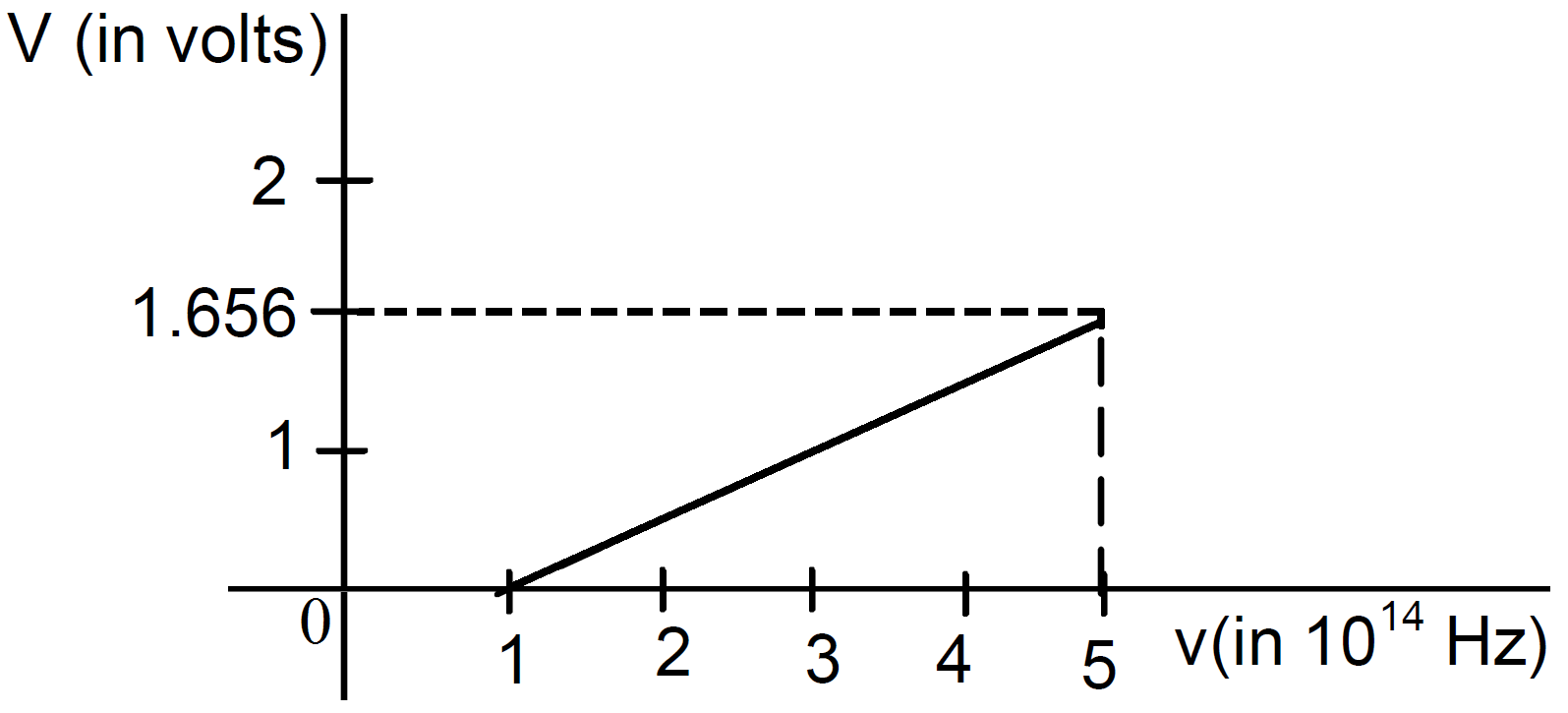
Figure is the plot of the stopping potential versus the frequency of the light used in an experiment on photoelectric effect. Find.
  1. The ratio h/e and.
  2. The work function.