Question
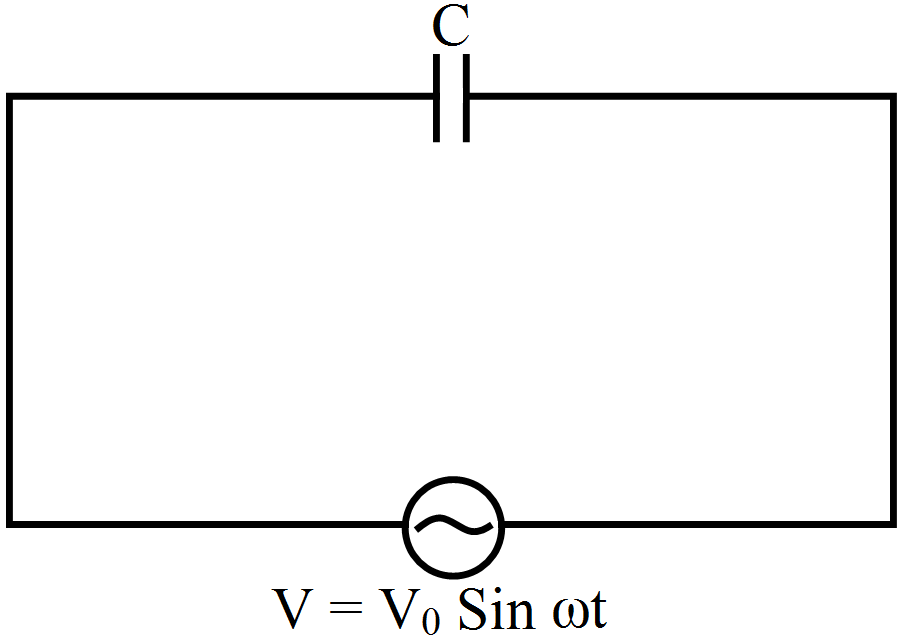
A device ‘X’ is connected to an ac source $\text{V = V}_0\sin\omega\text{t}.$ The variation of voltage, current and power in one cycle is show in the following graph:
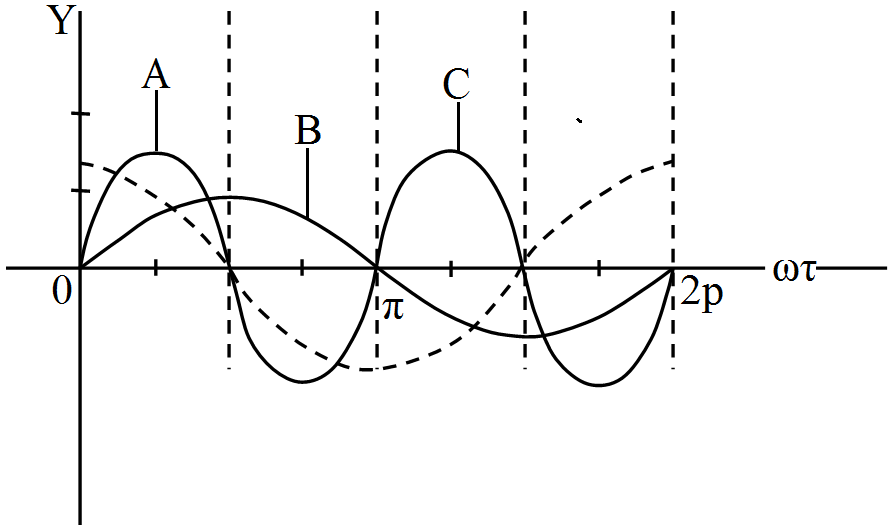
  1. Identify the device ‘X’.
  2. Which of the curves, A, B and C represent the voltage, current and the power consumed in the circuit? Justify your answer.
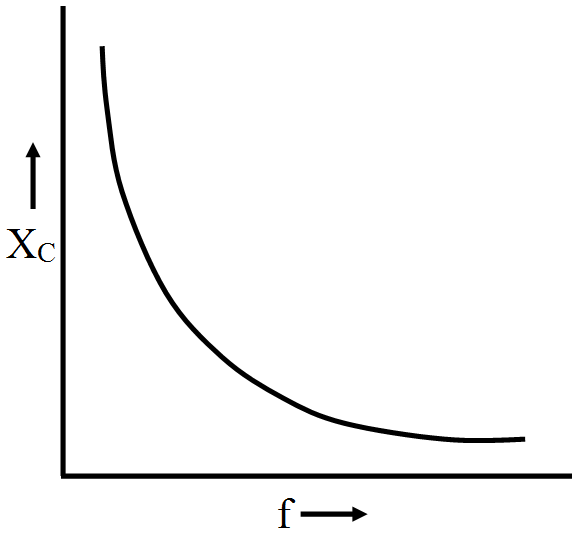
  3. How does its impedance vary with frequency of the ac source? Show graphically.
  4. Obtain an expression for the current in the circuit and its phase relation with ac voltage.
Answer

  1. The device ‘X’ is a capacitor.
  2. Curve B: Voltage
Curve C: Current

Curve A: Power consumed in the circuit

Reason: This is because current leads the voltage in phase by $\frac{\pi}{2}$ for a capacitor.
  1. Impedance:
$\text{XC}=\frac{1}{\omega\text{C}}=\frac{1}{2\pi}=\text{C}$

$\Rightarrow\text{X}_{\text{C}}\propto\frac{1}{\text{f}}$
  1.  


Voltage applied to the circuit is

$\text{V = V}_0\sin\omega\text{t}$

Due to this voltage, a charge will be produced which will charge the plates of the capacitor with positive and negative charges.

$\text{V}=\frac{\text{Q}}{\text{C}}\Rightarrow\text{Q}=\text{CV}$

Therefore, the instantaneous value of the current in the circuit is

$\text{I}=\frac{\text{dQ}}{\text{dt}}=\frac{\text{d(CV)}}{\text{dt}}=\frac{\text{d}}{\text{dt}}(\text{CV}_0\sin\omega\text{t})$

$\text{I}=\omega\text{CV}_0\cos\omega\text{t}=\frac{\text{V}_0}{\frac{1}{\omega\text{C}}}\sin\Big(\omega\text{t}+\frac{\pi}{2}\Big)$

$\text{I}=\text{I}_0\sin\Big(\omega\text{t}+\frac{\pi}{2}\Big)$

where, $\text{I}_0=\frac{\text{V}_0}{\frac{1}{\omega\text{C}}}$ = Peak value of current

Hence current leads the voltage in phase by $\frac{\pi}{2}.$

Need a full question paper?

Generate a complete, print-ready paper with questions like this in minutes — across 16+ boards, with answer keys.

Start Generating Free

Similar questions

A ball is dropped from a height of 5m onto a sandy floor and penetrates the sand up to 10cm before coming to rest. Find the retardation of the ball in sand assuming it to be uniform.
A sound source, fixed at the origin, is continuously emitting sound at a frequency of 660Hz. The sound travels in air at a speed of 330m/s. A listener is moving along the line x = 336m at a constant speed of 26m/s. Find the frequency of the sound as observed by the listener when he is:
  1. At y = - 140m.
  2. At y = 0.
  3. At y = 140m.
Calculate the work done in moving a test charge q0 from point A to point B against the repulsive force acting on it due to the other charge Q > 0 located at the origin.
A particle on a stretched string supporting a travelling wave, takes 5.0ms to move from its mean position to the extreme position. The distance between two consecutive particles, which are at their mean positions, is 2.0cm. Find the frequency, the wavelength and the wave speed.
The wavelength of sodium light in air is 589nm.
  1. Find its frequency in air.
  2. Find its wavelength in water (refractive index = 1.33).
  3. Find its frequency in water.
  4. Find its speed in water.
A conducting loop of area $5.0cm^2$ is placed in a magnetic field which varies sinusoidally with time as $\text{B}=\text{B}_0\sin\omega\text{t}$ wherer $\text{B}_0=0.20\text{T}$ and $\omega=300\text{s}^{-1}.$ The normal to the coil makes an angle of 60° with the field. Find
  1. The maximum emf induced in the coil.
  2. The emf induced at $\text{t}=\Big(\frac{\pi}{900}\Big)\text{s}$
  3. $\text{t}=\Big(\frac{\pi}{600}\Big)\text{s}.$
  4. The emf induced at $\text{t}=\Big(\frac{\pi}{600}\Big)\text{s}.$
A long, straight wire carries a current i. Let $B_1,$ be the magnetic field at a point Pat a distance d from the wire. Consider a section of length l of this wire such that the point P lies on a perpendicular bisector of the section. Let B2 be the magnetic field at this point due to this section only. Find the value of $\frac{\text{d}}{\text{l}}$ so that $B_2$ differs from $B_1$, by 1%.
Figure shows three equidistant slits being illuminated by a monochromatic parallel beam of light. Let $\text{BP}_0-\text{AP}=\frac{\lambda}{3}$ and $\text{D}>\lambda.$
  1. Show that in this case $\text{d}=\sqrt{\frac{2\lambda\text{D}}{3}}.$
  2. Show that the intensity at P, is three times the intensity due to any of the three slits individually.
A 6.5m long ladder rests against a vertical wall reaching a height of 6.0m. A 60kg man stands half way up the ladder.
  1. Find the torque of the force exerted by the man on the ladder about the upper end of the ladder.
  2. Assuming the weight of the ladder to be negligible as compared to the man and assuming the wall to be smooth, find the force exerted by the ground on the ladder.
Define the following :
(a) Total internal reflection
(b) Diffraction of light
(c) Refraction of light.