Question
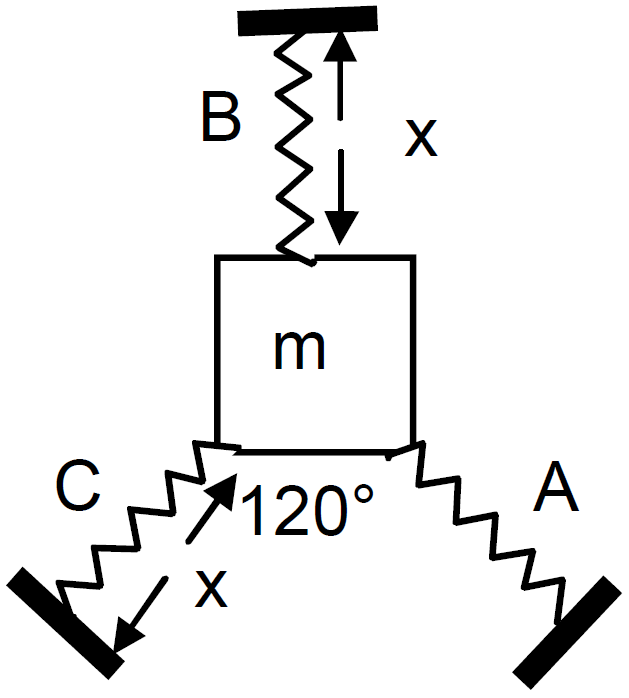
Repeat the previous exercise if the angle between each pair of springs is 120° initially.

Answer

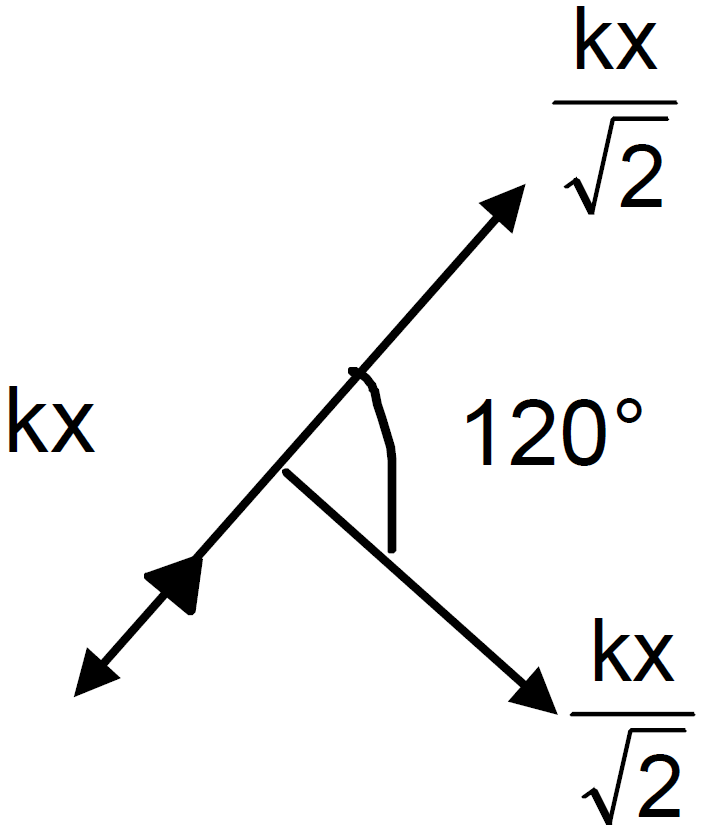
In this case, if the particle ‘m’ is pushed against ’C’ a by distance ‘x’. Total resultant force acting on man ‘m’ is given by,$\text{F}=\text{kx}+\frac{\text{kx}}{2}=\frac{3\text{kx}}{2}$
Because net force $\text{A }\&\text{ B}=\sqrt{\Big(\frac{\text{kx}}{2}\Big)^2+\Big(\frac{\text{kx}}{2}\Big)^2+2\Big(\frac{\text{kx}}{2}\Big)\Big(\frac{\text{kx}}{2}\Big)\cos120^\circ}=\frac{\text{kx}}{2}$$\therefore\text{a}=\frac{\text{F}}{\text{m}}=\frac{3\text{kx}}{2\text{m}}$
$\Rightarrow\frac{\text{a}}{\text{x}}=\frac{3\text{k}}{2\text{m}}=\omega^2$
$\Rightarrow\omega=\sqrt{\frac{3\text{k}}{2\text{m}}}$
$\therefore$ time period $\text{T}=\frac{2\pi}{\omega}=2\pi\sqrt{\frac{2\text{m}}{3\text{k}}}$

Need a full question paper?

Generate a complete, print-ready paper with questions like this in minutes — across 16+ boards, with answer keys.
Start Generating Free

Similar questions

A vector $\overrightarrow{\text{A}}$ makes an angle of 20° and $\overrightarrow{\text{B}}$ makes an angle of 110° with the X-axis. The magnitudes of these vectors are 3 m and 4 m respectively. Find the resultant.
For a normal eye, the far point is at infinity and the near point of distinct vision is about 25 cm in front of the eye. The cornea of the eye provides a converging power of about 40 dioptres, and the least converging power of the eye-lens behind the cornea is about 20 dioptres. From this rough data estimate the range of accommodation (i.e., the range of converging power of the eye-lens) of a normal eye.
A source emits light of wavelengths $555\ nm$ and $600\ nm$. The radiant flux of the $555\ nm$ part is $40W$ and of the $600\ nm$ part is $30W$. The relative luminosity at $600\ nm$ is $0\ '6$. Find:
  1. The total radiant flux.
  2. The total luminous flux.
  3. The luminous efficiency.
Indium antimonide has a band gap of 0.23eV between the valence and the conduction band. Find the temperature at which kT equals the band gap.
The sound level at a point 5.0m away from a point source is 40dB. What will be the level at a point 50m away from the source?
Define the terms (i) drift velocity, (ii) relaxation time.
A conductor of length L is connected to a dc source of emf ε. If this conductor is replaced by another conductor of same material and same area of cross-section but of length 3L, how will the drift velocity change?
The fission properties of $^{239}_{94}\text{Pu}$ are very similar to those of $^{235}_{92}\text{U}.$ The average energy released per fission is $180 MeV$. How much energy, in $MeV,$ is released if all the atoms in $1 \ kg$ of pure $^{239}_{94}\text{Pu}$ undergo fission?
Can we perform Young's double slit experiment with sound waves? To get a reasonable "fringe pattern", what should be the order of separation between the slits? How can the bright fringes and the dark fringes be detected in this case?
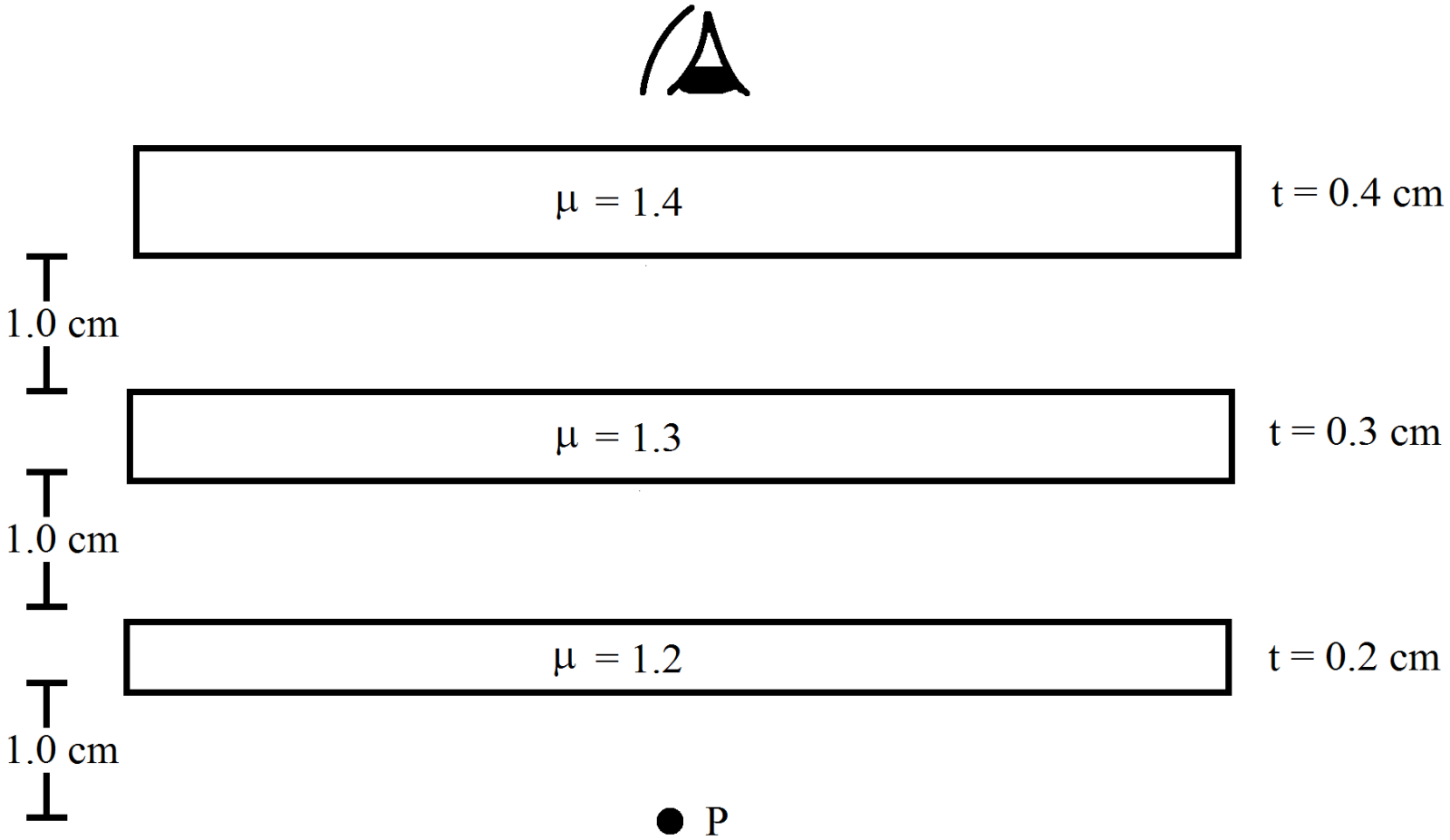
Locate the image of the point P as seen by the eye in the figure.
What is the kinetic energy of an electron in electronvolts with mass equal to double its rest mass?