Question
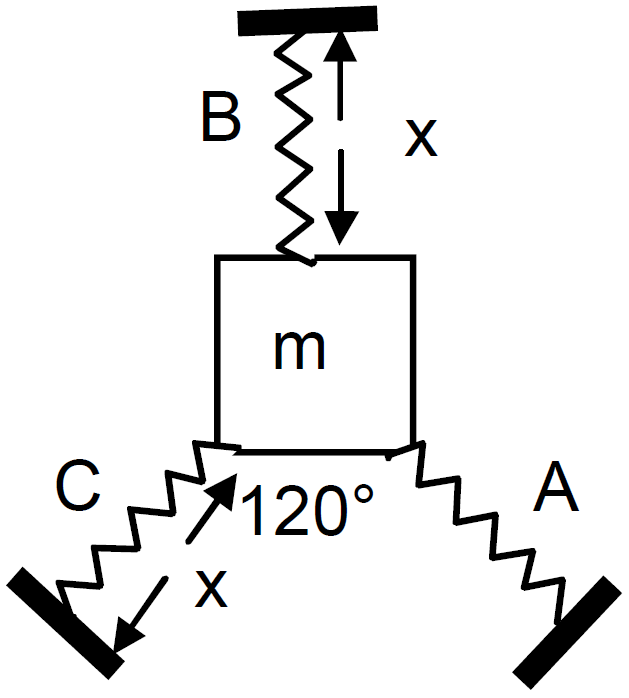
Repeat the previous exercise if the angle between each pair of springs is 120° initially.

Answer

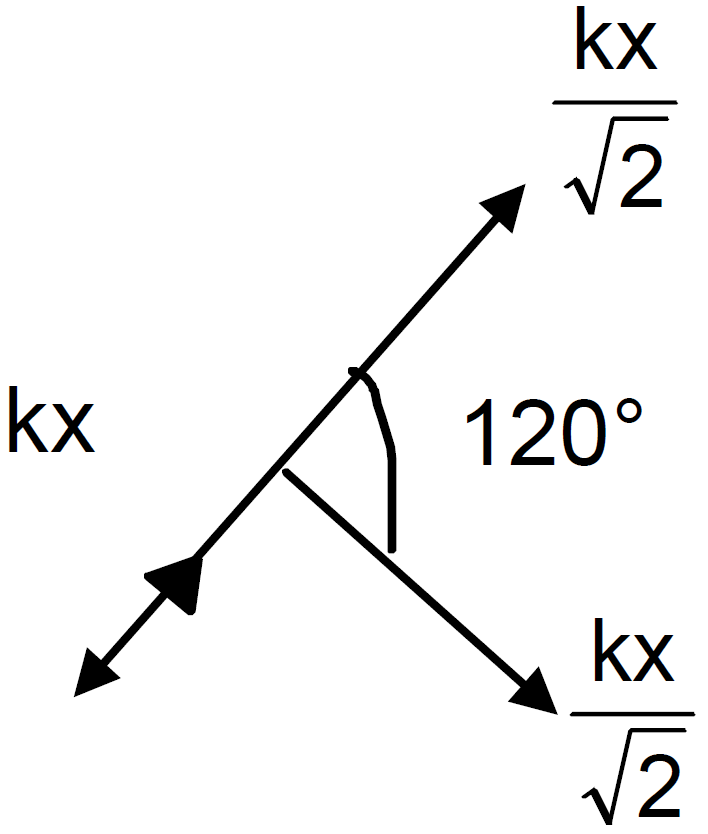
In this case, if the particle ‘m’ is pushed against ’C’ a by distance ‘x’. Total resultant force acting on man ‘m’ is given by,$\text{F}=\text{kx}+\frac{\text{kx}}{2}=\frac{3\text{kx}}{2}$
Because net force $\text{A }\&\text{ B}=\sqrt{\Big(\frac{\text{kx}}{2}\Big)^2+\Big(\frac{\text{kx}}{2}\Big)^2+2\Big(\frac{\text{kx}}{2}\Big)\Big(\frac{\text{kx}}{2}\Big)\cos120^\circ}=\frac{\text{kx}}{2}$$\therefore\text{a}=\frac{\text{F}}{\text{m}}=\frac{3\text{kx}}{2\text{m}}$
$\Rightarrow\frac{\text{a}}{\text{x}}=\frac{3\text{k}}{2\text{m}}=\omega^2$
$\Rightarrow\omega=\sqrt{\frac{3\text{k}}{2\text{m}}}$
$\therefore$ time period $\text{T}=\frac{2\pi}{\omega}=2\pi\sqrt{\frac{2\text{m}}{3\text{k}}}$

Need a full question paper?

Generate a complete, print-ready paper with questions like this in minutes — across 16+ boards, with answer keys.
Start Generating Free

Similar questions

Derive the equation of energy density for electromagnetic wave.
A nonconducting sheet of large surface area and thickness d contains uniform charge distribution of density $\rho.$ Find the electric field at a point P inside the plate, at a distance x from the central plane. Draw a qualitative graph of E against x for 0 < x < d.
The potential barrier existing across an unbiased p-n. junction is 0·2 volt. What minimum kinetic energy a hole should have to diffuse from the p-side to the n-side if,
  1. The junction is unbiased.
  2. The junction is forwardbiased at 0.1 volt.
  3. The junction is reverse-biased at 0.1 volt?
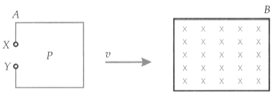
A rectangular coil P is moved from a point A to another point B with uniform velocity 'v' through a region of a uniform magnetic field acting normally inwards as shown in the figure. Show graphically (i) the variation of magnetic flux associated with the coil with time, (ii) the variation of induced emf across points X and Y of the coil with time. 
Image

Explain the nature of variation in magnetic flux as represented by the graph in the first case.
Consider a variation of the previous problem (figure). Suppose the circular loop lies in a vertical plane. The rod has a mass m. The rod and the loop have negligible resistances but the wire connecting O and C has a resistance R. The rod is made to rotate with a uniform angular velocity $\omega$ in the clockwise direction by applying a force at the midpoint of OA in a direction perpendicular to it. Find the magnitude of this force when the rod makes an angle $\theta$ with the vertical.
A square coil of edge l and with n turns carries a current i. It is kept on a smooth horizontal plate. A uniform magnetic field B exists parallel to an edge. The total mass of the coil is M. What should be the minimum value of B for which the coil will start tipping over?
An air-cored solenoid with length 30cm, area of cross-section $25cm^2$ and number of turns 500, carries a current of 2.5A. The current is suddenly switched off in a brief time of $10^{–3}s$. How much is the average back emf induced across the ends of the open switch in the circuit? Ignore the variation in magnetic field near the ends of the solenoid.
A pole of length 1.00m stands half dipped in a swimming pool with water level 50.0 cm higher than the bed. The refractive index of water is 1.33 and sunlight is coming at an angle of 45° with the vertical. Find the length of the shadow of the pole on the bed.
Define the terms threshold frequency and stopping potential in relation to the phenomenon of photoelectric effect. How is the photoelectric current affected on increasing the (1) frequency (2) intensity of the incident radiations and why?
  1. A giant refracting telescope has an objective lens of focal length 15 m. If an eye piece of focal length 1.0 cm is used, what is the angular magnification of the telescope?
  2. If this telescope is used to view the moon, what is the diameter of the image of the moon formed by the objective lens? The diameter of the moon is 3.48 × 10⁶ m and the radius of lunar orbit is 3.8 x 10⁸ m.