Question
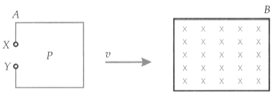
A rectangular coil P is moved from a point A to another point B with uniform velocity 'v' through a region of a uniform magnetic field acting normally inwards as shown in the figure. Show graphically (i) the variation of magnetic flux associated with the coil with time, (ii) the variation of induced emf across points X and Y of the coil with time. 
Image

Explain the nature of variation in magnetic flux as represented by the graph in the first case.
Answer

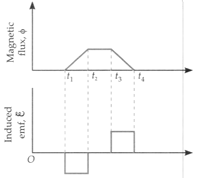
The graphs given in the figure show the variation of flux $\phi$ with time $t$ and induced emf $\varepsilon$ with time t , respectively.
Image

Explanation of variation of magnetic time. Magnetic flux is proportional to the coil linked with flux. Initially, the coil lies magnetic field, flux through it is zero. As the field at time $t_1$ the flux begins to increase. with time. Between times $t_2$ and $t_3$, in the magnetic field, so flux remains: After this the flux decreases linearly with reduces to zero at time $t_4$, when the coil co the magnetic field.

Need a full question paper?

Generate a complete, print-ready paper with questions like this in minutes — across 16+ boards, with answer keys.

Start Generating Free

Similar questions

A wave pulse is travelling on a string with a speed v towards the positive X-axis. The shape of the string at t = 0 is given by $\text{g(x)}=\text{A}\sin\big(\frac{\text{x}}{\text{a}}\big),$ where A and a are constants.
  1. What are the dimensions ot A and a?
  2. Write the equation of the wave for a general time t, if the wave speed is v.
Why are the magnification properties of microscopes and telescopes defined in terms of the ratio of angles and not in terms of the ratio of sizes of objects and images?
Write the product of equivalent capacitances when 10 capacitors, each having a capacitance of $10 \mu F$, are connected in series and then parallel connection.
What should be the distance between the object in Exercise 9.30 and the magnifying glass if the virtual image of each square in the figure is to have an area of $6.25\ mm^2$. Would you be able to see the squares distinctly with your eyes very close to the magnifier?
Deduce an expression for the electric potential due to an electric dipole at any point on its axis. Mention one contrasting feature of electric potential of a dipole at a point as compared to that due to a single charge.
In a p-n junction, the depletion region is 400nm wide and an electric field of $5 \times 10^5$ V/m exists in it.
  1. Find the height of the potential barrier.
  2. What should be the minimum kinetic energy of a conduction electron which can diffuse from the n-side to the p-side?
A 0.5m long metal rod PQ completes the circuit as shown in the figure. The area of the circuit is perpendicular to the magnetic field of flux density 0.15T. If the resistance of the total circuit is $3\Omega$ calculate the force needed to move the rod in the direction as indicated with a constant speed of $2ms^{-1}.$
A metal wire PQ of mass 10g lies at rest on two horizontal metal rails separated by 4.90cm A vertically-downward magnetic field of magnitude 0.800T exists in the space. The resistance of the circuit is slowly decreased and it is found that when the resistance goes below 20.0Ω, the wire PQ starts sliding on the rails. Find the coefficient of friction.
A block of mass 5.0kg is suspended from the end of a vertical spring which is stretched by 10cm under the load of the block. The block is given a sharp impulse from below so that it acquires an upward speed of 2.0m/s. How high will it rise? Take $g = 10m/s^2.$
The potential difference between the terminals of a battery of emf 6.0V and internal resistance $1\Omega$ drops to 5.8V when connected across an external resistor. Find the resistance of the external resistor.