Question
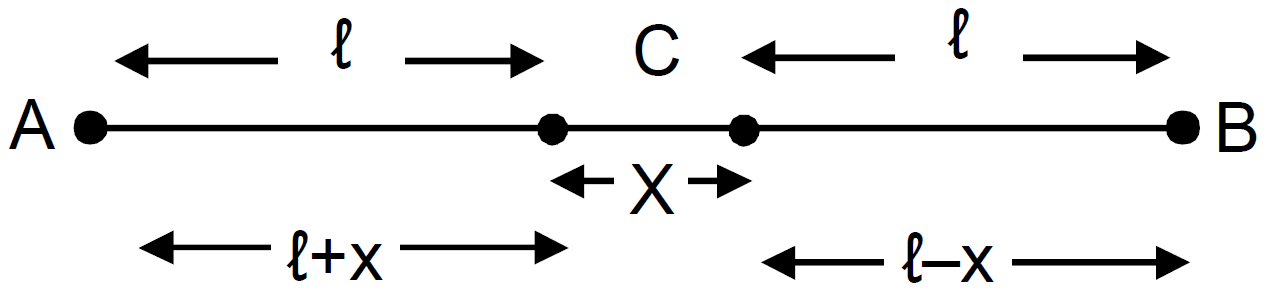
Repeat the previous problem if the particle C is displaced through a distance x along the line AB.
Answer


$\text{F}_\text{AC}=\frac{\text{KQq}}{(\ell+\text{x})^2}$
$\text{F}_\text{CA}=\frac{\text{KQq}}{(\ell-\text{x})^2}$
Net force $=\text{KQq}\Big[\frac{1}{(\ell-\text{x})^2}-\frac{1}{(\ell-\text{x})^2}\Big]$
$=\text{KQq}\bigg[\frac{(\ell+\text{x})^2-(\ell-\text{x})^2}{(\ell+\text{x})^2(\ell-\text{x})^2}\bigg]$
$=\text{KQq}\bigg[\frac{4\ell\text{x}}{(\ell^2-\text{x}^2)^2}\bigg]$
$\text{x}<<<\text{l}=\frac{\text{d}}{2}$ neglecting x w.r.t. $\ell$ We get
net $\text{F}=\frac{\text{KQq}4\ell\text{x}}{\ell^4}=\frac{\text{KQq}4\text{x}}{\ell^3}$ acceleration $=\frac{4\text{KQqx}}{\text{m}\ell^3}$
Time period $=2\pi\sqrt{\frac{\text{displacement}}{\text{acceleration}}}$
$=2\pi\sqrt{\frac{\text{xm}\ell^3}{4\text{KQqx}}}$
$=2\pi\sqrt{\frac{\text{m}\ell^3}{4\text{KQq}}}$
$=\sqrt{\frac{4\pi^2\text{m}\ell^34\pi\in_0}{4\text{Qq}}}$
$=\sqrt{\frac{4\pi^3\text{m}\ell^3\in_0}{\text{Qq}}}$
$=\sqrt{4\pi^3\text{md}^3\in_08\text{Qq}}$
$=\bigg[\frac{\pi^3\text{md}^3\in_0}{2\text{Qq}}\bigg]^{\frac{1}{2}}$

Need a full question paper?

Generate a complete, print-ready paper with questions like this in minutes — across 16+ boards, with answer keys.
Start Generating Free

Similar questions

A parallel-plate capacitor having plate area $400cm^2$ and separation between the plates 1.0mm is connected to a power supply of 100V. A dielectric slab of thickness 1.0mm and dielectric constant 5.0 is inserted into the gap:
  1. Find the increase in electrostatic energy.
  2. If the power supply is now disconnected and the dielectric slab is taken out, find the further increase in energy.
  3. Why does the energy increase in inserting the slab as well as in taking it out?
Two vessels A and B of equal volume $V_0$ are connected by a narrow tube that can be closed by a valve. The vessels are fitted with pistons that can be moved to change the volumes. Initially, the valve is open and the vessels contain an ideal gas $\Big(\frac{\text{C}_\text{P}}{\text{C}_\text{V}}=\gamma\Big)$ at atmospheric pressure $p_0$ and atmospheric temperature $T_0$. The walls of vessel A are diathermic and those of B are adiabatic. The valve is now closed and the pistons are slowly pulled out to increase the volumes of the vessels to double the original value.
  1. Find the temperatures and pressures in the two vessels.
  2. The valve is now opened for sufficient time so that the gases acquire a common temperature and pressure. Find the new values of the temperature and pressure.
Write first and second postulates of Bohr's Atomic Model. Obtain the expression for radius and velocity of stable orbit of electron.###Explain Bohr's two postulates for hydrogen atom.
Two capacitors of capacitances 20.0pF and 50.0pF are connected in series with a 6.00V battery. Find:
  1. The potential difference across each capacitor.
  2. The energy stored in each capacitor.
The convex surface of a thin concavo-convex lens of glass of refractive index 1.5 has a radius of curvature 20cm. The concave surface has a radius of curvature 60cm. The convex side is silvered and placed on a horizontal surface as shown in figure.
  1. Where should a pin be placed on the axis so that its image is formed at the same place?
  2. If the concave part is filled with water $\Big(\mu=\frac{4}{3}\Big),$ find the distance through which the pin should be moved so that the image of the pin again coincides with the pin.
Obtain an expression for the frequency of radiation emitted when a hydrogen atom de-excites from level n to level (n – ncy of revolution of the electron in the orbit.
A metal ball of mass 1kg is heated by means of a 20W heater in a room at $20^\circ C.$ The temperature of the ball becomes steady at $50^\circ C.$
  1. Find the rate of loss of heat to the surrounding when the ball is at $50^\circ C.$
  2. Assuming Newton's law of cooling, calculate the rate of loss of heat to the surrounding when the ball is at $30^\circ C$.
  3. Assume that the temperature of the ball rises uniformly from $20^\circ c$ to $30^\circ C$ in 5 minutes. Find the total loss of heat to the surrounding during this period.
  4. Calculate the specific heat capacity of the metal.
During a thunderstorm the ‘live' wire of the transmission line fell down on the ground. A group of boys passing through noticed it and some of them wanted to place the wire by the side. As they were approaching the wire and trying to lift it, Bari noticed it and immediately pushed them away to prevent them from touching the wire. Two of them got hunt in the process. Bari took them to a doctor to get medical aid.
Based on the above paragraph, answer the following:
  1. Write two values which Bari displayed during the incident.
  2. Why is it that a bird can sit over a suspended ‘live' wire without any harm whereas touching it on the ground can give a fatal shock?
  3. The electric power from a power plant is set up to a very high voltage before transmitting it to distant consumers. Write the reason for it.
What is the speed of a photon with respect to another photon if:
  1. The two photons are going in the same direction and.
  2. They are going in opposite directions?
A glass window is to be fit in an aluminium frame. The temperature on the working day is $40^{\circ} \mathrm{C}$ and the glass window measures exactly $20 \mathrm{~cm} \times 30 \mathrm{~cm}$. What should be the size of the aluminium frame so that there is no stress on the glass in winter even if the temperature drops to $0^{\circ} \mathrm{C}$ ? Coefficients of linear expansion for glass and aluminium are $9.0 \times 10^{-6}{ }^{\circ} \mathrm{C}^{-1}$ and $24 \times 10^{-6}{ }^{\circ} \mathrm{C}^{-1}$ respectively.