Question
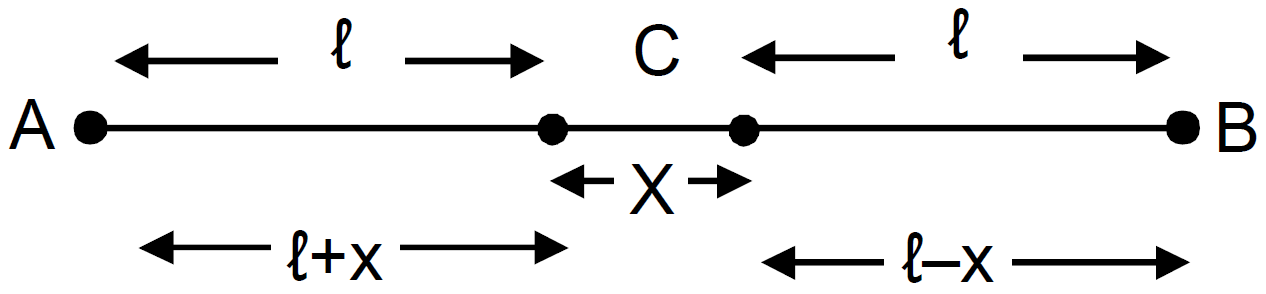
Repeat the previous problem if the particle C is displaced through a distance x along the line AB.
Answer


$\text{F}_\text{AC}=\frac{\text{KQq}}{(\ell+\text{x})^2}$

$\text{F}_\text{CA}=\frac{\text{KQq}}{(\ell-\text{x})^2}$

Net force $=\text{KQq}\Big[\frac{1}{(\ell-\text{x})^2}-\frac{1}{(\ell-\text{x})^2}\Big]$

$=\text{KQq}\bigg[\frac{(\ell+\text{x})^2-(\ell-\text{x})^2}{(\ell+\text{x})^2(\ell-\text{x})^2}\bigg]$

$=\text{KQq}\bigg[\frac{4\ell\text{x}}{(\ell^2-\text{x}^2)^2}\bigg]$

$\text{x}<<<\text{l}=\frac{\text{d}}{2}$ neglecting x w.r.t. $\ell$ We get

net $\text{F}=\frac{\text{KQq}4\ell\text{x}}{\ell^4}=\frac{\text{KQq}4\text{x}}{\ell^3}$ acceleration $=\frac{4\text{KQqx}}{\text{m}\ell^3}$

Time period $=2\pi\sqrt{\frac{\text{displacement}}{\text{acceleration}}}$

$=2\pi\sqrt{\frac{\text{xm}\ell^3}{4\text{KQqx}}}$

$=2\pi\sqrt{\frac{\text{m}\ell^3}{4\text{KQq}}}$

$=\sqrt{\frac{4\pi^2\text{m}\ell^34\pi\in_0}{4\text{Qq}}}$

$=\sqrt{\frac{4\pi^3\text{m}\ell^3\in_0}{\text{Qq}}}$

$=\sqrt{4\pi^3\text{md}^3\in_08\text{Qq}}$

$=\bigg[\frac{\pi^3\text{md}^3\in_0}{2\text{Qq}}\bigg]^{\frac{1}{2}}$

Need a full question paper?

Generate a complete, print-ready paper with questions like this in minutes — across 16+ boards, with answer keys.
Start Generating Free

Similar questions

Derive the electric field generated due to the dipole at any point located on the equatorial plane of the electric dipole. Draw the necessary diagram.
Find the diameter of the image of the moon formed by a spherical concave mirror of focal length 7.6m. The diameter of the moon is 3450km and the distance between the earth and the moon is 3.8 × 10⁵km.
The bob of a pendulum at rest is given a sharp hit to impart a horizontal velocity $\sqrt{10\text{gl}},$ where l is the length of the pendulum. Find the tension in the string when,
  1. The string is horizontal.
  2. The bob is at its highest point.
  3. The string makes an angle of 60° with the upward vertical.
A particle of mass m and charge q is projected into a region that has a perpendicular magnetic field B. Find the angle of deviation of the particle as it comes out of the magnetic field if the width d of the region is very slightly smaller than

  1. $\frac{\text{mv}}{\text{qB}}$

  2. $\frac{\text{mv}}{2\text{qB}}$

  3. $\frac{2\text{mv}}{\text{qB}}.$

Write the expression for the force, $\vec{\text{F}}$ acting on a charged particle of charge ‘q’, moving with a velocity $\vec{\text{v}}$ in the presence of both electric field $\vec{\text{E}}$ and magnetic field $\vec{\text{B}}$. Obtain the condition under which the particle moves undeflected through the fields.
A $5.0\mu\text{F}$ capacitor is charged to 12V. The positive plate of this capacitor is now connected to the negative terminal of a 12V battery and vice versa. Calculate the heat developed in the connecting wires.
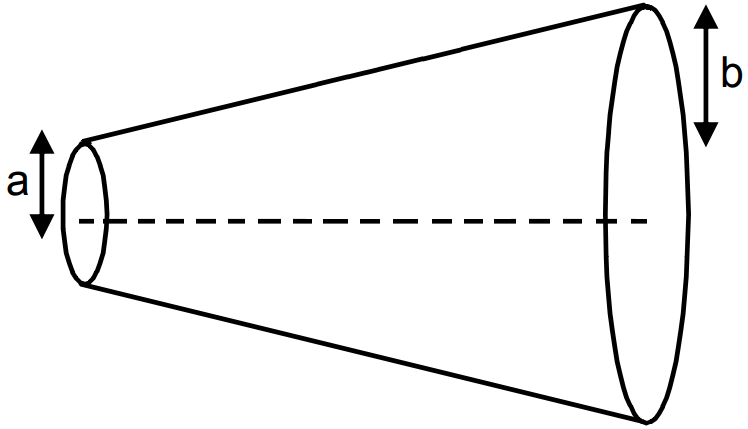
Figure. shows a conductor of length l with a circular cross-section. The radius of the cross-section varies linearly from a to b. The resistivity of the material is ρ. Assuming that b - a << l, find the resistance of the conductor.

A horizontal cesium plate ($\phi$ = l.9 eV) is moved vertically downward at a constant speed u in a room full of radiation of wavelength 250 run and above. What should be the minimum value of u so that the vertically upward component of velocity is nonpositive for each photoelectron?
A vessel of volume 125cm3 contains tritium $\big(\text{ }^3\text{H,t}_{\frac{1}{2}}=12.3\text{y}\big)$ at 500 kPa and 300K. Calculate the activity of the gas.