Question
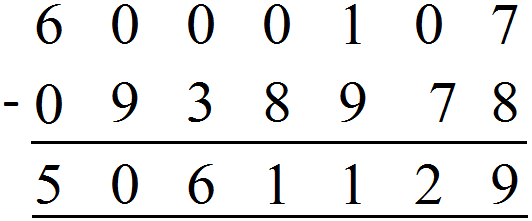
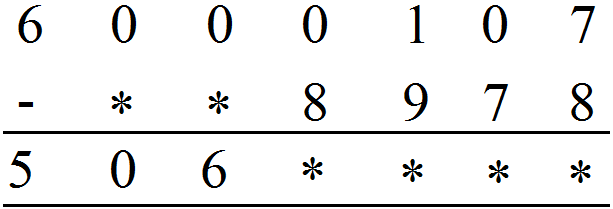
Replace each * by the correct digit in the following:
Answer


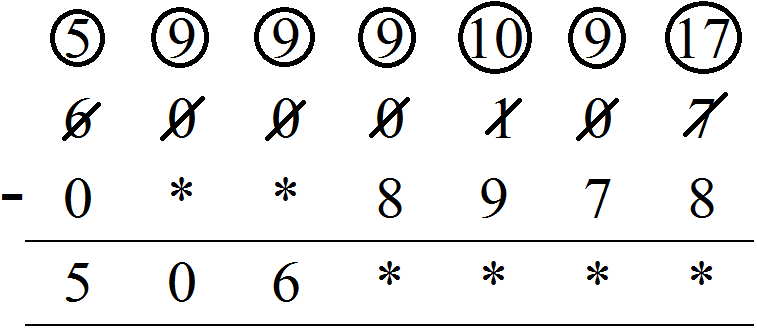
Here, in the units digit, 17 - 8 = 9
In the tens digit, 9 - 7 = 2
In the hundreds place, 10 - 9 = 1
And in the thousands place, 9 - 8 = 1.
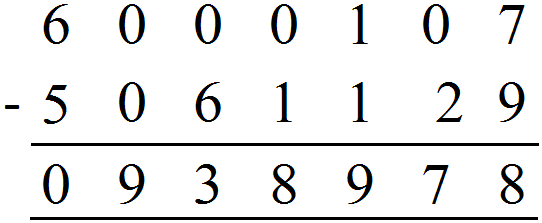
Addend difference = 5061129.
So, in order to get the addend, we will subtract 5061129 from 6000107.

Thus, the correct answer is:

Need a full question paper?

Generate a complete, print-ready paper with questions like this in minutes — across 16+ boards, with answer keys.

Start Generating Free

Similar questions

Find the largest number that divides 59 and 54 leaving remainders 3 and 5 respectively
Write the greatest and the smallest numbers of 4 digits that can be formed using the digits 0, 8, 7, 5 ; using each digit only once.
The ratio of story books in a library to other books is 1 : 7. The total number of story books is 800. Find the total number of books in the library.
Compare the fractions given below:
$\frac{4}{9},\frac{5}{6}$
Take a rectangular sheet of paper. Fold the paper so that the lower edge of the paper falls on its top edge, and fold it over again from right to left. Observe the two folds that have formed on the . paper. Verify that each fold is a perpendicular bisector of the other. Then measure the following distances. (Textbook pg. no. 91)
i. l(XP)
ii. l(XA)
iii. l(XB)
iv. l(YP)
v. l(YA)

Image

You will observe that l(XP) = l(YP), l(XA) = l(YA) and l(XB) = l(YB)
Therefore we can conclude that all points on the vertical fold (perpendicular bisector) are equidistant from the endpoints of the horizontal fold.

A school bus picking up children in a colony of flats stops at every sixth block of flats. Another school bus starting from the same place stops at every eighth blocks of flats. Which is the first bus stop at which both of them will stop?
After 32 years, Rahim will be 5 times as old as he was 8 years ago. How old is Rahim today?
Add:
$\frac{3}{4}$ and $\frac{5}{6}$
Divide, and find out the quotient and remainder. Check your answer.
23025 ÷ 1000
Find the area of a square whose diagonal is $5\sqrt{2}\text{cm}.$
Hint: Area $=\Big[\frac{1}{2}\times (\text{diagonal})^2\Big]\text{sq}-\text{units}.$