Question
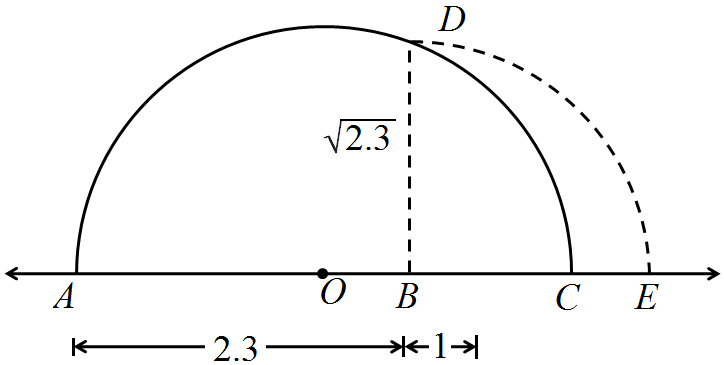
Represent geometrically the following numbers on the number line: $\sqrt{2.3}$

Answer

Firstly, we draw a line segment $A S=2.3$ units and extend it to $C$ such that $S C=1$ unit. Let $O$ be the mid-point of $A C$. Now, draw a semi-circle with centre $0$ and radius $OA$. Let us draw $BD$ perpendicular to $AC$ passing through point $6 $and intersecting the semi-circle at point $D$ . Hence, the distance $BD$ is $\sqrt{2.3}$ units. Draw an arc with centre $6$ and radius $B D$, meeting $A C$ produced at $E$, then $B E=B D=\sqrt{2.3}$ units.

Need a full question paper?

Generate a complete, print-ready paper with questions like this in minutes — across 16+ boards, with answer keys.
Start Generating Free

Similar questions

A rectangular plot is given for constructing a house, having a measurement of $40\ m$ long and $15\ m$ in the front. According to the laws, a minimum of $3\ m$, wide space should be left in the front and back each and $2\ m$ wide space on each of other sides. Find the largest area where house can be constructed. 
Evaluate: $\big[(16)^{\frac{1}{2}}\big]^{\frac{1}{2}}$
$\text{ABC}$ is a triangle right angled at $C. A$ line through the mid $-$ point $M$ of hypotenuse $AB$ and parallel to $BC$ intersects $AC$ at $D$. Show that
$i. D$ is the mid $-$ point of $AC$
$ii. MD \perp AC$
$iii. CM = MA =\frac{1}{2} AB$
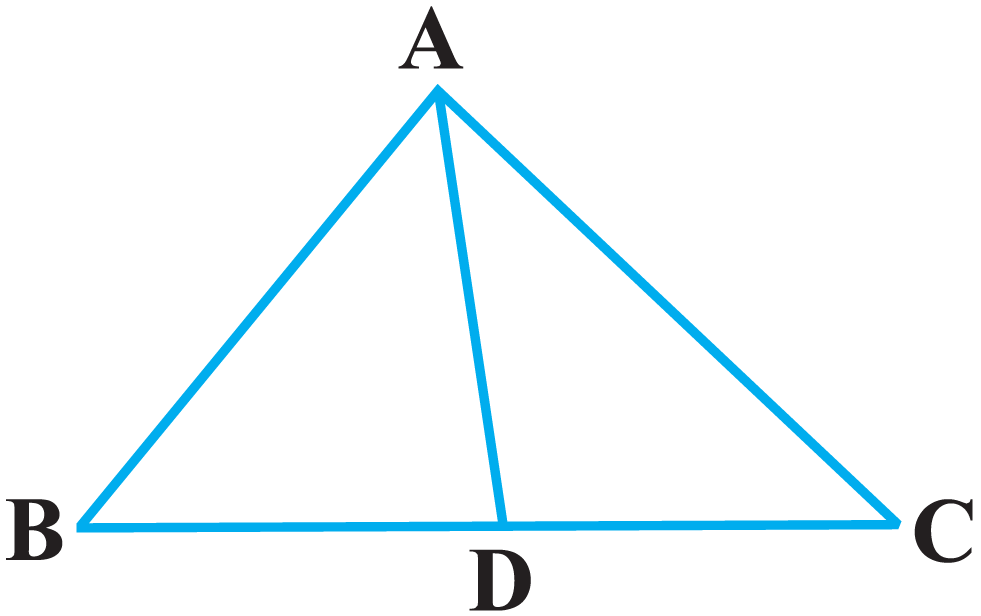
In following figure if $AD$ is the bisector of $\angle\text{BAC},$ then prove that $AB > BD.$
In a circket match, a batsman hits a boundary $6$ times out of $30$ balls he plays. Find the probability that he did not hit a boundary.
Draw the graph of the following equation. $y = 3$
In a parallelogram $A B C D$, it is being given that $A B=10\ cm$ and the altitudes corresponding to the sides $A B$ and $A D$ are $D L=6\ cm$ and $B M=8\ cm$, respectively. Find $A D$.
Show that the quadrilateral formed by joining the mid-points the sides of a rhombus, taken in order, form a rectangle.
Examine whether $x+2$ is a factor of $x^3+3 x^2+5 x+6$ and of $2 x+4$.
For the polynomial $\frac{\text{x}^3+2\text{x}+1}{5}-\frac{7}{2}\text{x}^2-\text{x}^6,$ write.
$i.$ The degree of the polynomial.
$ii.$ The coefficient of $x^3.$
$iii.$ The coefficient of $x^{6.}$
$iv.$ The constant term.