Question
Represent $\sqrt{7.28}$ geometrically on the number line.

Answer


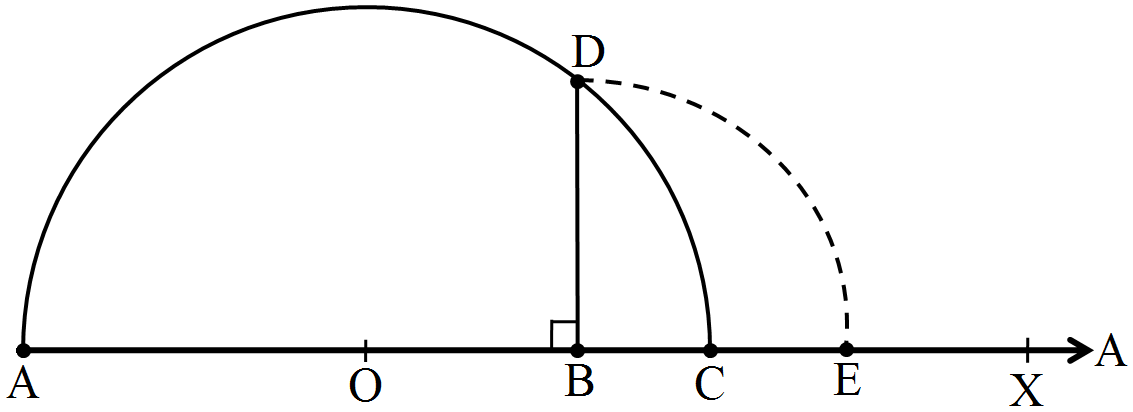
Draw a line segment $AB = 7.28$ units and extend it to $C$ such that $BC = 1$ unit.
Find the midpoint $O$ of $AC$. With $O$ as centre and $OA$ as radius, draw a semicircle.
Now, draw $\text{BD}\perp\text{AC},$ intersecting the semicircle at $D$.
Then, $\text{BD}=\sqrt{7.28}\ \text{units}.$ With $D$ as centre and $BD$ as radius, draw an arc, meeting $AC$ produced at $E$.
​​​​​​​Then, $\text{BE}=\text{BD}=\sqrt{7.28}\ \text{units}.$

Need a full question paper?

Generate a complete, print-ready paper with questions like this in minutes — across 16+ boards, with answer keys.
Start Generating Free

Similar questions

A quadrilateral $ABCD$ is inscribed in a circle such that $AB$ is a diameter and $\angle\text{ADC}=130^\circ.$ Find $\angle\text{BAC}.$
The sum of two angles of a triangle is equal to its third angle. Determine the measure of the third angle.
Visualise the representation of $5.3\bar{7}$ on the number line upto 5 decimal places, that is upto $5.37777.$
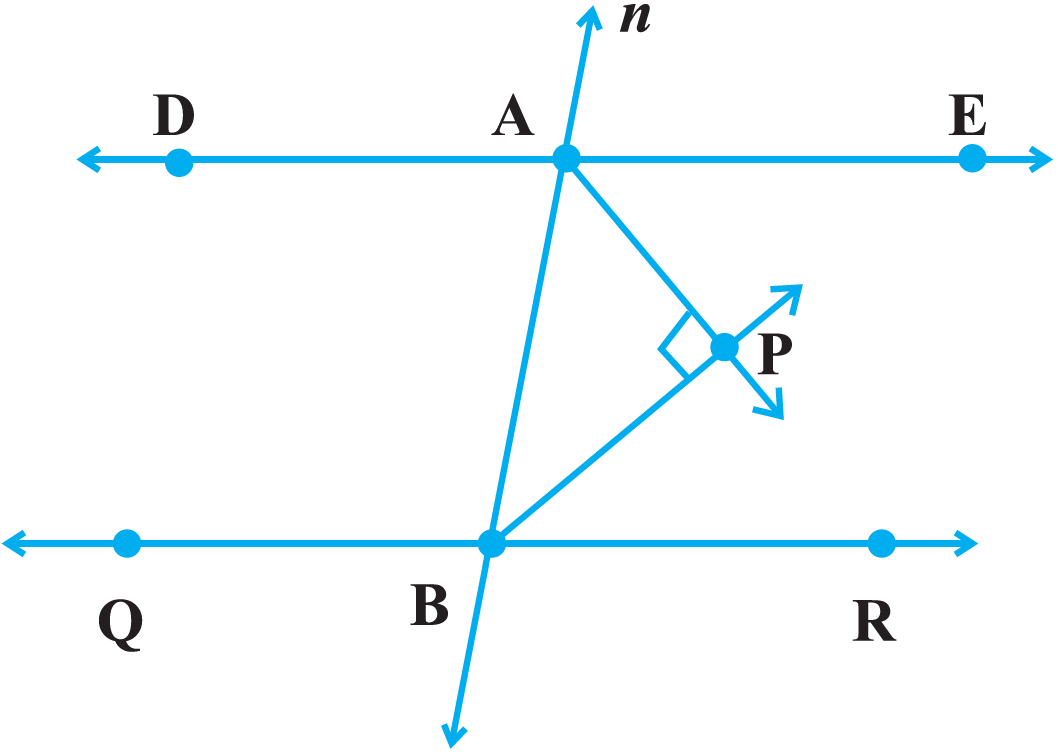
In Fig. $\text{DE}||\text{QR}$ and $AP$ and $BP$ are bisectors of $\angle\text{EAB}$ and respectively. Find $\angle\text{APB}$
Find a rational number and also an irrational number lying between the numbers $0.3030030003...$ and $0.3010010001...$
The following observation are arranged in ascending order: $26, 29, 42, 53, x, x + 2, 70, 75, 82, 93$. If the median is $65$, find the value of $x$.
If a line is drawn parallel to the base of an isosceles triangle to intersect its equal sides, prove that the quadrilateral so formed is cyclic.
The water bills (in rupees) of $32$ houses in a certain street for the period $1.198$ to $31.398$ are given below: $56, 43, 32, 38, 56, 24, 68, 85, 52, 47, 35, 58, 63, 74, 27, 84, 69, 35, 44, 75, 55, 30, 54, 65, 45, 67, 95, 72, 43, 65, 35, 69.$ Tabulate the data and present the data as a cumulative frequency table using $70 - 79$ as one of the class intervals.
$ABCD$ is a trapezium in which $AB || DC, DC = 30\ cm$ and $AB = 50\ cm.$ If $X$ and $Y$ are, respectively the mid-points of $AD$ and $BC,$ prove that $\text{ar}(\text{DCYX})=\frac{7}{9}\ \text{ar}(\text{XYBA})$