Question
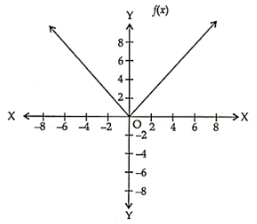
The logarithmic function expressed as $\log _e R^{+} \rightarrow R$ and given by $\log _e x=y$ iff $e^y=x$. The graph of the function is given below :
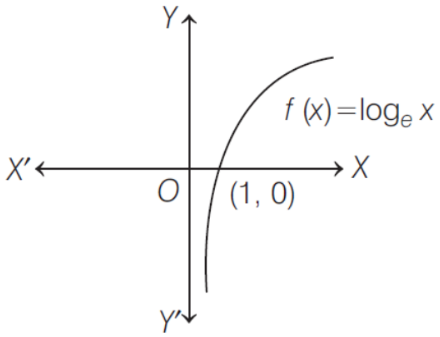
(i) Domain of $f(x)=(0, \infty)$ or $R^{+}$
(ii) Range of $f(x)=(-\infty, \infty)$ or $R$
To find the limit of functions involving logarithmic function, we use the following theorem Theorem $\lim _{x \rightarrow 0} \frac{\log _e(1+x)}{x}=1$
Based on above information, answer the following questions.
(i) $\lim _{x \rightarrow 0} \frac{\log _e(1+5 x)}{x}$ is equal to
(a) 5 (b) 4 (c) 3 (d) 1
(ii) $\lim _{x \rightarrow 0} \frac{\log _e(1+6 x)-5 x^2}{x}$ is equal to
(a) 1 (b) 2 (c) 3 (d) 6
(iii) $\quad \lim _{x \rightarrow 0} \frac{\sqrt{1+x}-1}{\log (1+x)}$ is equal to
(a) 1 (b) $\frac{1}{2}$ (c) $\frac{1}{3}$ (d) $\frac{3}{2}$
(iv) $\quad \lim _{x \rightarrow 5} \frac{\log x-\log 5}{x-5}$ is equal to
(a) $\frac{1}{5}$ (b) $\frac{3}{5}$ (c) $\frac{1}{4}$ (d) $\frac{2}{3}$
(v) $\quad \lim _{x \rightarrow 0} \frac{\log (5+x)-\log (5-x)}{x}$ is equal to
(a) $\frac{1}{5}$ (b) $\frac{2}{5}$ (c) $\frac{3}{5}$ (d) $\frac{4}{5}$
(i) Domain of $f(x)=(0, \infty)$ or $R^{+}$
(ii) Range of $f(x)=(-\infty, \infty)$ or $R$
To find the limit of functions involving logarithmic function, we use the following theorem Theorem $\lim _{x \rightarrow 0} \frac{\log _e(1+x)}{x}=1$
Based on above information, answer the following questions.
(i) $\lim _{x \rightarrow 0} \frac{\log _e(1+5 x)}{x}$ is equal to
(a) 5 (b) 4 (c) 3 (d) 1
(ii) $\lim _{x \rightarrow 0} \frac{\log _e(1+6 x)-5 x^2}{x}$ is equal to
(a) 1 (b) 2 (c) 3 (d) 6
(iii) $\quad \lim _{x \rightarrow 0} \frac{\sqrt{1+x}-1}{\log (1+x)}$ is equal to
(a) 1 (b) $\frac{1}{2}$ (c) $\frac{1}{3}$ (d) $\frac{3}{2}$
(iv) $\quad \lim _{x \rightarrow 5} \frac{\log x-\log 5}{x-5}$ is equal to
(a) $\frac{1}{5}$ (b) $\frac{3}{5}$ (c) $\frac{1}{4}$ (d) $\frac{2}{3}$
(v) $\quad \lim _{x \rightarrow 0} \frac{\log (5+x)-\log (5-x)}{x}$ is equal to
(a) $\frac{1}{5}$ (b) $\frac{2}{5}$ (c) $\frac{3}{5}$ (d) $\frac{4}{5}$