Question
represents the golden ratio spiral. The sequence $0,1,1,2,3,5,8,13$ is called a Fibonacci sequence in which each term (except the first two terms) is obtained by adding the previous two terms of the sequence.
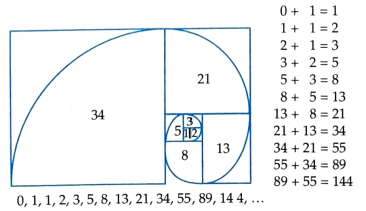
(i) The next two numbers in the sequence are
(a) 223 and 367 $\qquad$ (b) 233 and 367 $\qquad$ (c) 223 and 377 $\qquad$ (d) 233 and 377
(ii) A rational number has terminating decimal expansion, if the denominator is of the form
(a) $2^m \times 5^n$ $\qquad$ (b) $3^m \times 5^n$ $\qquad$ (c) $2^m \times 3^n$ $\qquad$ (d) $3^m \times 4^n$
where $m, n$ are non-negative integers.
(iii) Which of the following rational numbers (formed by taking the ratio of a term to its previous term) has terminating decimal expansion?
(a) $\frac{5}{3}$ $\qquad$ (b) $\frac{21}{13}$ $\qquad$ (c) $\frac{13}{8}$ $\qquad$ (d) $\frac{34}{21}$
(iv) HCF of two consecutive numbers in the given sequence (except the first 3 terms) is
(a) 1 $\qquad$ (b) 0 $\qquad$ (c) 2 $\qquad$ (d) 3
(i) The next two numbers in the sequence are
(a) 223 and 367 $\qquad$ (b) 233 and 367 $\qquad$ (c) 223 and 377 $\qquad$ (d) 233 and 377
(ii) A rational number has terminating decimal expansion, if the denominator is of the form
(a) $2^m \times 5^n$ $\qquad$ (b) $3^m \times 5^n$ $\qquad$ (c) $2^m \times 3^n$ $\qquad$ (d) $3^m \times 4^n$
where $m, n$ are non-negative integers.
(iii) Which of the following rational numbers (formed by taking the ratio of a term to its previous term) has terminating decimal expansion?
(a) $\frac{5}{3}$ $\qquad$ (b) $\frac{21}{13}$ $\qquad$ (c) $\frac{13}{8}$ $\qquad$ (d) $\frac{34}{21}$
(iv) HCF of two consecutive numbers in the given sequence (except the first 3 terms) is
(a) 1 $\qquad$ (b) 0 $\qquad$ (c) 2 $\qquad$ (d) 3