Questions

Case study (4 Marks)

Take a timed test

9 questions · self-marked practice — reveal the answer and mark yourself.

Question 14 Marks
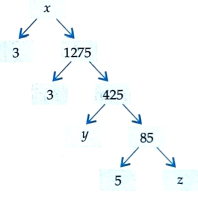
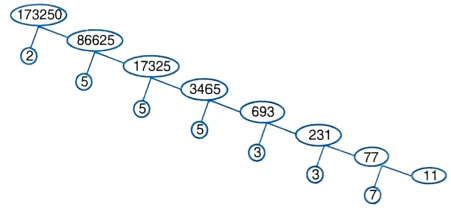
Teaching Mathematics through activities is a powerful approach that enhances students' understanding and engagement. Keeping this in mind, Ms. Mukta planned a prime number game for class 5 students. She announces the number 2 in her class and asked the first student to multiply it by a prime number and then pass it to second student. Second student also multiplied it by a prime number and passed it to third student. In this way by multiplying to a prime number, the last student got 173250.
Now, Mukta asked some questions as given below to the students:
(i) What is the least prime number used by students?
(ii) (a) How many students are in the class?
OR
(b) What is the highest prime number used by students?
(iii) Which prime number has been used maximum times?
View full question & answer
Question 24 Marks
Answer
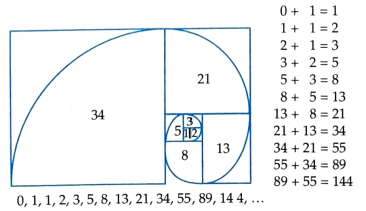
(i) (d): Since each term (except first two terms) of the sequence is sum of the preceding two terms. So, next two terms of the sequence are $144+89=233$ and $144+233=377$.
(ii) (a): If the denominator of a rational number is of the form $2^m \times 5^n$, where $m, n$ are non-negative integers, then the decimal expansion is terminating.
(iii) (c): We find that $\frac{13}{8}=\frac{13}{2^3 \times 5^0}$. Clearly, its denominator is of the form $2^m \times 5^n$, where $m$, $n$ are non-negative integers, so, its decimal expansion is terminating.
(iv) (a): Any two consecutive terms (except first 3 terms) are co-prime. So, their HCF is 1.
View full question & answer
Question 34 Marks
Answer
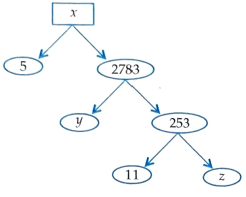
(i) (b): $x=5 \times 2783=13915$
(ii) (c): From the factor tree we find that
$
2783=y \times 253 \Rightarrow y=\frac{2783}{253}=11
$
(iii) (b): From the factor tree, we find that
$
253=11 \times z \Rightarrow z=\frac{253}{11}=23
$
(iv) (a): It is evident from the factor tree that $x=13915$ is equal to $5 \times 11^2 \times 23$. Clearly, it is a composite number having $5,11,23$ as its factors.
View full question & answer
Question 44 Marks
A seminar is being conducted by an educational organisation, where the participants will be educators of different subjects. The numbers of participants in Hindi, English and Mathematics are 60, 84 and 108 respectively.
(i) In each room the same number of participants are to be seated and all of them being in the same subject, hence the maximum number of participants that can be accomodated in each room is
(a) 14 $\qquad$ (b) 12$\qquad$ (c) 16 $\qquad$ (d) 18
(ii) The minimum number of rooms required during the event, is
(a) 11 $\qquad$ (b) 9 $\qquad$ (c) 7 $\qquad$ (d) 21
(iii) The LCM of 60,84 and 108 is
(a) 3780 $\qquad$ (b) 3680 $\qquad$ (c) 4780 $\qquad$ (d) 4680
(iv) The product of HCF and LCM of 60,84 and 108 is
(a) 55360 $\qquad$ (b) 35360 $\qquad$ (c) 45500 $\qquad$ (d) 45360
Answer
(i) (B): In each room the same number of participants are to be seated and all of them must be in the same subject. So, the number of participants is a factor of 60,84 and 108. Therefore, the maximum number of participants that can be accomodated in each room is the HCF of 60,84 , and 108.
$\begin{array}{ll}\text { Now, } & 60=2^2 \times 3^1 \times 5,84=2^2 \times 3^1 \times 7^1 \text { and } 108=2^2 \times 3^3 \\ \therefore & \operatorname{HCF}(60,84,108)=2^2 \times 3=12\end{array}$
Hence, the maximum number of participants that can be accomodated $=12$
(ii) (d): Numbers of rooms required for participants in Hindi, English and Mathematics are
$
\frac{60}{12}=5,=\frac{84}{12}=7 \text { and }=\frac{108}{12}=9 \text { respectively. }
$
$
\therefore \quad \text { Minimum number of rooms required }=5+7+9=21
$
(iii) (a): $\operatorname{LCM}(60,84,108)=2^2 \times 3^3 \times 5 \times 7=3780$
(iv) (d): We have, $\operatorname{HCF}(60,84,108)=12$ and $\operatorname{LCM}(60,84,108)=3780$
$
\therefore \quad \operatorname{HCF}(60,84,108) \times \operatorname{LCM}(60,84,108)=12 \times 3780=45360
$
View full question & answer
Question 54 Marks
Answer
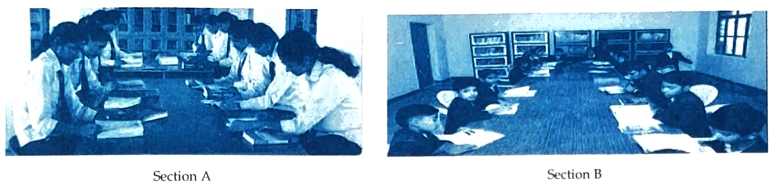
(i) (C): Since Books are to be distributed equally among students of section $A$ or section B. So, the number of books is a multiple of 32 as well as 36 and it is the least such number. Therefore, required number of books is the LCM of 32 and 36 .
$
\begin{array}{ll}
\text { Now, } & 32=2^5 \text { and } 36=2^2 \times 3^2 \\
\therefore & \operatorname{LCM}(32,36)=2^5 \times 3^2=32 \times 9=288
\end{array}
$
Hence, required number of books $=288$.
(ii) (B): $32 \times 36=\operatorname{HCF}(32,36) \times \operatorname{LCM}(32,36)$
$
\Rightarrow \quad \operatorname{HCF}(32,36)=\frac{32 \times 36}{\operatorname{LCM}(32,36)}=\frac{32 \times 36}{288}=4
$
(iii) (A): See Solution of (i)
(iv) (B): $\because \quad 7 \times 11 \times 13 \times 15+15=(7 \times 11 \times 13+1) \times 15$
$\Rightarrow \quad 7 \times 11 \times 13 \times 15+15$ is a composite number
View full question & answer
Question 74 Marks
Jai, Jameel and Jony decided to play a game of climbing 100 stairs. Jai climbs 5 stairs and gets down 2 stairs in one turn, Jameel goes up by 7 stairs and comes down by 2 stairs in a turn, Jony goes 10 stairs up and 3 stairs down each time. Each one of them stops when less number of stairs are left than the number of stairs for his forward movement.
(i) Who climbs the maximum number of stairs?
(a) Jai $\qquad$ (b) Jameel $\qquad$ (c) Jony $\qquad$ (d) Jai and Jameel
(ii) How many times can they meet in between on the same stair?
(a) 3 $\qquad$ (b) 4 $\qquad$ (c) 5 $\qquad$ (d) Never
(iii) Who takes the least number of attempts to reach near the $100^{\text {th }}$ stair?
(a) Jai $\qquad$ (b) Jameel $\qquad$ (c) Jony $\qquad$ (d) All take equal number of steps
(iv) Who meets for the first time on a stair?
(a) Jai and Jameel after 15 turns
(b) Jameel and Jony after 35 turns
(c) Jai and Jony after 21 turns
(d) Jai and Jameel after 21 turns
Answer
(i) (c) (ii) (d) (iii) (c) (iv) (a)
View full question & answer
Question 84 Marks
Mira is very health conscious and avoids fast food, cakes, icreams etc. On her birthday she decided to serve fruits to her friend guests. She had 60 bananas and 36 apples which are to be distributed equally among all.
(i) How many maximum guests Mira can invite?
(a) 6 $\qquad$ (b) 96 $\qquad$ (c) 12 $\qquad$ (d) 180
(ii) How many apples will each guests get?
(a) 3 $\qquad$ (b) 6 $\qquad$ (c) 4 $\qquad$ (d) 5
(iii) How many bananas will each guest get?
(a) 3 $\qquad$ (b) 6 $\qquad$ (c) 4 $\qquad$ (d) 5
(iv) If Mira also decides to distribute 42 mangoes, how many maximum guests she can invite?
(a) 12 $\qquad$ (b) 6 $\qquad$ (c) 8 $\qquad$ (d) 180
Answer
(i) (c) (ii) (a) (iii) (d) (iv) (b)
View full question & answer
Question 94 Marks
Ajay wants to host a party on his $50^{\text {th }}$ birthday in a large banquet hall having a certain number of chairs. He wants that guests should sit in different groups like in pairs, triplets, quadruplets, fives and sixes etc. When the banquet hall manager arranges chairs in such pattern like in $2^{\prime S}, 3^{\prime S}, 4^S, 5^{\prime S}$ and $6^{\prime S}$ then $1,2,3,4$ and 5 chairs are left respectively. But, when he arranges in groups of $11^{\prime} S$ no chair is left.
(i) How many chairs are in the banquet hall?
(a) 407 $\qquad$ (b) 209 $\qquad$ (c) 539 $\qquad$ (d) 149
(ii) If three chairs are removed, then the remaining chairs can be arranged in groups of
(a) $2^{\prime s}$ $\qquad$ (b) $3^{\prime s}$ $\qquad$ (c) $4^{\prime s}$ $\qquad$ (d) $2^{\prime s}$
(iii) If one chair is added, then the total number of chairs can be arranged in groups of
(a) $2^{\prime s}$ $\qquad$ (b) $3^{\prime s}$ $\qquad$ (c) $4^{\prime s}$ $\qquad$ (d) $11^{\prime s}$
(iv) If one chair is added to the total number of chairs, how many chairs will be left when arranged in groups of $11^s$
(a) 1 $\qquad$ (b) 2 $\qquad$ (c) 3 $\qquad$ (d) 4
Answer
(i) (c) (ii) (a) (iii) (a) (iv) (a)
View full question & answer