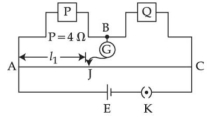
Resistance are connected in a meter bridge circuit as shown in the figure. The balancing length $l_{1}$ is $40\,cm$. Now an unknown resistance $x$ is connected in series with $P$ and new balancing length is found to be $80\,cm$ measured from the same end. Then the value of $x$ will be $.......\Omega$
JEE MAIN 2022, Diffcult
Download our app for free and get started
Initially, $\frac{ P }{ Q }=\frac{40 cm }{60 cm }=\frac{2}{3}$
Finally, $\frac{ P + x }{ Q }=\frac{80 cm }{20 cm }=\frac{4}{1} \ldots(2)$
Divide $(2)$ by $(1)$
$\frac{ P + x }{ P }=4 \times \frac{3}{2}=6$
$1+\frac{ x }{ P }=6 \Rightarrow \frac{ x }{ P }=5$
$\therefore x =5 P =5 \times 4=20 \Omega$

Download our appand get started for free
Experience the future of education. Simply download our apps or reach out to us for more information. Let's shape the future of learning together!No signup needed.*
Similar Questions
- 1In a conductor, if the number of conduction electrons per unit volume is $8.5 \times 10^{28}\, m^{-3}$ and mean free time is $25\,fs$ (femto second), its approximate resistivity is $\left( {{m_e} = 9.1 \times {{10}^{ - 31}}\,kg} \right)$View Solution
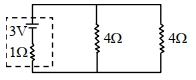
- 2View SolutionIn the given circuit, the terminal potential difference of the cell is:
- 3If $n, e, \tau$ and $m$ are representing electron density, charge, relaxation time and mass of an electron respectively, then the resistance of a wire of length / and cross-sectional area $A$ is given byView Solution
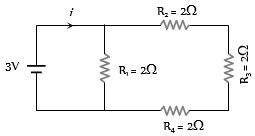
- 4What is the current $(i)$ in the circuit as shown in figure ........... $A$View Solution
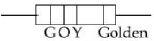
- 5View SolutionA carbon resistance has a following colour code. What is the value of the resistance?
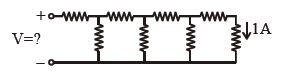
- 6Each element in the finite chain of resistors shown in the figure is $\,1\,\Omega $ . A current of $1\, A$ flows through the final element. Then what is the potential difference $V$ across input terminals of the chain .................. $\mathrm{volt}$View Solution
- 7A certain wire has a resistance $R$. The resistance of another wire identical with the first except having twice its diameter isView Solution
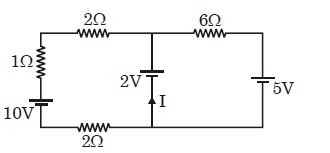
- 8Find the value of $I$ ?................ $\mathrm{A}$View Solution
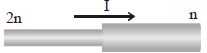
- 9Two cylindrical rods of uniform crosssection area $A$ and $2A$, having free electrons per unit volume $2n$ and $n$ respectively are joined in series. A current $I$ flows through them in steady state. Then the ratio of drift velocity of free electron in left rod to drift velocity of electron in the right rod is $\left( {\frac{{{v_L}}}{{{v_R}}}} \right)$View Solution
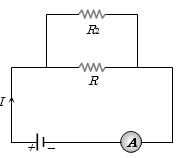
- 10If a resistance ${R_2}$ is connected in parallel with the resistance $R$ in the circuit shown, then possible value of current through $R$ and the possible value of ${R_2}$ will beView Solution