Resistance in the two gaps of a meter bridge are $10\, ohm$ and $30\, ohm$ respectively. If the resistances are interchanged the balance point shifts by.............. $cm$
Medium


Download our appand get started for free
Experience the future of education. Simply download our apps or reach out to us for more information. Let's shape the future of learning together!No signup needed.*
Similar Questions
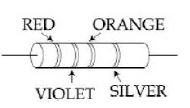
- 1View SolutionA resistance is shown in the figure. Its value and tolerance are given respectively by
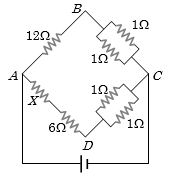
- 2For what value of unknown resistance $X$, the potential difference between $B$ and $D$ will be zero in the circuit shown in the figure ............... $\Omega$View Solution
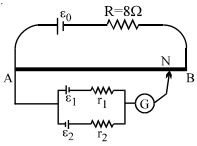
- 3$A$ battery of $\mathrm{emf}$ $E_0 = 12\, V$ is connected across a $4\,m$ long uniform wire having resistance $4\,\Omega /m$. The cells of small $\mathrm{emfs}$ $\varepsilon_1 = 2\,V$ and $\varepsilon_2 = 4\,V$ having internal resistance $2\Omega$ and $6\Omega$ respectively, are connected as shown in the figure. If galvanometer shows no deflection at the point $N$, the distance of point $N$ from the point $A$ is equal toView Solution
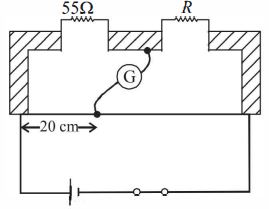
- 4Shown in the figure below is a meter-bridge set up with null deflection in the galvanometer. The value of the unknown resistor $R$ is ............. $\Omega$View Solution
- 5View SolutionExpress which of the following setups can be used to verify Ohm’s law
- 6A $5\;ampere$ fuse wire can withstand a maximum power of $1\; watt$ in the circuit. The resistance of the fuse wire isView Solution
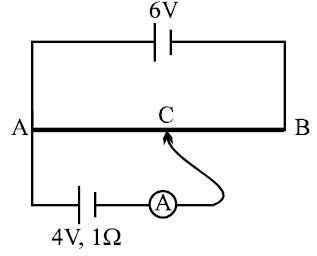
- 7$A \,6 \,V$ battery of negligible internal resistance is connected across a uniform wire of length $1\, m$. The positive terminal of another battery of emf $4\,V$ and internal resistance $1\, \Omega$ is joined to the point $A$ as shown in figure. The ammeter shows zero deflection when the jockey touches the wire at the point $C$. The $AC$ is equal toView Solution
- 8A heating element has a resistance of $100\,\Omega $ at room temperature. When it is connected to a supply of $220\,V,$ a steady current of $2\,A$ passes in it and temperature is $500\,^oC$ more than room temperature. What is the temperature coefficient resistance of the heating element?View Solution
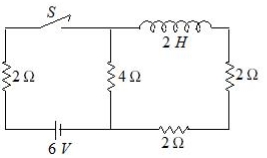
- 9For the given circuit the current through battery of $6\,V$ just after closing the switch ' $S$ ' will be$.......A$.View Solution
- 10View SolutionIn charging a battery of motor-car, the following effect of electric current is used