MCQ
Resistivity of a wire depends on:
  • A
    its length
  • B
    area of its cross-section
  • its substance
  • D
    its shape

Answer

Correct option: C.
its substance
(c )its substance

Need a full question paper?

Generate a complete, print-ready paper with questions like this in minutes — across 16+ boards, with answer keys.

Start Generating Free

Similar questions

The magnetic induction in air at a point 1cm away from a long wire that carries a current of 1A, will be
Two concentric conducting thin spherical shells of radii $a$ and $b\  (b > a)$ are given charges $Q$ and $ -2Q$ respectively. The electric field along a line passing through centre as a function of distance $(r)$ from centre is given by
The continuous $x-$ ray spectrum obtained from a Coolidge tube is of the form
The charges on two sphere are $+7\,\mu C$ and $-5\,\mu C$ respectively. They experience a force $F$. If each of them is given and additional charge of $-2\,\mu C$, the new force of attraction will be
A proton of mass $m$ and charge $+e$ is moving in a circular orbit in a magnetic field with energy $1\, MeV$. What should be the energy of $\alpha - $particle (mass = $4m$ and charge = $+ 2e),$ so that it can revolve in the path of same radius.......$MeV$
An expression for rate of heat generated, if a current of I ampere flows through a resistance of R W, is
The photoelectric effect can be understood on the basis of
A nucleus $_Z{X^A}$ emits $3 \alpha$ - particles and $5 \beta$ particle. The ratio of total neutrons and protons in the final nucleus is
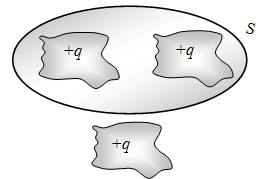
Shown below is a distribution of charges. The flux of electric field due to these charges through the surface S is
The distance between charges $5  \times 10^{-11}C$ and $-2.7 \times 10^{-11}C$  is 0.2 m. The distance at which a third charge should be placed in order that it will not experience any force along the line joining the two charges is