MCQ
Resolving power of a microscope depends upon
  • A
    Wavelength of light used, directly
  • Wavelength of light used, inversely
  • C
    Frequency of light used
  • D
    Focal length of objective

Answer

Correct option: B.
Wavelength of light used, inversely
b
( b)Resolving power of microscope $ \propto \frac{1}{\lambda }$

Need a full question paper?

Generate a complete, print-ready paper with questions like this in minutes — across 16+ boards, with answer keys.
Start Generating Free

Similar questions

A ship of mass $3 \times {10^7}\,kg$ initially at rest is pulled by a force of $5 \times {10^4}\,N$ through a distance of $3 \,m$. Assume that the resistance due to water is negligible, the speed of the ship is ........... $m/s$
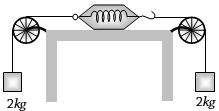
As shown in the figure, two equal masses each of $2\, kg$ are suspended from a spring balance. The reading of the spring balance will be ......... $kg$
The maximum energy in thermal radiation from a source occurs at the wavelength $4000Å$ . The effective temperature of the source is ....... $K$
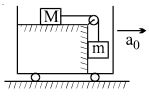
Imagine the situation in which the given arrangement is placed inside a trolley that can move only in the horizontal direction, as shown in figure. If the trolley is accelerated horizontally along the positive $x$ -axis with $a_0$, then Choose the correct statement $(s)$.
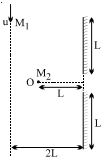
Two plane mirrors of length $L$ are separated by distance $L$ and $a$ man $M_2$ is standing at distance $L$ from the connecting line of mirrors as shown in figure. $A$ man $M_1$ is walking is a straight line at distance $2 L$ parallel to mirrors at speed $u$, then man $M_2$ at $O$ will be able to see image of $M_1$ for total time: 
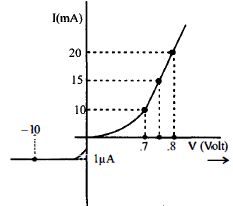
The $V-I$ characteristic of a diode is shown in the figure. The ratio of forward to reverse bias resistance is
The displacement $x$ (in metre) of a particle in, simple harmonic motion is related to time t (in seconds) as

$x = 0.01\cos \left( {\pi \,t + \frac{\pi }{4}} \right)$

The frequency of the motion will be

An iron ball and a wooden ball of the same radius are released from the same height in vacuum. They take the same time to reach the ground. The reason for this is
A plane electromagnetic wave, has frequency of $2.0 \times 10^{10}\, Hz$ and its energy density is $1.02 \times 10^{-8}\, J / m ^{3}$ in vacuum. The amplitude of the magnetic field of the wave is close to$....nT$

$\left(\frac{1}{4 \pi \varepsilon_{0}}=9 \times 10^{\circ} \frac{ Nm ^{2}}{ C ^{2}}\right.$ and speed of $1 ight$ $\left.=3 \times 10^{8}\, ms ^{-1}\right)$

To determine Young's modulus of a wire, the formula is $Y = \frac{F}{A}.\frac{L}{{\Delta L}}$ where $F/A$ is the stress and $L/\Delta L$ is the strain. The conversion factor to change $Y$ from $CGS$ to $MKS$ system is