MCQ
Resolving power of a microscope depends upon
  • A
    Wavelength of light used, directly
  • Wavelength of light used, inversely
  • C
    Frequency of light used
  • D
    Focal length of objective

Answer

Correct option: B.
Wavelength of light used, inversely
b
( b)Resolving power of microscope $ \propto \frac{1}{\lambda }$

Need a full question paper?

Generate a complete, print-ready paper with questions like this in minutes — across 16+ boards, with answer keys.

Start Generating Free

Similar questions

Assertion : In a simple battery circuit, the point of the lowest potential is negative terminal of the battery.

Reason : The current flows towards the point of the higher potential, as it does in such a circuit from the negative to the positive terminal.
The mass defect for the nucleus of helium is $0.0303 \,a.m.u.$ What is the binding energy per nucleon for helium in ........$MeV$
Which of the following velocity-time graphs is physically not possible?
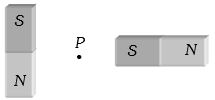
Two equal bar magnets are kept as shown in the figure. The direction of resultant magnetic field, indicated by arrow head at the point $P$  is (approximately)
Which of the following statements is incorrect?
A hypothetical atom has only three energy levels. The ground level has energy, $E_1 = - 8\, eV$. The two excited states have energies, $E_2 = - 6\, eV$ and $E_3 = - 2\, eV$. Then which of the following wavelengths will not be present in the emission spectrum of this atom? .............. $nm$
Time period of a simple pendulum in a stationary lift is ' $T$ '. If the lift accelerates with $\frac{ g }{6}$ vertically upwards then the time period will be .....

(where $g =$ acceleration due to gravity)
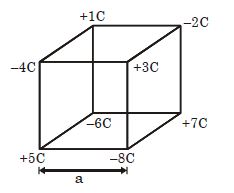
The electric flux passing through the cube for the given arrangement of charges placed at the corners of the cube (as shown in the figure) is 
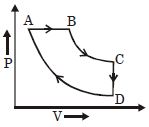
A cyclic process $ABCD$ is shown in the given $P-V$ diagram. $P-T$ diagram that  represents the same process is
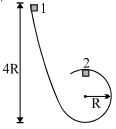
$A$ small cube with mass $M$ starts at rest at point $1$ at a height $4R$, where $R$ is the radius of the circular part of the track. The cube slides down the frictionless track and around the loop. The force that the track exerts on the cube at point $2$ is nearly ......... times the cube's weight $mg$.