MCQ
Rotation as well as translation motion is an example of:
  • A
    Constrained motion.
  • B
    Unconstrained motion.
  • C
    Perpetual motion.
  • D
    None of these.

Answer

  1. Constrained motion.

Explanation:

Rotational motion and translational motion both are constrained motion.

Need a full question paper?

Generate a complete, print-ready paper with questions like this in minutes — across 16+ boards, with answer keys.

Start Generating Free

Similar questions

Two spheres of same size one of mass $2\, kg$ and another of mass $4\, kg$ are dropped simultaneously from the top of Qutab Minar(height $= 72\,m$). When they are $1\,m$ above the ground, the two spheres have the same
$\overrightarrow A $ and $\overrightarrow B $ are two vectors given by $\overrightarrow A  = 2\widehat i + 3\widehat j$ and $\overrightarrow B  = \widehat i + \widehat j$. The magnitude of  the component (projection) of $\overrightarrow A$ on $\overrightarrow  B$ is
The centre of mass of a system of particles is at the origin. It follows that:
  1. The number of particles to the right of the origin is equal to the number of particles to the left.
  2. The total mass of the particles to the right of the origin is same as the total mass to the left of the origin.
  3. The number of particles on X-axis should be equal to the number of particles on Y-axis.
  4. If there is a particle on the positive X-axis, there must be at least one particle on the negative X-axis.
  5. None.
Match the followings :
Column $-I$ Column $-II$
$(a)$ Combined existence of liquid-gaseous state of substance. $(i)$ Sublimation curve
$(b)$ Combined existence of solid-gaseous state of substance. $(ii)$ Fusion curve
    $(iii)$ Vaporization curve
The resultant of $\overrightarrow P $ and $\overrightarrow Q $ is perpendicular to $\overrightarrow P $. What is the angle between $\overrightarrow P $ and $\overrightarrow Q $
At $N.T.P.$ one mole of diatomic gas is compressed adiabatically to half of its volume $\gamma = 1.41$. The work done on gas will be ....... $J$
Find the maximum velocity for skidding for a car moved on a circular track of radius $100\, m$. The coefficient of friction between the road and tyre is $0.2$ ....... $m/s$
$41$ forks are so arranged that each produces $5$ beats per sec when sounded with its near fork. If the frequency of last fork is double the frequency of first fork, then the frequencies of the first and last fork are respectively
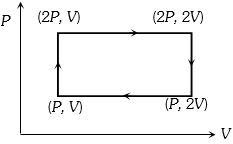
Work done in the given $P-V$ diagram in the cyclic process is
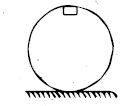
A ring of mass $m = 1\ kg$ and radius $R = 1.25\ m$ is kept on a rough horizontal ground. A small body of same mass $m = 1\ kg$ is struck to the top of the ring. When it was given a slight push forward, the ring started rolling purely on the ground. What is the maximum speed of the centre of the ring (in $m/s$ )?