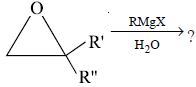
MCQ
Rutherford created a theoretical picture of the atom based on :
- AStars in galaxy
- ✓Model of planets revolving round the sun
- CBehavior of waves in the ocean
- DClouds in sky that move and mix in changing shapes
Generate a complete, print-ready paper with questions like this in minutes — across 16+ boards, with answer keys.
$2 \mathrm{Fe}_{(\mathrm{s})}+\frac{3}{2} \mathrm{O}_{2(\mathrm{~g})} \rightarrow \mathrm{Fe}_2 \mathrm{O}_{3(\mathrm{~s})}, \Delta \mathrm{H}^{\mathrm{o}}=-822 \mathrm{~kJ} / \mathrm{mol}$
$\mathrm{C}_{(\mathrm{s})}+\frac{1}{2} \mathrm{O}_{2(\mathrm{~g})} \rightarrow \mathrm{CO}_{(\mathrm{g})}, \Delta \mathrm{H}^{\mathrm{o}}=-110 \mathrm{~kJ} / \mathrm{mol}$
Then enthalpy change for following reaction
$3\mathrm{C}_{(\mathrm{s})}+\mathrm{Fe}_2 \mathrm{O}_{3(\mathrm{~s})} \rightarrow 2 \mathrm{Fe}_{(\mathrm{s})}+3 \mathrm{CO}_{(\mathrm{g})}$
$2H_2(g) + O_2(g) \to 2H_2O(l)$ ; $\Delta _fH^o_{298}(H_2O(l)) = -285.5\, kJ/mol$
What is $\Delta S^o_{298}$ for the given fuel cell reaction ?
Given $: O_2(g) + 4H^+(aq) + 4e^- \to 2H_2O(l)$ $E^o = 1.23\, V$