MCQ
Rutherford’s atomic model was unstable because:
  • A
    Nuclei will break down.
  • Electrons do not remain in orbit.
  • C
    Orbiting electrons radiate energy.
  • D
    Electrons are repelled by the nucleus.

Answer

Correct option: B.
Electrons do not remain in orbit.

Need a full question paper?

Generate a complete, print-ready paper with questions like this in minutes — across 16+ boards, with answer keys.
Start Generating Free

Similar questions

$20\,\mu A$ current flows for $30$ seconds in a wire, transfer of charge will be
In the Young’s double slit experiment with sodium light. The slits are $0.589 m$ a part. The angular separation of the third maximum from the central maximum will be (given $\lambda$ $= 589 mm$)
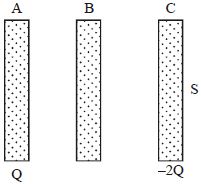
Three identical metal plates with large surface areas are kept parallel to each other as shown in figure. The left most plates is given a charge $Q$ and the right most plate $C$ is given a charge $-2Q.$ The middle plate $B$ is neutral. Then the charge appearing on the outer surface $S$ of the plate $C$ is :-
The maximum distance upto which $TV$ transmission from a $TV$ tower of height $h $ can be received is proportional to
the anode is kept at positive potential with respect to the cathode:
Moving charge produces:
The magnetic field of a plane electromagnetic wave is given by

$\vec B\, = {B_0}\hat i\,[\cos \,(kz - \omega t)]\, + \,{B_1}\hat j\,\cos \,(kz - \omega t)$ where ${B_0} = 3 \times {10^{-5}}\,T$ and ${B_1} = 2 \times {10^{-6}}\,T$. The rms value of the force experienced by a stationary charge $Q = 10^{-4} \,C$ at $z = 0$ is closet to
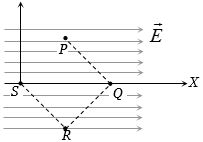
Point charge $q$ moves from point $P$ to point $S$ along the path $PQRS$ (figure shown) in a uniform electric field $E$ pointing coparallel to the positive direction of the $X - $axis. The coordinates of the points $P,\,Q,\,R$ and $S$ are $(a,\,b,\,0),\;(2a,\,0,\,0),\;(a,\, - b,\,0)$ and $(0,\,0,\,0)$ respectively. The work done by the field in the above process is given by the expression
The de Broglie wavelengths of a proton and an $\alpha$ particle are $\lambda$ and $2 \lambda$ respectively. The ratio of the velocities of proton and $\alpha$ particle will be :
A small square loop of wire of side $l$ is placed inside a large square loop of wire of side $(L > l)$. The loop are coplanar and their centre coincide. The mutual inductance of the system is proportional to