MCQ
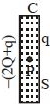
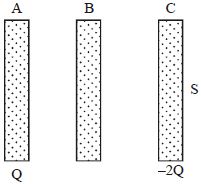
Three identical metal plates with large surface areas are kept parallel to each other as shown in figure. The left most plates is given a charge $Q$ and the right most plate $C$ is given a charge $-2Q.$ The middle plate $B$ is neutral. Then the charge appearing on the outer surface $S$ of the plate $C$ is :-
  • $-Q/2$
  • B
    $-Q$
  • C
    $+Q$
  • D
    $+2Q$

Answer

Correct option: A.
$-Q/2$
a
The net field inside plate $\mathrm{C}$ at say point $\mathrm{P}$ should be zero. Let $\mathrm{q}$ is charge on $\mathrm{S}.$ Then field at $\mathrm{P}$ from all the charges (plate $\mathrm{A}, \mathrm{B}$ and $\mathrm{C}$ ) is

$\frac{{{\rm{Q}}/2{\rm{A}}}}{{{ \in _0}}} + 0 - \frac{{(2{\rm{Q}} + {\rm{q}})/{\rm{A}}}}{{2{ \in _0}}} - \frac{{{\rm{q}}/{\rm{A}}}}{{2{ \in _0}}} = 0$

or $\mathrm{Q}-2 \mathrm{Q}-\mathrm{q}-\mathrm{q}=0$

or $\mathrm{q}=-\mathrm{Q} / 2$

Need a full question paper?

Generate a complete, print-ready paper with questions like this in minutes — across 16+ boards, with answer keys.

Start Generating Free

Similar questions

The impedance of a circuit consists of $3\, ohm$ resistance and $4 \,ohm$ reactance. The power factor of the circuit is
The capacity of a spherical conductor in $ MKS$ system is
The intensity of electric field required to balance a proton of mass $1.7 \times {10^{ - 27}} kg$ and charge $1.6 \times {10^{ - 19}} C$ is nearly
A particle of charge $ -16 \times 10^{-8}$ coulomb moving with velocity 10 ms$^{-1}$ along the x-axis enters a region where a magnetic field of induction B is along the y-axis, and an electric field of magnitude $10^4$V/m  is  along the negative z-axis. If the charged particle continues moving along the x-axis, the magnitude of B is
A conducting loop of radius $\frac{10}{\sqrt{\pi}}\,cm$ is placed perpendicular to a uniform magnetic field of $0.5\,T$. The magnetic field is decreased to $zero$ in $0.5\,s$ at a steady rate. The induced emf in the circular loop at $0.25\,s$ is:
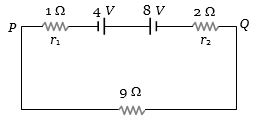
Two batteries of $e.m.f.$ $4\,V$ and $8 \,V$ with internal resistances $1\, \Omega$ and $2\,\Omega$ are connected in a circuit with a resistance of $9 \,\Omega$ as shown in figure. The current and potential difference between the points $P$ and $Q$ are
Electromagnetic waves travel in a medium which has relative permeability $1.3$ and relative permittivity $2.14$. Then the speed of the electromagnetic wave in the medium will be
A galvanometer having a coil resistance $100 \;\Omega$ gives a full scale deflection when a current of $1 \;\mathrm{mA}$ is passed through it. What is the value of the resistance which can convert this galvanometer into a voltmeter giving full scale deflection for a potential difference of $10\; \mathrm{V} ?$......$k\Omega$
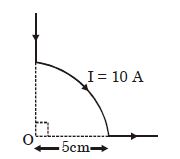
Find out magnetic field at point $O$ ?
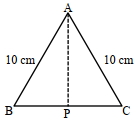
Cross-section view of a prism is the equilateral triangle ${ABC}$ in the figure. The minimum deviation is observed using this prism when the angle of incidence is equal to the prism angle. The time taken by light to travel from midpoint of ${BC}$ to ${A}$ is $.....\times 10^{-10}\, {s}$. $($ Given, speed of light in vacuum $=3 \times 10^{8} \,{m} / {s}$ and $\left.\cos 30^{\circ}=\frac{\sqrt{3}}{2}\right)$