Question
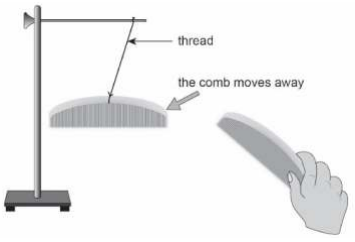
Ryan ran two combs through his hair.
He hung one comb from a stand using a thread.
Ryan brought the other comb close to the irst comb.
The picture below shows the result.
Image

$1.$ Why did the comb move away from the other$?$
$2.$ Ryan repeats the activity using a pair of glass rods in place of the combs.
What would be the result$?$
$A.$ The hanging rod will move away
$B.$ The hanging rod will come closer
$C. $ The hanging rod will show no change
$D. $ The hanging rod will start spinning
Answer

$1.$ Mentions that the combs are likely charged.
$2. A.$ The hanging rod will move away

Need a full question paper?

Generate a complete, print-ready paper with questions like this in minutes — across 16+ boards, with answer keys.

Start Generating Free

Similar questions

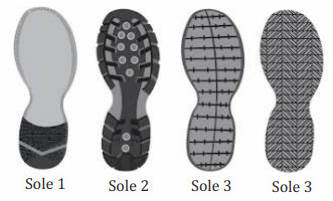
The picture shows four types of shoe soles.
Image
$9.$ Which shoe sole provides the best grip and friction while walking$?$
$A.$ Sole$1$
$B.$ Sole $2$
$C.$ Sole $3$
$D.$ Sole $4$
$10.$ Why do weightlifters apply chalk powder on their palms while lifting weights$?$
The table shows the caloriic value and pollutants released by four types of fuels.
Fuel Caloriic value (kilojoule / kg) Pollution factor
Type $1$ $25000 - 33000$ $CO_2,$ sulphur oxides and Nitrogen oxides
Type $2$ $55000$ $CO_2,$ Water vapour
Type $3$ $45000$ Carbon monoxide, $CO_2,$ Nitrogen oxides
Type $4$ $35000 - 40000$ $CO_2$ and Methane
$8.$ Which fuel can boil the water in a vessel the fastest$?$
$A.$ Type $1$
$B.$ Type $2$
$C.$ Type $3$
$D.$ Type $4$
$9.$ Which fuel can cause acid rain on combustion$?$
$A.$ Type $1$ only
$B.$ Type $4$ only
$C.$ Both Type $1$ and Type $3$
$D.$ Both Type $2$ and Type $4$
$10.$ Which fuel type is likely to be biogas$?$
$A.$ Type $1$
$B.$ Type $2$
$C.$ Type $3$
$D.$ Type $4$
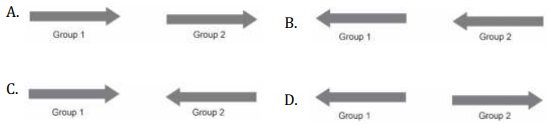
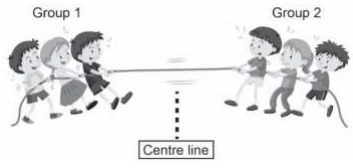
Two groups of students are playing tug-of-war.
Image
$2.$ Choose the correct direction of force applied by Group $1$ and Group $2.$
Image
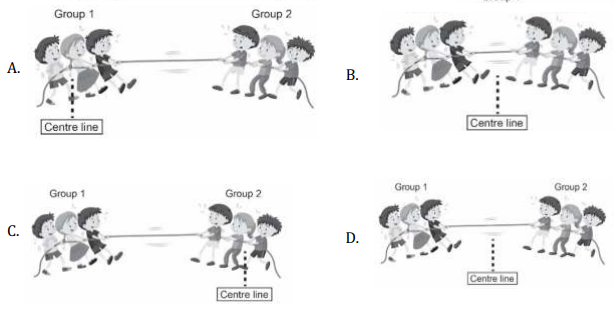
$3.$ Group $1$ is pulling with $250\ N$ force and Group $2$ is pulling with $300\ N$ force.
What would be the likely position of the two groups after a minute of pulling$?$​​​​​​​
Image
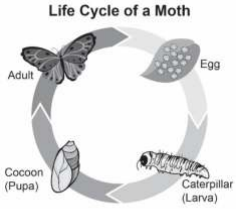
The picture shows the life cycle of a moth.
Image

$9.$ What can be concluded from the picture$?$
Circle ‘Yes’ or ‘No’ for the correct response.
Can this be concluded from the picture? Yes or No
Moth is an oviparous animal. Yes/No
A moth looks different in each stage of its life cycle. Yes/No
There are two different stages in the life cycle of a moth. Yes/No
The material X is a fossil fuel. It is formed from the buried large land plants (vegetation) by a very slow process Y. When X is heated in the absence of air, it gives three products A, B and C.
A is used in steel making B is used as an industrial fuel, whereas the product C has been traditionally used for metalling the roads. It is now replaced by a petroleum product, bitumen.
Now give the answer of the following questions.
(i) What is the material X ?
(ii) What is the physical state and colour of X ?
(iii) Name the processes Y.
(iv) What are the products A, B and C ?
Erik dumped four types of domestic waste in separate land pits.
He covered the pits and left them undisturbed for a year.
The table below shows what he observed after a year.
Waste $1$ Waste $2$ Waste $3$ Waste $4$
Fully decomposed Not decomposed at all Fully decomposed Not decomposed at all
$9.$ Which type of waste(s) is most likely to cause soil pollution$?$
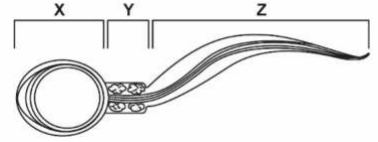
The picture shows the basic parts of a salmon ish sperm.

Image
$7.$ Which part of the sperm helps it to swim in water and reach the egg$?$
$8.$ Which of these animals reproduce by external fertilization?
$A.$ Snake
$B.$ Frog
$C.$ Horse
$D.$ Elephant
The table shows the properties of four water samples.
Water Sample Smell Colour
Sample $1$ No smell Slightly muddy
Sample $2$ Strong bad smell Muddy and greenish
Sample $3$ Very light smell Colourless
Sample $4$ No smell Colourless
$6$. Which water sample is likely to be least polluted$?$
$A.$ Sample $1$
$B.$ Sample $2$
$C$. Sample $ 3$
$D$. Sample $4$
$7.$ In which water source will the survival of aquatic animals be the most dificult$?$
$A.$ Source of Sample $1$
$B.$ Source of Sample $2$
$C.$ Source of Sample $3$
$D.$ Source of Sample $4$
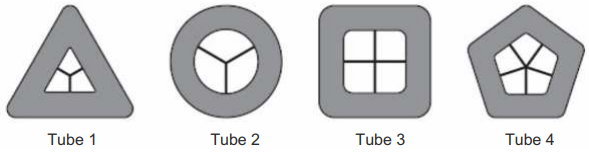
The picture shows four different rubber tubes.
Image
$5.$ Which tube will experience the least friction while rolling on a surface?
Explain your answer.
$6.$ Which of these would affect the amount of friction generated on a moving object$?$
Circle ‘Yes’ or ‘No’ for the correct response.
Does this Affect the Amount of Friction Generated? Yes or No
Mass of the object Yes/No
Surface area of the object Yes/No
Roughness of the object Yes/No


Which of these is true about the four sound waves$?$
Circle ‘Yes’ or ‘No’ to mark your responses.
Animal Frequency range of sound waves
Elephant $15–12000\ Hz$
Human $20–22000\ Hz$
Dog $65–45000\ Hz$
Chicken $125–2000\ Hz$
$5.$ A cat made a purring sound that had a frequency of $35\ Hz.$
Which of the animals mentioned in the table can hear the purring$?$
$A.$ Only human
$B.$ Only elephant
$C.$ Dog and chicken
$D.$ Elephant and human
$6.$ Which of the following sounds can be classiied as noise for humans$?$
$A.$ Sounds that are softer than $20\ dB$
$B.$ Sounds that are in between $20\ dB$ and $40\ dB$
$C.$ Sounds that are between $40\ dB$ and $80\ dB$
$D.$ Sounds that are louder than $80\ dB$
$7.$ Which of these will reduce noise pollution?
Circle ‘Yes’ or ‘No’ to mark your responses.
Will this reduce noise pollution? Yes or No
Regulating the use of loudspeakers Yes/No
Setting up more thermal power plants Yes/No
Using more electric vehicles Yes/No