MCQ
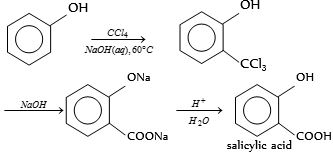
Salicylic acid is prepared from phenol by
- ✓Kolbe-smmith reaction
- BReimer Tiemann reaction
- CKolbe-electrolysis reaction
- DNone of these
Generate a complete, print-ready paper with questions like this in minutes — across 16+ boards, with answer keys.
$\mathrm{M}(\mathrm{s}) \mid \mathrm{M}^{+}$(aq; $0.05$ molar) || $\mathrm{M}^{+}(\mathrm{aq}), 1$ molar) $\mid \mathrm{M}(\mathrm{s})$
For the above electrolytic cell the magnitude of the cell potential $\left|E_{\text {cell }}\right|=70 \mathrm{mV}$.
$1.$ For the above cell
$(A)$ $\mathrm{E}_{\text {cell }}<0 ; \Delta \mathrm{G}>0$ $(B)$ $\mathrm{E}_{\text {cell }}>0 ; \Delta \mathrm{G}<0$
$(C)$ $\mathrm{E}_{\text {cell }}<0 ; \Delta \mathrm{G}^{\circ}>0$ $(D)$ $\mathrm{E}_{\text {cell }}>0 ; \Delta \mathrm{G}^{\circ}>0$
$2.$ If the $0.05$ molar solution of $\mathrm{M}^{+}$is replaced by $0.0025$ molar $\mathrm{M}^{+}$solution, then the magnitude of the cell potential would be
$(A)$ $35 \mathrm{mV}$ $(B)$ $70 \mathrm{mV}$ $(C)$ $140 \mathrm{mV}$ $(D)$ $700 \mathrm{mV}$
Give the answer question $1,2.$
then which one is not correct
Compound $(C)$ can show geometrical isomerism. Product $(E)$ of the reaction will be
$\mathop {(A)}\limits_{{C_{11}}{H_8}O} \to $ does not under go self aldol condensation
$\mathop {(A)}\limits_{{C_{11}}{H_8}O} \xrightarrow{{{O_3}}}ph\, - \,CHO\, + \,2B\,\xrightarrow{{A{g^ + }}}$ Oxalic acid
$A.$ $E _{\text {cell }}$ is an intensive parameter.
$B.$ A negative $E^{\Theta}$ means that the redox couple is a stronger reducing agent than the $H ^{+} / H _2$ couple.
$C.$ The amount of electricity required for oxidation or reduction depends on the stoichiometry of the electrode reaction.
$D.$ The amount of chemical reaction which occurs at any electrode during electrolysis by a current is proportional to the quantity of electricity passed through the electrolyte.