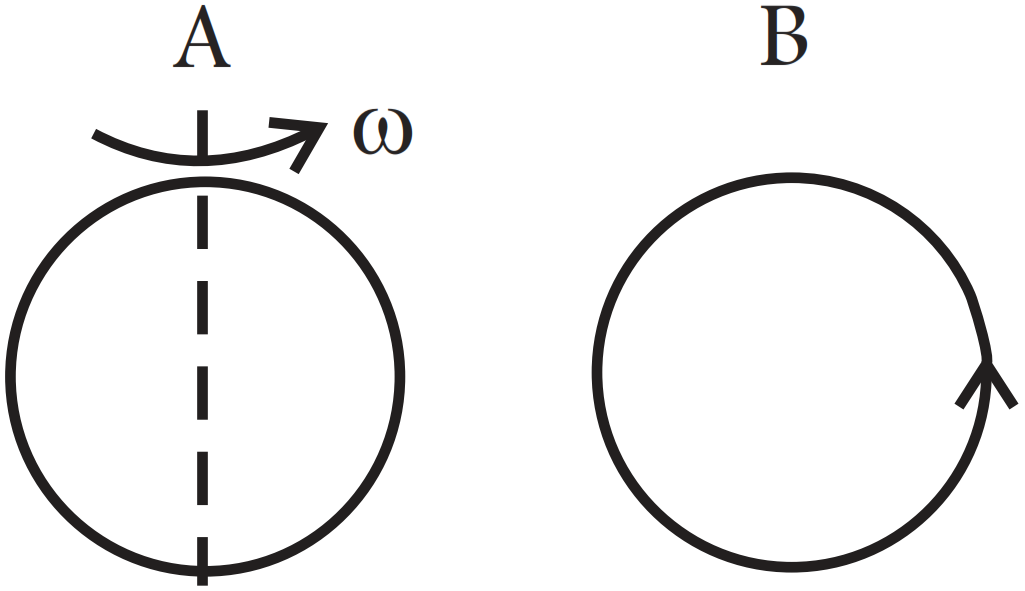
- AConstant current clockwise.
- BVarying current clockwise.
- CVarying current counterclockwise.
- DConstant current counterclockwise.

Solution:
Key concept: In this problem, the Lenz’s law is applicable so let us introduce Lenz’s law first.
Lenz's law gives the direction of induced emf/induced current. According to this law, the direction of induced emf or current in a circuit is such as to oppose the cause that produces it. This law is based upon law of conservation of energy.
When the current in coil B (at t = 0) is counter-clockwise and the coil A is considered above it. The counter clockwise flow of the current in coil B is equivalent to north pole of magnet and magnetic field lines are eliminating upward to coil A. When coil A starts rotating at t = 0, the current in A is constant along clockwise direction by Lenz's rule.
Generate a complete, print-ready paper with questions like this in minutes — across 16+ boards, with answer keys.
Photo cells are used for the
|
(a) Reproduction of pictures from the cinema film |
|
(b) Reproduction of sound from the cinema film |
|
(c) Automatic switching of street light |
|
(d) (b) and (c) both |
The magnetic field at the centre of a circular coil of radius r carrying current I is . The field at the centre of another coil of radius 2 r carrying same current I is
. The ratio
is
|
(a) |
(b) 1 |
(c) 2 |
(d) 4 |
If the length of potentiometer wire is increased, then the length of the previously obtained balance point will
|
(a) Increase |
(b) Decrease |
(c) Remain unchanged |
(d) Become two times |
A battery having e.m.f. 5V and internal resistance 0.5 W is connected with a resistance of 4.5 W then the voltage at the terminals of battery is
|
(a) 4.5 V |
(b) 4 V |
(c) 0 V |
(d) 2 V |
Assertion : The temperature coefficient of resistance is positive for metals and negative for p-type semiconductor.
Reason : The effective charge carriers in metals are negatively charged whereas in p-type semiconductor they are positively charged.
|
(a) If both assertion and reason are true and the reason is the correct explanation of the assertion. |
|
(b) If both assertion and reason are true but reason is not the correct explanation of the assertion. |
|
(c) If assertion is true but reason is false. |
|
(d) If the assertion and reason both are false. |
The phenomenon due to which a ray of light .......... from its path while travelling from one optical medium to another optical medium is called refraction.
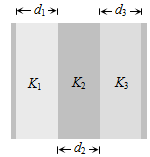
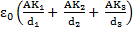
The expression for the capacity of the capacitor formed by compound dielectric placed between the plates of a parallel plate capacitor as shown in figure, will be (area of plate = A)

|
(a) |
(b) |
(c) |
(d) |