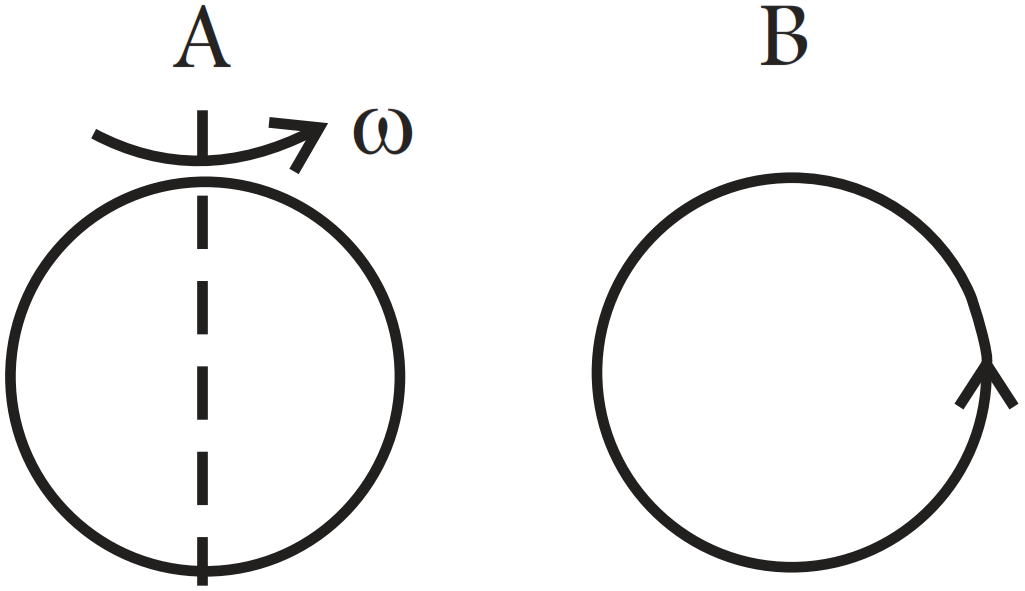
- AConstant current clockwise.
- BVarying current clockwise.
- CVarying current counterclockwise.
- DConstant current counterclockwise.

Solution:
Key concept: In this problem, the Lenz’s law is applicable so let us introduce Lenz’s law first.
Lenz's law gives the direction of induced emf/induced current. According to this law, the direction of induced emf or current in a circuit is such as to oppose the cause that produces it. This law is based upon law of conservation of energy.
When the current in coil B (at t = 0) is counter-clockwise and the coil A is considered above it. The counter clockwise flow of the current in coil B is equivalent to north pole of magnet and magnetic field lines are eliminating upward to coil A. When coil A starts rotating at t = 0, the current in A is constant along clockwise direction by Lenz's rule.
Generate a complete, print-ready paper with questions like this in minutes — across 16+ boards, with answer keys.
X-rays region lies between
| (a) Short radiowave and visible region | (b) Visible and ultraviolet region |
| (c) Gamma rays and ultraviolet region | (d) Short radiowave and long radiowave |
Faraday's laws of electrolysis are related to
|
(a) The atomic number of positive ion |
(b) The equivalent weight of electrolyte |
|
(c) The atomic number of negative ion |
(d) The velocity of positive ion |
In an RC circuit while charging, the graph of in i versus time is as shown by the dotted line in the diagram figure, where i is the current. When the value of the resistance is doubled, which of the solid curve best represents the variation of in i versus time
|
(a) P |
(b) Q |
(c) R |
(d) S |
X-rays are known to be electromagnetic radiations. Therefore the X-ray photon has
| (a) Electric charge |
| (b) Magnetic moment |
| (c) Both electric charge and magnetic moment |
| (d) Neither electric charge nor magnetic moment |