Scheme $1$ and $2$ describe the conversion of $P$ to $Q$ and $R$ to $S$, respectively. Scheme $3$ describes the synthesis of $T$ from $Q$ and $S$. The total number of $Br$ atoms in a molecule of $T$ is. . . . . . . .
Scheme $1$ : (image)
Scheme $2$ :(image)
Scheme $3$ :(image)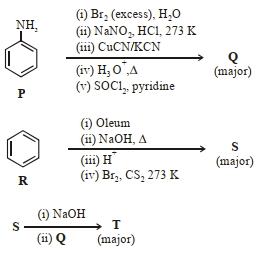
IIT 2019, Medium


Download our appand get started for free
Experience the future of education. Simply download our apps or reach out to us for more information. Let's shape the future of learning together!No signup needed.*
Similar Questions
- 1View SolutionMelting points are normally the highest for
- 2The major products obtained from the following sequence of reactions areView Solution
$(CH_3)_2CHCH_2N(CH_2CH_3)_2 \xrightarrow{C{{H}_{3}}I}\xrightarrow[{{H}_{2}}O]{A{{g}_{2}}O}\xrightarrow{heat}$ products
- 3View SolutionWhich one of the following will give a primary amine on hydrolysis
- 4In the series of reactionView Solution
${C_6}{H_5}N{H_2}\mathop {\xrightarrow{{NaN{O_2}/HCl}}}\limits_{0 - 5\,^o C} X\mathop {\xrightarrow{{HN{O_2}}}}\limits_{C{H_2}O} Y + {N_2} + HCl$
$X$ and $Y$ are respectively
- 5When acetamide is treated with $NaOBr,$ the product formed isView Solution
- 6View SolutionWhich has a pyramidal structure
- 7View SolutionHinsberg’s reagent is
- 8When propanamide reacts with $B{r_2}$ and $NaOH$ then which of the following compound is formedView Solution
- 9Consider the following reaction sequenceView Solution
The product $'B'$ is?

- 10Reaction $C{H_3}CON{H_2}\xrightarrow{{NaOBr}}$ givesView Solution