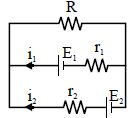
See the electrical circuit shown in the adjoining figure. Which of the following equation is a correct equation for it
Medium
Download our app for free and get started
Applying Kirchhoff's equation to the loop $\mathrm{ABFE},$
$-\left(\mathrm{i}_{1}+\mathrm{i}_{2}\right) \mathrm{R}-\mathrm{i}_{1} \mathrm{r}_{1}+\mathrm{E}_{1}=0$
or $\mathrm{E}_{1}-\left(\mathrm{i}_{1}+\mathrm{i}_{2}\right) \mathrm{R}-\mathrm{i}_{1} \mathrm{r}_{1}=0$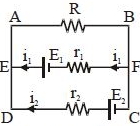

Download our appand get started for free
Experience the future of education. Simply download our apps or reach out to us for more information. Let's shape the future of learning together!No signup needed.*
Similar Questions
- 1$A$ uniform copper wire carries a current $i$ amperes and has $p$ carriers per meter$^3$. The length of the wire is $\lambda$ meters and its cross-section area is $s$ meter $^2$. If the charge on a carrier is $q$ coulombs, the drift velocity in $ms^{-1}$ is given byView Solution
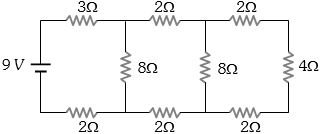
- 2View SolutionIn the circuit shown in the figure, the current through
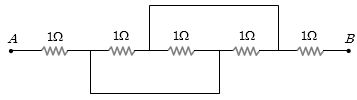
- 3Equivalent resistance between the points $A$ and $B$ is (in $\Omega$)View Solution
- 4By what percentage will the illumination of the lamp decrease if the current drops by $20 \%$ ?View Solution
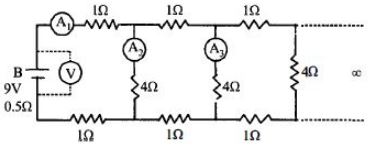
- 5A $9\, V$ battery with internal resistance of $0.5\,\Omega $ is connected across an infinite network as shown in the figure. All ammeters $A_1 , A_2, A_3$ and voltmeter $V$ are ideal. Choose correct statementView Solution
- 6Two resistances ${R_1}$ and ${R_2}$ are made of different materials. The temperature coefficient of the material of ${R_1}$ is $\alpha $ and of the material of ${R_2}$ is $ - \beta $. The resistance of the series combination of ${R_1}$ and ${R_2}$ will not change with temperature, if ${R_1}/{R_2}$ equalsView Solution
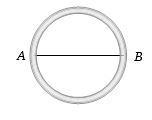
- 7The resistance of a wire is ${10^{ - 6}}\,\Omega $ per meter. It is bend in the form of a circle of diameter $2\,m$. A wire of the same material is connected across its diameter. The total resistance across its diameter $AB$ will beView Solution
- 8A series combination of two resistors $1\,\Omega $ each is connected to a $12\,V$ battery of internal resistance $0.4\,\Omega $. The current flowing through it will be ............... $A$View Solution
- 9View SolutionTwo resistors having equal resistances are joined in series and a current is passed through the combination. Neglect any variation in resistance as the temperature changes. In a given time interval
- 10Two electric bulbs whose resistances are in the ratio of $1 : 2$ are connected in series. The powers dissipated in them have the ratioView Solution