MCQ
Select incorrect statement regarding turbulent flow
  • A
    It dissipates kinetic energy in form of heat
  • B
    It promotes mixing of fluids
  • C
    It increases the rate of transfer of momentum and energy
  • It decreases rate of transfer of momentum and energy

Answer

Correct option: D.
It decreases rate of transfer of momentum and energy
d

Need a full question paper?

Generate a complete, print-ready paper with questions like this in minutes — across 16+ boards, with answer keys.
Start Generating Free

Similar questions

Two vectors having equal magnitudes of $x\, units$ acting at an angle of $45^o$ have resultant $\sqrt {\left( {2 + \sqrt 2 } \right)} $ $units$. The value of $x$ is
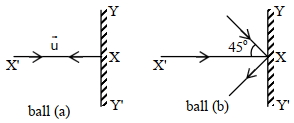
Two billiard balls of equal mass $30 \,{g}$ strike a rigid wall with same speed of $108\, {kmph}$ (as shown) but at different angles. If the balls get reflected with the same speed then the ratio of the magnitude of impulses imparted to ball $'a'$ and ball $'b'$ by the wall along $'X'$ direction is :
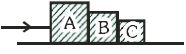
Three blocks $A, B$ and $C$ of masses $4\, kg$, $2\, kg$ and $1\, kg$ respectively, are in contact on a frictionless surface, as shown. If a force of $14\, N$ is applied on the $4\, kg$ block, then the contact force between $A$ and $B$ is .......... $N$
The elastic potential energy stored in a steel wire of length $20\,m$ stretched through $2 \,m$ is $80\,J$. The cross sectional area of the wire is $.........\,mm ^2$ (Given, $y =2.0 \times 10^{11}\,Nm ^{-2}$ )
A block of mass m is placed on a smooth inclined plane of inclination $\theta$ with the horizontal. The force exerted by the plane on the block has a magnitude:
The centre of mass of an extended body on the surface of the earth and its centre of gravity.
  1. Are always at the same point for any size of the body.
  2. Are always at the same point only for spherical bodies.
  3. Can never be at the same point.
  4. Is close to each other for objects, say of sizes less than 100m.
  5. Both can change if the object is taken deep inside the earth.
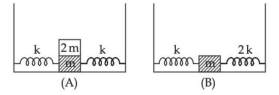
In figure $(A),$ mass ' $2 m$ ' is fixed on mass ' $m$ ' which is attached to two springs of spring constant $k$. In figure $(B),$ mass ' $m$ ' is attached to two spring of spring constant ' $k$ ' and ' $2 k$ '. If mass ' $m$ ' in $(A)$ and $(B)$ are displaced by distance ' $x$ ' horizontally and then released, then time period $T_{1}$ and $T_{2}$ corresponding to $(A)$ and $(B)$ respectively follow the relation.
If a particle moves in a circle describing equal angles in equal times, its velocity vector
If the initial velocity in horizontal direction of a projectile is unit vector $\hat{i}$ and the equation of trajectory is $y =5 x (1- x )$. The $y$ component vector of the initial velocity is.

(Take $g=10\,m / s ^{2}$ )

In forced oscillations, a particle oscillates simple harmonically with frequency equal to