MCQ
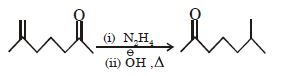
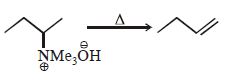
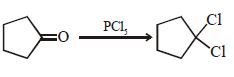
Select option in which incorrect major product is shown

  • B

  • C

  • D
    $Ph - I\xrightarrow[\Delta ]{{Cu}}Ph - Ph$

Answer

Correct option: A.

a

Need a full question paper?

Generate a complete, print-ready paper with questions like this in minutes — across 16+ boards, with answer keys.

Start Generating Free

Similar questions

$\begin{array}{*{20}{c}}
  {O\,\,\,\,\,\,\,\,\,\,\,\,\,\,\,\,\,\,\,\,\,\,\,\,\,\,\,\,\,\,\,\,\,\,\,\,\,\,\,\,\,\,\,\,\,\,\,\,\,\,\,\,\,\,\,\,\,\,} \\ 
  {||\,\,\,\,\,\,\,\,\,\,\,\,\,\,\,\,\,\,\,\,\,\,\,\,\,\,\,\,\,\,\,\,\,\,\,\,\,\,\,\,\,\,\,\,\,\,\,\,\,\,\,\,\,\,\,\,\,\,\,} \\ 
  {Et - {\text{ }}O - {\text{ }}C - {\text{ }}O - {\text{ }}Et\xrightarrow[{(2){H_3}{O^ \oplus }}]{{\left( 1 \right){\text{ }}C{H_3}MgBr\,\,\left( {excess} \right)}}(A),} 
\end{array}$

 Product $(A)$ is 

The following results were obtained during kinetic studies of the reaction $2A+B$ $\to$ products

Experiment

$[A]$

(in $mol\, L^{-1})$

$[B]$

(in $mol\, L^{-1})$

Initial rate of reaction

(in $mol\, L^{-1}\,min^{-1})$

$I$ $0.10$ $0.20$ $6.93 \times {10^{ - 3}}$
$II$ $0.10$ $0.25$ $6.93 \times {10^{ - 3}}$
$III$ $0.20$ $0.30$ $1.386 \times {10^{ - 2}}$

The time(in minutes) required to consume half of $A$ is

For reaction
$2P(g) + Q(g) \rightleftharpoons R(g) + S(g) ; K_C = 10^{12}$ If initial moles of $P, Q, R, S$ are $2, 1, 7$ and $3$ moles espectively in a one litre vessel. Find equilibrium concentration of $P$
A hypothetical electrochemical cell is shown below.

$A \,|\, A^+\, (xM)\, ||\, B^+ \,(yM)\, |\, B$

The $emf$ measured is $+ 0.20\, V.$ The cell reaction is

The relative reactivities of acyl compounds towards nucleophbstitution are in the order of
$XY_2$ dissociates $X{Y_2}(g)\,\rightleftharpoons \,XY{\kern 1pt} (g)\, + \,Y\,(g)$  When the initial presure of $XY_2$ is $600\,mm\,Hg,$ the total equilibrium pressure is $800 \,mm\,Hg.$ Calculate $K$ for the reaction. Assuming that the volume of the system remains unchanged.
Silver nitrate is supplied in coloured bottles because it is
Which of the following statements is correct for covalent bond
Which of the following will be most easily attacked by an electrophile
For the formation of covalent bond, the difference in the value of electronegativities should be