MCQ
Select the correct alternative$(s)$
  • Elastic forces are not always conservative
  • B
    Elastic forces are always conservative
  • C
    Elastic forces are conservative only when Hooke's law is obeyed
  • D
    Elastic forces are not conservative

Answer

Correct option: A.
Elastic forces are not always conservative
a
(a)

Since at every value of force material is not able to gain its shape. Therefore elastic forces are not always conservative.

Need a full question paper?

Generate a complete, print-ready paper with questions like this in minutes — across 16+ boards, with answer keys.
Start Generating Free

Similar questions

In compound microscope, the focal length of the objective and eye lens are $2.5\, cm$ and $5\,cm$ respectively. An object is at $3.75\, cm$ before the objective and image is formed at the least distance of distinct vision, then the distance between two lenses will be.......$cm$ (i.e. length of the microscope tube)
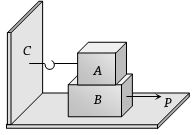
Block $A$ weighing $100$ kg rests on a block $B$ and is tied with a horizontal string to the wall at $C$. Block $B$ weighs $200 \,kg$. The coefficient of friction between $A$ and $B$ is $0.25$ and between $B$ and the surface is $1/3$. The horizontal force $P$ necessary to move the block $B$ should be  ........ $N$ $(g = 10\,m/{s^2})$
In an $X$-ray tube, electrons emitted from a filament (cathode) carrying current I hit a target (anode) at a distance $d$ from the cathode. The target is kept at a potential $V$ higher than the cathode resulting in emission of continuous and characteristic $X$-rays. If the filament current $I$ is decreased to $\frac{ I }{2}$, the potential difference $V$ is increased to $2 V$, and the separation distance $d$ is reduced to $\frac{ d }{2}$, then

$(A)$ the cut-off wavelength will reduce to half, and the wavelengths of the characteristic $X$-rays will remain the same

$(B)$ the cut-off wavelength as well as the wavelengths of the characteristic $X$-rays will remain the same

$(C)$ the cut-off wavelength will reduce to half, and the intensities of all the $X$-rays will decrease

$(D)$ the cut-off wavelength will become two times larger, and the intensity of all the $X$-rays will decrease
In a hydrogen atom, the distance between the electron and proton is $2.5 \times {10^{ - 11}}\,m$. The electrical force of attraction between them will be
The magnitude of angular momentum, orbit radius and frequency of revolution of electron in hydrogen atom corresponding to quantum number $n$ are $L, r$ and $f$ respectively. Then according to Bohr's theory of hydrogen atom,
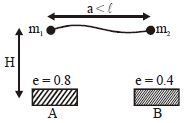
Two masses $m_1$ and $m_2$ are connected by a string of length $l$. They are held in a horizontal plane at a height $H$ above two heavy plates $A$ and $B$ made of different material placed on the floor. Initially distance between two masses is $a < l$. When the masses are released under gravity they make collision with $A$ and $B$ with coefficient of restitution $0.8$ and $0.4$ respectively. The time after the collision when the string becomes tight is :- (Assume $H>>l$)
Which one of the following schematic graphs best represents the variation of $p V$ (in Joules) versus $T$ (in Kelvin) of one mole of an ideal gas? (The dotted line represents $p V=T$ )
A cart is moving with a velocity $20\,m/s$. Sand is being dropped into the cart at the rate of $50\, kg/min$. The force required to move the cart with constant velocity will be ............ $N$
A uniform rod of length $2.0 \,m$ is suspended through an end and is set into oscillation with small amplitude under gravity. The time period of oscillation is approximately .... $\sec$
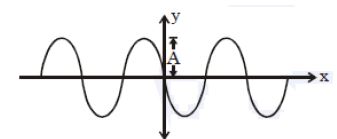
A progressive wave travelling along the positive $x-$ direction is represented by $y(x, t) = A\,sin\,\left( {kx - \omega t + \phi } \right)$. Its snapshot at $t = 0$ is given in the figure For this wave, the phase $\phi $ is