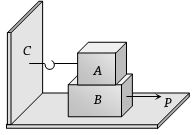
Block $A$ weighing $100$ kg rests on a block $B$ and is tied with a horizontal string to the wall at $C$. Block $B$ weighs $200 \,kg$. The coefficient of friction between $A$ and $B$ is $0.25$ and between $B$ and the surface is $1/3$. The horizontal force $P$ necessary to move the block $B$ should be ........ $N$ $(g = 10\,m/{s^2})$
AIIMS 2017, Difficult
Download our app for free and get started
(b) Friction between block $A$ and block $B$ & between block $B$ and surface will oppose the $P$
$\therefore $ $P = {F_{AB}} + {F_{BS}}$ $ = {\mu _{AB}}{m_A}g + {\mu _{BS}}({m_A} + {m_B})g$
$ = 0.25 \times 100 \times 10 + \frac{1}{3}(100 + 200) \times 10$ $=1250\, N$

Download our appand get started for free
Experience the future of education. Simply download our apps or reach out to us for more information. Let's shape the future of learning together!No signup needed.*
Similar Questions
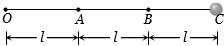
- 1Three identical particles are joined together by a thread as shown in figure. All the three particles are moving in a horizontal plane. If the velocity of the outermost particle is $v_0$, then the ratio of tensions in the three sections of the string isView Solution
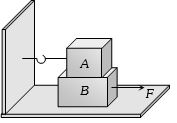
- 2A block A with mass $100\, kg $ is resting on another block $B$ of mass $200\, kg$. As shown in figure a horizontal rope tied to a wall holds it. The coefficient of friction between $A$ and $B$ is $ 0.2 $ while coefficient of friction between $B$ and the ground is $0.3$. The minimum required force $F$ to start moving $B$ will be ........ $N$View Solution
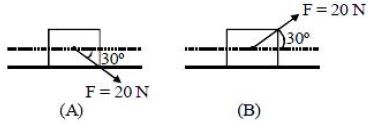
- 3A block of mass $5\, kg$ is $(i)$ pushed in case $(A)$ and $(ii)$ pulled in case $(B)$, by a force $F = 20\, N$, making an angle of $30^o$ with the horizontal, as shown in the figures. The coefficient of friction between the block and floor is $\mu = 0.2$. The difference between the accelerations of the block, in case $(B)$ and case $(A)$ will be $....... ms^{-2}$ .$(g = 10\, ms^{-2})$View Solution
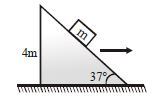
- 4If the coefficient of friction between block & wedge is $\mu $, then the maximum horizontal acceleration of the wedge for which block will remain at rest w.r.t. the wedge isView Solution
- 5A block of mass $m$ is placed on a surface with a vertical cross section given by $y = \frac{{{x^3}}}{6}$ If the coefficient of friction is $0.5$,the maximum height above the ground at which the block can be placed without slipping is:View Solution
- 6The coefficient of friction between the tyres and the road is $0.25$. The maximum speed with which a car can be driven round a curve of radius $40 \,m$ without skidding is ........ $ms^{-1}$ (assume $g = 10 \,ms^{-2}$)View Solution
- 7The upper half of an inclined plane of inclination $\theta$ is perfectly smooth while lower half is rough. A block starting from rest at the top of the plane will again come to rest at the bottom, if the coefficient of friction between the block and lower half of the plane is given byView Solution
- 8A block of mass $m$ slides down the plane inclined at angle $30^{\circ}$ with an acceleration $\frac{ g }{4}$. The value of coefficient of kinetic friction will be :View Solution
- 9Two blocks $A$ and $B$ are released from the top of a rough inclined plane so that $A$ slides along the plane and $B$ falls down freely. Which will have higher velocity on reaching the ground ?View Solution
- 10A truck starting from rest moves with an acceleration of $5 m/s^2$ for $1 sec$ and then moves with constant velocity. The velocity $w.r.t$ ground $v/s$ time graph for block in truck is ( Assume that block does not fall off the truck)View Solution