MCQ
Select the correct choice(s) :
  • A
    The gravitational field insideaspherical cavity,with inaspherical planet must be non zero and uniform.
  • B
    When a body is projected horizontally at an appreciable large height above the earth, with a velocity less than for a circular orbit, it will fall to the earth along a parabolic path.
  • Abody of zero total mechanical energy placed in a gravitational field will escape the field
  • D
    Earth’s satellite must be in equatorial plane .

Answer

Correct option: C.
Abody of zero total mechanical energy placed in a gravitational field will escape the field
c
Gravitational field is conservative field, total mechanical energy is conserved. If a body is in gravitational field with $U+K=0 \rightarrow K=-U \rightarrow(1)$ i.e. Kinetic energy is non zero.So, it will move away from the field till its kinetic energy is also zero.

If $K=0 \rightarrow U=0$ from $(1).$ But, $U=0$ is at $\infty$ and thus the body escapes the field.

Need a full question paper?

Generate a complete, print-ready paper with questions like this in minutes — across 16+ boards, with answer keys.

Start Generating Free

Similar questions

$540$ calories of heat convert $1 $ cubic centimeter of water at ${100^o}C$ into $1671 $ cubic centimeter of steam at ${100^o}C$ at a pressure of one atmosphere. Then the work done against the atmospheric pressure is nearly  ...... $cal$
In the diagram shown, a time varying non uniform magnetic field passes through acircular region of radius $R$. The magn eticfield is directed outwards and it is a function of radial distance $'r'$ and time $'t'$ according to the relation $B = B_0rt$. What is the induced electric field strength at a radial distance $R/2$ from the center ?
An expression for a dimensionless quantity $P$ is given by $P=\frac{\alpha}{\beta} \log _{e}\left(\frac{ kt }{\beta x }\right)$; where $\alpha$ and $\beta$ are constants, $x$ is distance ; $k$ is Boltzmann constant and $t$ is the temperature. Then the dimensions of $\alpha$ will be
Match List $I$ with List $II$

List $I$ List $II$
$A$ Spring constant $I$ $(T ^{-1})$
$B$ Angular speed $II$ $(MT ^{-2})$
$C$ Angular momentum $III$ $(ML ^2)$
$D$ Moment of Inertia $IV$ $(ML ^2 T ^{-1})$

Choose the correct answer from the options given below

The correct relation between the degree of freedom $f$ and the ratio of specific heat $\gamma$ is
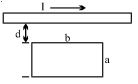
A long straight wire is parallel to one edge as in fig. If the current in the long wire is varies in time as $I = I_0e^{-t/\tau}$, what will be the induced $emf $ in the loop?
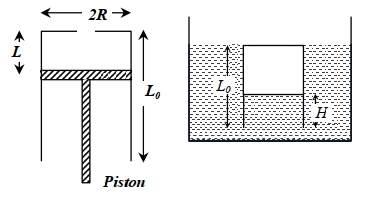
A fixed thermally conducting cylinder has a radius $\mathrm{R}$ and height $\mathrm{L}_0$. The cylinder is open at its bottom and has a small hole at its top. A piston of mass $M$ is held at a distance $L$ from the top surface, as shown in the figure. The atmospheric pressure is $\mathrm{P}_0$.

$1.$  The piston is now pulled out slowly and held at a distance $2 \mathrm{~L}$ from the top. The pressure in the cylinder between its top and the piston will then be

$(A)$ $\mathrm{P}_0$ $(B)$ $\frac{\mathrm{P}_0}{2}$  $(C)$ $\frac{P_0}{2}+\frac{M g}{\pi R^2}$  $(D)$ $\frac{\mathrm{P}_0}{2}-\frac{\mathrm{Mg}}{\pi \mathrm{R}^2}$

$2.$  While the piston is at a distance $2 \mathrm{~L}$ from the top, the hole at the top is sealed. The piston is then released, to a position where it can stay in equilibrium. In this condition, the distance of the piston from the top is

$(A)$ $\left(\frac{2 \mathrm{P}_0 \pi \mathrm{R}^2}{\pi \mathrm{R}^2 \mathrm{P}_0+\mathrm{Mg}}\right)(2 \mathrm{~L})$  $(B)$ $\left(\frac{\mathrm{P}_0 \pi R^2-\mathrm{Mg}}{\pi R^2 \mathrm{P}_0}\right)(2 \mathrm{~L})$ 

$(C)$ $\left(\frac{\mathrm{P}_0 \pi \mathrm{R}^2+\mathrm{Mg}}{\pi \mathrm{R}^2 \mathrm{P}_0}\right)(2 \mathrm{~L})$  $(D)$ $\left(\frac{\mathrm{P}_0 \pi \mathrm{R}^2}{\pi \mathrm{R}^2 \mathrm{P}_0-\mathrm{Mg}}\right)(2 \mathrm{~L})$

$3.$  The piston is taken completely out of the cylinder. The hole at the top is sealed. A water tank is brought below the cylinder and put in a position so that the water surface in the tank is at the same level as the top of the cylinder as shown in the figure. The density of the water is $\rho$. In equilibrium, the height $\mathrm{H}$ of the water column in the cylinder satisfies

$(A)$ $\rho g\left(\mathrm{~L}_0-\mathrm{H}\right)^2+\mathrm{P}_0\left(\mathrm{~L}_0-\mathrm{H}\right)+\mathrm{L}_0 \mathrm{P}_0=0$

$(B)$ $\rho \mathrm{g}\left(\mathrm{L}_0-\mathrm{H}\right)^2-\mathrm{P}_0\left(\mathrm{~L}_0-\mathrm{H}\right)-\mathrm{L}_0 \mathrm{P}_0=0$

$(C)$ $\rho g\left(\mathrm{~L}_0-\mathrm{H}\right)^2+\mathrm{P}_0\left(\mathrm{~L}_0-\mathrm{H}\right)-\mathrm{L}_0 \mathrm{P}_0=0$

$(D)$ $\rho \mathrm{g}\left(\mathrm{L}_0-\mathrm{H}\right)^2-\mathrm{P}_0\left(\mathrm{~L}_0-\mathrm{H}\right)+\mathrm{L}_0 \mathrm{P}_0=0$

Give the answer question $1,2$ and $3.$
It is estimated that per minute each $cm^2$ of earth receives about $2\ cal (1\ cal = 4.18\ J)$ of heat  energy from the sun. This is called Solar constant. In $SI$ units the value is
A ray passes through a prism of angle $60^o$ in minimum deviation position and suffers a deviation of $30^o $. What is the angle of incidence on the prism......$^o$
Magnification of a compound microscope is $30$. Focal length of eye-piece is $5\, cm$ and the image is formed at a distance of distinct vision of $25\, cm$. The magnification of the objective lens is