It is estimated that per minute each $cm^2$ of earth receives about $2\ cal (1\ cal = 4.18\ J)$ of heat energy from the sun. This is called Solar constant. In $SI$ units the value is
Medium


Download our appand get started for free
Experience the future of education. Simply download our apps or reach out to us for more information. Let's shape the future of learning together!No signup needed.*
Similar Questions
- 1View SolutionCan we boil water inside the earth satellite by convection
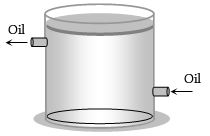
- 2The top of insulated cylindrical container is covered by a disc having emissivity $0.6$ and thickness $1\, cm$. The temperature is maintained by circulating oil as shown in figure. If temperature of upper surface of disc is $127^o C$ and temperature of surrounding is $27^o C$, then the radiation loss to the surroundings will be (Take $\sigma = \frac{{17}}{3} \times {10^{ - 8}}W/{m^2}{K^4})$View Solution
- 3View SolutionWoollen clothes are used in winter season because woolen clothes
- 4View SolutionA piece of blue glass heated to a high temperature and a piece of red glass at room temperature, are taken inside a dimly lit room then
- 5Two walls of thicknesses $d_1$ and $d_2$ and thermal conductivities $k_1$ and $k_2$ are in contact. In the steady state, if the temperatures at the outer surfaces are ${T_1}$ and ${T_2}$, the temperature at the common wall isView Solution
- 6Distance between sun and Earth is $2 \times 10^{8}\, km ,$ temperature of sun $6000\, K ,$ radius of sun $7 \times 10^{5}\, km .$ If emmisivity of the earth is $0.6,$ find out the temperature of the earth in thermal equilibrium (in $k$)View Solution
- 7The rate of radiation of a black body at $0°C$ is $E\,J/sec$ . The rate of radiation of this black body at ${273^o}C$ will beView Solution
- 8A black body at a temperature of $1640 K$ has the wavelength corresponding to maximum emission equal to $1.75$ $\mu $. Assuming the moon to be a perfectly black body, the temperature of the moon, if the wavelength corresponding to maximum emission is $ 14.35$ $\mu $ is ...... $K$View Solution
- 9A black body at $200 K$ is found to exit maximum energy at a wavelength of $14\mu m$. When its temperature is raised to $1000K$ , the wavelength at which maximum energy is emitted isView Solution
- 10View SolutionColour of shining bright star is an indication of its