Question
Select the correct statement about electric charge

Answer

(c)

Quantization of charge.

Need a full question paper?

Generate a complete, print-ready paper with questions like this in minutes — across 16+ boards, with answer keys.
Start Generating Free

Similar questions

A spherical body of mass $2\,kg$ starting from rest acquires a kinetic energy of $10000\,J$ at the end of $5^{\text {th }}$ second. The force acted on the body is $.....N$
When light of wavelength $\lambda $ is incident on an equilateral prism kept in its minimum deviation position, it is found that the angle of deviation equals the angle of the prism itself. The refractive index of the material of the prism for the wavelength $\lambda $ is, then
Which one of the following is a possible nuclear reaction
A man of mass $m$ starts falling towards a planet of mass $M$ and radius $R.$ As he reaches near to the surface, he realizes that he will pass through a small hole in the planet. As he enters the hole, he sees that the planet is really made of two pieces a spherical shell of negligible thickness of mass $\frac{2M}{3}$ and a point  mass $\frac{M}{3}$ at the centre. Change in the force of gravity experienced by the man is
Find the equivalent capacitance of the circuit between point $A$ and $B$.
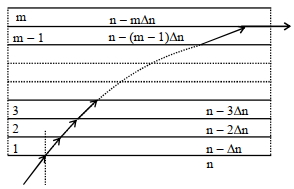
A monochromatic light is travelling in a medium of refractive index $n=1.6$. It enters a stack of glass layers from the bottom side at an angle $\theta=30^{\circ}$. The interfaces of the glass layers are parallel to each other. The refractive indices of different glass layers are monotonically decreasing as $n_m=n-m / n$, where $n_m$ is the

refractive index of the $\mathrm{m}^{\text {th }}$ slab and $\Delta \mathrm{n}=0.1$ (see the figure). The ray is refracted out parallel to the interface between the $(m-1)^{\text {th }}$ and $m^{\text {th }}$ slabs from the right side of the stack. What is the value of $m$ ?

(IMAGE)
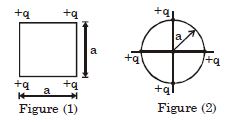
Consider the configuration of a system of four charges each of value $+q$ . The work done by external agent in changing the configuration of the system from figure $(1)$ to figure $(2)$ is 
Consider the following statements. The total energy of a particle executing simple harmonic motion depends on its

$(1)$ Amplitude      $(2) $ Period         $(3)$ Displacement

Of these statements
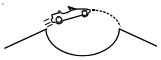
A stunt man jumps his car over a crater as shown (neglect air resistance)
An artificial satellite moving in a circular orbit around the earth has a total (kinetic + potential) energy ${E_0}$. Its potential energy is