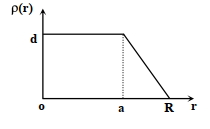
The nuclear charge $(\mathrm{Ze})$ is non-uniformly distributed within a nucleus of radius $R$. The charge density $\rho$ (r) [charge per unit volume] is dependent only on the radial distance $r$ from the centre of the nucleus as shown in figure The electric field is only along rhe radial direction.
Figure:$Image$
$1.$ The electric field at $\mathrm{r}=\mathrm{R}$ is
$(A)$ independent of a
$(B)$ directly proportional to a
$(C)$ directly proportional to $\mathrm{a}^2$
$(D)$ inversely proportional to a
$2.$ For $a=0$, the value of $d$ (maximum value of $\rho$ as shown in the figure) is
$(A)$ $\frac{3 Z e}{4 \pi R^3}$ $(B)$ $\frac{3 Z e}{\pi R^3}$ $(C)$ $\frac{4 Z e}{3 \pi R^3}$ $(D)$ $\frac{\mathrm{Ze}}{3 \pi \mathrm{R}^3}$
$3.$ The electric field within the nucleus is generally observed to be linearly dependent on $\mathrm{r}$. This implies.
$(A)$ $a=0$ $(B)$ $\mathrm{a}=\frac{\mathrm{R}}{2}$ $(C)$ $a=R$ $(D)$ $a=\frac{2 R}{3}$
Give the answer question $1,2$ and $3.$