MCQ
Select the correct statement among following
  • A
    Number of chiral atom in $\alpha$ -$D$ - glucose is less than $D$ - glucose
  • B
    $D$ - glucose and $D$ - fructose give same product with $HIO_4$
  • C
    $D$ - glucose and $D$ - fructose give same product with $H_2NOH$
  • $D$ - glucose and $D$ - fructose form same product with $H_2N-NH-Ph$

Answer

Correct option: D.
$D$ - glucose and $D$ - fructose form same product with $H_2N-NH-Ph$
d

Need a full question paper?

Generate a complete, print-ready paper with questions like this in minutes — across 16+ boards, with answer keys.

Start Generating Free

Similar questions

Amongst $FeCl _{3} \cdot 3 H _{2} O , \quad K _{3}\left[ Fe ( CN )_{6}\right]$ and $\left[ Co \left( NH _{3}\right)_{6}\right] Cl _{3}$, the spin-only magnetic moment value of the inner-orbital complex that absorbs light at shortest wavelength is $B.M.\,......$ [nearest integer]
Which of the following is invert sugar
The metal capable of gaining as well as losing an electron is:
Least chemical activity is shown by
A trinitro compound, $1, 3,5$ tris-($4$-nitrophenyl) benzene, on complete reaction with an excess of $\mathrm{Sn} / \mathrm{HCl}$ gives major product, which on treatment with an excess of $NaNO_2 /  HCl$ at $0^{\circ} C$ provides $P$ as the product. $P$, upon treatment with excess of $H_2 O$ at room temperature, gives the product $Q$. Bromination of $Q$ in aqueous medium furnishes the product $R$. The compound $P$ upon treatment with an excess of phenol under basic conditions gives the product $S$.

The molar mass difference between compounds $Q$ and $R$ is $474 \mathrm{~mol}^{-1}$ and between compounds $P$ and $S$ is $172.5 \mathrm{~g} \mathrm{~mol}^{-1}$.

($1$)The number of heteroatoms present in one molecule of $R$ is. . . . .  .

[Use: Molar mass (in g mol ${ }^{-1}$ ): $\mathrm{H}=1, \mathrm{C}=12, \mathrm{~N}=14, \mathrm{O}=16, \mathrm{Br}=80, \mathrm{Cl}=35.5$

Atoms other than $\mathrm{C}$ and $\mathrm{H}$ are considered as heteroatoms]

($2$)The total number of carbon atoms and heteroatoms present in one molecule of $S$. . . . . .

[Use: Molar mass in $\mathrm{g} \mathrm{mol}^{-1}$ ]: $\mathrm{H}=1, \mathrm{C}=12, \mathrm{~N}=14, \mathrm{O}=16, \mathrm{Br}=80, \mathrm{Cl}=35.5$

Atoms other than $\mathrm{C}$ and $\mathrm{H}$ are considered as heteroatoms

Give the answer quetion ($1$) and ($2$)
One mole of the complex compound $Co(NH_3)_5Cl_3,$ gives $3$ moles of ions on dissolution in water. One mole of the same complex reacts with two moles of $AgNO_3$ solution to yield two moles of $AgCl(s).$ The structure of the complex is :-
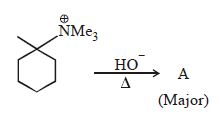
Major product $A$ is 
${K_2}C{r_2}{O_7}$ on heating with aqueous $NaOH$ gives
$RMgX\xrightarrow{{\begin{array}{*{20}{c}}
  O \\ 
  {||} \\ 
  {H - C - H} 
\end{array}}}$ $\begin{array}{*{20}{c}}
  {C{H_3} - CH - C{H_2} - OH} \\ 
  {|\,\,\,\,\,\,\,\,\,\,\,\,\,\,\,\,\,\,\,\,\,} \\ 
  {C{H_3}\,\,\,\,\,\,\,\,\,\,\,\,\,\,\,} 
\end{array}$ Find out $R$ in this reaction
Molecular formula of ethanol is?