MCQ
Select the right option in the following
  • A
    Christian Huygens a contemporary of Newton established the wave theory of light by assuming that light waves were transverse
  • Maxwell provided the compelling theoretical evidence that light is transverse wave
  • C
    Thomas Young experimentally proved the wave behaviour of light and Huygens assumption
  • D
    All the statements give above, correctly answers the question “what is light”

Answer

Correct option: B.
Maxwell provided the compelling theoretical evidence that light is transverse wave
b
In Huygen's principle the wave theory was established by assuming that the waves were longitudinal. So, option $(A)$ is wrong.

In Maxwell's theory of light, he stated that light is a transverse wave and conducted multiple experiments to prove so. So, option $(B)$ is correct.

Thomas Young conducted his double slit experiment and tried to prove the wave nature of light by proving that light undergoes interference which is a phenomenon showed by waves. He never proved the type of wave light is, i.e transverse or longitudinal. So, option $(C)$ is wrong.

These statements mostly highlight the wave nature of light. They do not comment on the particle nature of light or the dual nature of light established. Hence, they clearly do not answer the question "what is light" correctly. So, option $(D)$ is also wrong.
Need a full question paper?

Generate a complete, print-ready paper with questions like this in minutes — across 16+ boards, with answer keys.

Start Generating Free

Similar questions

A small current element of length $d \ell$ and carrying current is placed at $(1,1,0)$ and is carrying current in ' $+ z$ ' direction. If magnetic field at origin be $\overrightarrow{ B }_1$ and at point $(2,2,0)$ be $\overrightarrow{ B }_2$ then
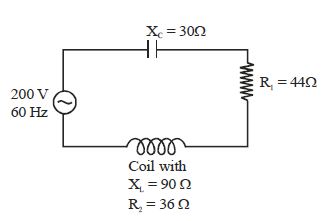
As given in the figure, a series circuit connected across a $200\, V$, $60\, Hz$ line consists of a capacitor of capacitive reactance $30\,\Omega $, a non-inductive resistor of $44\,\Omega $, and a coil of inductive reactance $90\,\Omega $ and resistance $36\,\Omega $. The power dissipated in the coil is......$W$
Two identical coaxial circular loops carry current $i$ each circulating in the clockwise direction. If the loops are approaching each other, then
The sensitiveness of a moving coil galvanometer can be increased by decreasing
Six protons and six neutrons are brought together to form a carbon nucleus, but the mass of the carbon nucleus is less than the sum of the masses of the individual particles due to the mass defect, This deducted mass has been:
A bubble in glass slab $(\mu = 1.5)$ when viewed from one side appears at $5\ cm$ and $2\ cm$ from other side, then thickness of slab is....$cm$
An inductor-coil carries a steedy-state current of $2.0\, A$ when connected across an ideal battery of $emf$ $4.0\, V$. If its inductance is $1.0\, H$, find the time constant of the circuit.....$sec$
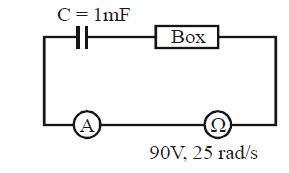
In the circuit shown, power factor of circuit is $1$ and power factor of box is $\frac{3}{5}$. Find reading of ammeter....$A$
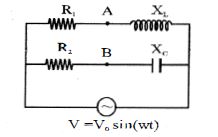
In a parallel $AC$ circuit with $R_1 = R_1 = R$ and $X_L = X_C = X$ . An $AC$ source is connected across the circuit as shown in figure. The $RMS$ value of potential difference $V_A - V_B$ will be
The length of a metallic wire is increased by $20 \%$ and its area of cross section is reduced by $4 \%$. The percentage change in resistance of the metallic wire is $.......$