Question
$SF_6$ is known but $SCl_6$ is not. Why?

Answer

Due to small size, six fluorine atoms can be accommodated around sulphur atom while chlorine atoms being larger in size are difficult to accommodate.
The other reason is that the fluorine being highly electronegative and oxidising in nature is capable of unpairing the paired orbitals of the values shell of sulphur atom and thereby showing the highest, oxidation state of $+6$ while chlorine is not able to do this.

Need a full question paper?

Generate a complete, print-ready paper with questions like this in minutes — across 16+ boards, with answer keys.

Start Generating Free

Similar questions

How would you bring about the following conversions?
i. Propanal to butanone
ii. Benzaldehyde to benzophenone
iii. Benzoyl chloride to benzonitrile
Explain the following items:
Biocatalysts.

Match the example given in Column I with the name of the reaction in Column II.
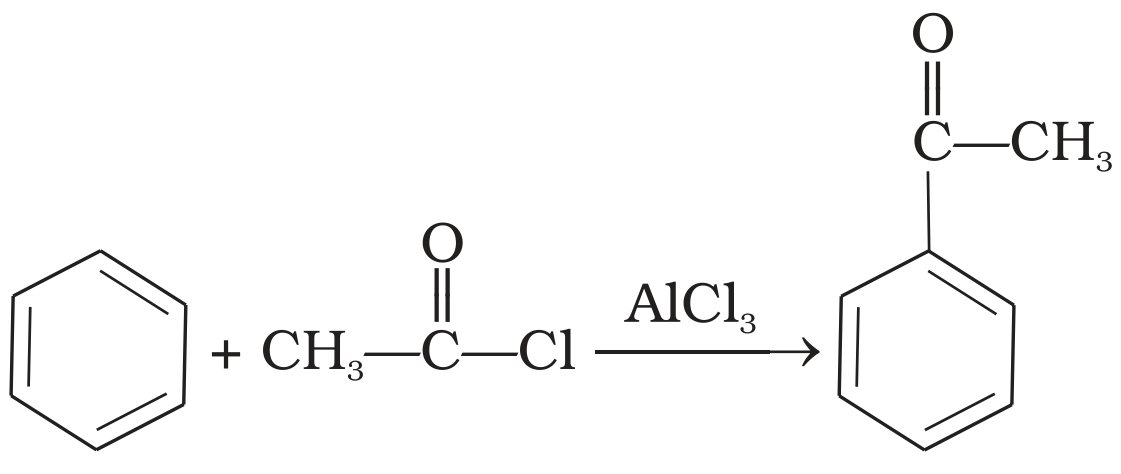
  Column I (Example)   Column II (Reaction)
(i) $\ \ \ \ \ \ \ \ \ \ \ \ \ \text{O}\ \ \ \ \ \ \ \ \ \ \ \ \ \ \ \ \ \ \ \ \ \ \ \ \ \ \ \ \ \ \ \ \ \ \ \ \ \ \ \ \ \ \ \ \ \ \ \ \ \ \ \text{O}\\ \ \ \ \ \ \ \ \ \ \ \ \ \ || \ \ \ \ \ \ \ \ \ \ \ \ \ \ \ \ \ \ \ \ \ \ \ \ \ \ \ \ \ \ \ \ \ \ \ \ \ \ \ \ \ \ \ \ \ \ \ \ \ \ \ \ ||\\\text{CH}_3-\text{C}-\text{Cl}+\text{H}_2\xrightarrow{\text{Pd-C/BaSO}_4}\text{CH}_3-\text{C}-\text{H}$ (a) Friedel Crafts acylation
(ii) (b) HVZ reaction
(iii) (c) Aldol condensation
(iv) $\text{R}-\text{CH}_2-\text{COOH}\xrightarrow{\text{Br}_2/\text{Red}\ \text{P}}\text{R}-\text{CH}-\text{COOH}\\ \ \ \ \ \ \ \ \ \ \ \ \ \ \ \ \ \ \ \ \ \ \ \ \ \ \ \ \ \ \ \ \ \ \ \ \ \ \ \ \ \ \ \ \ \ \ \ \ \ \ \ \ \ \ \ \ \ \ \ \ \ \ \ \ \ \ \ |\\\ \ \ \ \ \ \ \ \ \ \ \ \ \ \ \ \ \ \ \ \ \ \ \ \ \ \ \ \ \ \ \ \ \ \ \ \ \ \ \ \ \ \ \ \ \ \ \ \ \ \ \ \ \ \ \ \ \ \ \ \ \ \ \ \ \ ^\text{Br}$ (d) Cannizaro’s reaction
(v) $\text{CH}_3-\text{CN}\xrightarrow[\text{(ii)}\ \text{H}_2\text{O}/\text{H}^+]{\text{(i)}\ \text{SnCl}_2/\ \text{HCl}}\text{CH}_3\text{CHO}$ (e) Rosenmund’s reduction
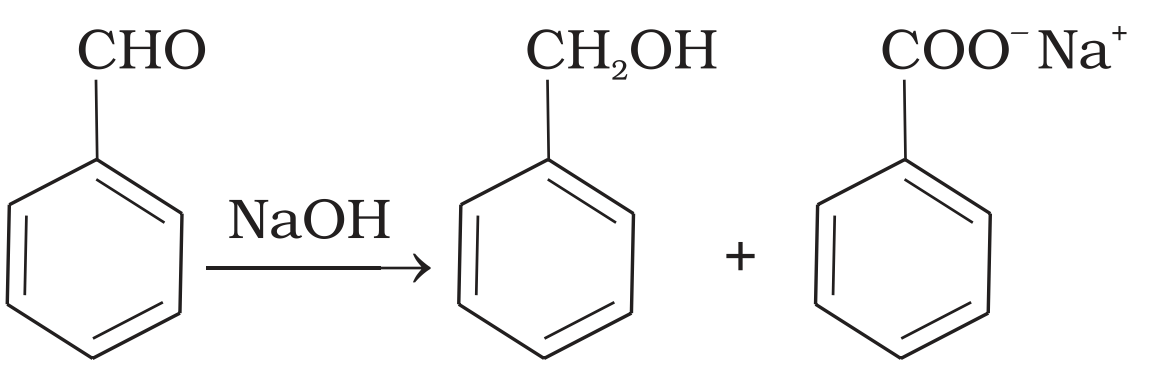
(vi) $2\text{CH}_3\text{CHO}\xrightarrow{\text{NaOH}}\text{CH}_3-\text{CH}=\text{CH}=\text{CHCHO}$ (f) Stephen’s reaction
Write only equations to obtain 1º, 2º and 3° alcohols from aldehydes and ketones.
A certain reaction is $50 \%$ complete in $20$ minutes at $300$ K and the same reaction is again $50 \%$ complete in 5 minutes at 350 K . Calculate the activation energy if it is a first order reaction.
$\left[\mathrm{R}=8.314 \mathrm{~J} \mathrm{~K}^{-1} \mathrm{~mol}^{-1} ; \log 4=0.602\right]$
The conductivity of $0.001028 \mathrm{~mol} \mathrm{~L}^{-1}$ acetic acid is $4.95 \times 10^{-5} \mathrm{~S} \mathrm{~cm}^{-1}$. Calculate its dissociation constant $\Lambda_{\mathrm{m}}^{\circ}$ if for acetic acid is $390.5 \mathrm{~S} \mathrm{~cm}^2 \mathrm{~mol}^{-1}$.
E° values of Mn, Ni and Zn are more negative than expected.
  1. Which one of the following is a disaccharide: Starch, Maltose, Fructose, Glucose?
  2. What is the difference between fibrous protein and globular protein?
  3. Write the name of vitamin whose deficiency causes bone deformities in children.
  1. Differentiate between adsorbtion and absorption.
  2. Out of $MgCl_2$ and $AlCl_3,$ which one is more effective in causing coagulation of negatively charged sol and why?
  3. Out of sulphur sol and proteins, which one forms multimolecular colloids?
State Raoult’s law for a solution containing volatile components. How does Raoult’s law become a special case of Henry’s law?