Question
Shobhit's father wants to construct a rectangular garden using a brick wall on one side of the garden and wire fencing for the other three sides as shown in figure. He has 200 ft of wire fencing.
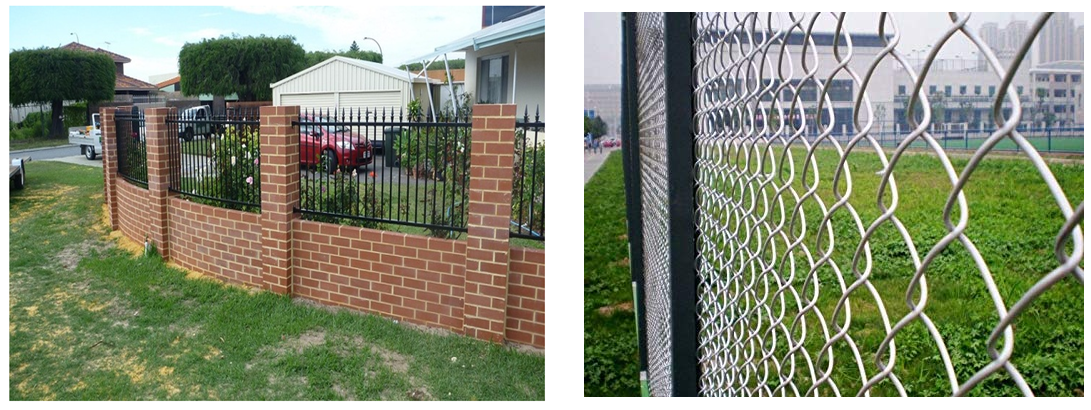
Based on the above information, answer the following questions.
  1. To construct a garden using 200 ft of fencing, we need to maximise its.
  1. Volume
  2. Area
  3. Perimeter
  4. Length of the side
  1. If x denote the length of side of garden perpendicular to brick wall and y denote the length of side parallel to brick wall, then find the relation representing total amount of fencing wire.
  1. x + 2y = 150
  2. x + 2y = 50
  3. y + 2x = 200
  4. y + 2x = 100
  1. Area of the garden as a function of x, say A(x), can be represented as.
  1. 200 + 2x2
  2. x - 2x2
  3. 200x - 2x2
  4. 200 - x2
  1. Maximum value of A(x) occurs at x equals.
  1. 50 ft
  2. 30 ft
  3. 26 ft
  4. 31 ft
  1. Maxi mum area of garden will be.
  1. 2500 sq. ft
  2. 4000 sq. ft
  3. 5000 sq. ft
  4. 6000 sq. ft

Answer

  1. (b) Area

Solution:

To create a garden using 200 ft fencing, we need to maximise its area.

  1. (c) y + 2x = 200

Solution:

Required relation is given by 2x + y = 200.

  1. (c) 200x - 2x2

Solution:

Area of garden as a function of x can be rep resented as 

A(x) = x·y = x(200 - 2x) = 200x - 2x2

  1. (a) 50 ft

Solution:

A(x) = 200x - 2x2 ⇒ A'(x) = 200 - 4x

For the area to be maximum A'(x) = 0

⇒ 200 - 4x =0

⇒ x = 50 ft

  1. (c) 5000 sq. ft

Solution:

Maximum area of the garden = 200(50) - 2(50)2 = 10000 - 5000 = 5000 sq. ft

Need a full question paper?

Generate a complete, print-ready paper with questions like this in minutes — across 16+ boards, with answer keys.

Start Generating Free

Similar questions

Corner points of the feasible region for an LPP are (0, 3), (5, 0), (6, 8), (0, 8). Let Z = 4x - 6y be the objective function.

Based on the above information, answer the following questions.

  1. The minimum value of Z occurs at:
  1. (6, 8)
  2. (5, 0)
  3. (0, 3)
  4. (0, 8)
  1. Maximum value of Z occurs at:
  1. (5, 0)
  2. (0, 8)
  3. (0, 3)
  4. (6, 8)
  1. Maximum of Z - Minimum of Z =
  1. 58
  2. 68
  3. 78
  4. 88
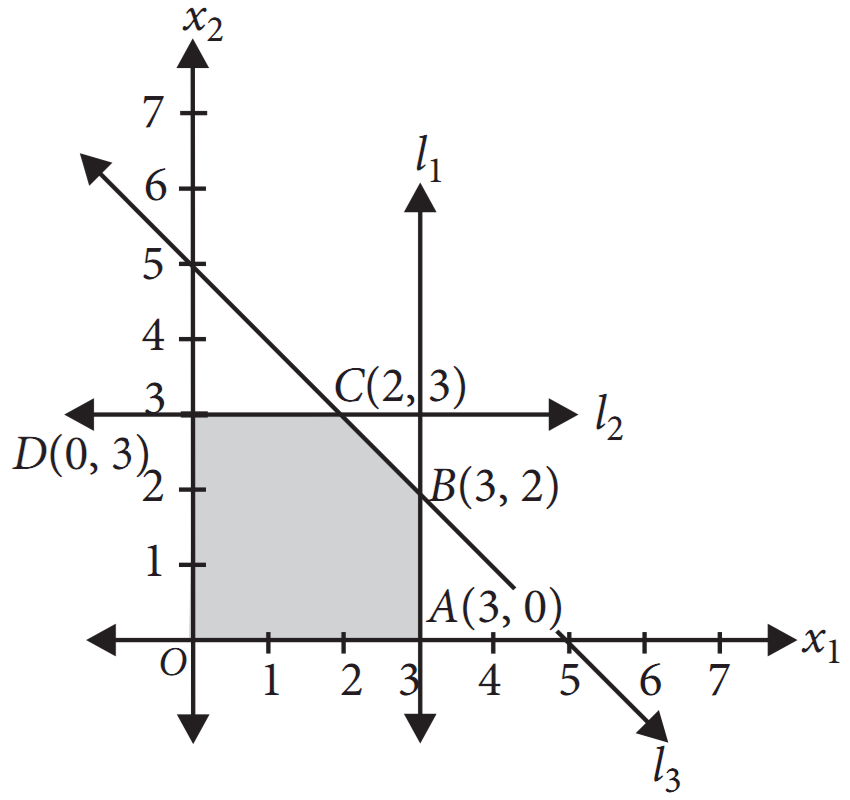
  1. The corner points of the feasible region determined by the system of linear inequalities are:

  1. (0, 0), (-3, 0), (3, 2). (2, 3)
  2. (3, 0), (3, 2), (2, 3), (0, -3)
  3. (0, 0), (3, 0), (3, 2), (2, 3), (0, 3)
  4. None of these
  1. The feasible solution of LPP belongs to:
  1. First and second quadrant.
  2. First and third quadrant.
  3. Only second quadrant.
  4. Only first quadrant.
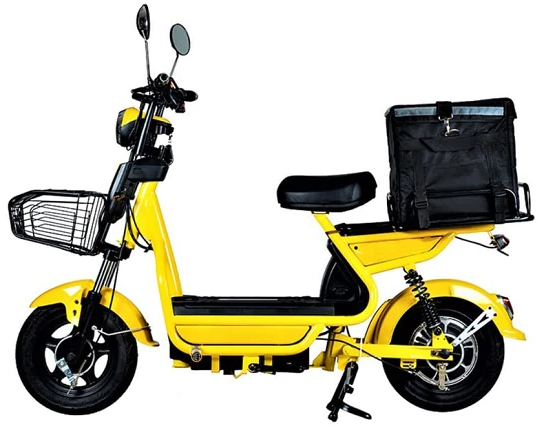
An owner of an electric bike rental company have determined that if they charge customers ₹ x per day to rent a bike, where 50 < x < 200, then number of bikes (n), they rent per day can be shown by linear function n(x) = 2000 - 10x. If they charge ₹ 50 per day or less, they will rent all their bikes. If they charge ₹ 200 or more per day, they will not rent any bike.

Based on the above information, answer the following questions.
  1. Total revenue R as a function of x can be represented as.
  1. 2000x - 10x2
  2. 2000x + 10x2
  3. 2000 - 10x
  4. 2000 - 5x2
  1. If R(x) denote the revenue, then maximum value of R(x) occur when x equals.
  1. 10
  2. 100
  3. 1000
  4. 50
  1. At x = 260, the revenue collected by the company is.
  1. ₹ 10
  2. ₹ 500
  3. ₹ 0
  4. ₹ 1000
  1. The number of bikes rented per day, if x = 105 is.
  1. 850
  2. 900
  3. 950
  4. 1000
  1. Maximum revenue collected by company is.
  1. ₹ 40,000
  2. ₹ 50,000
  3. ₹ 75,000
  4. ₹ 1,00,000
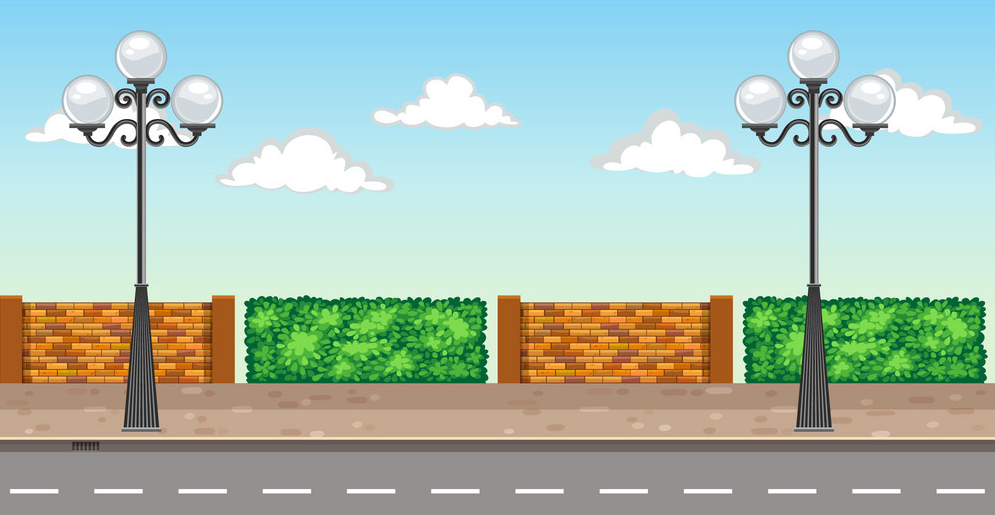
In a street, two lamp posts are 600 feet apart. The light intensity at a distanced from the first (stronger) lamp post is $\frac{1000}{\text{d}^2}$ the light intensity at distance d from the second (weaker) lamp post is $\frac{125}{\text{d}^2}$ (in both cases the light intensity is inversely proportional to the square of the distance to the light source). The combined light intensity is the sum of the two light intensities coming from both lamp posts.

Based on the above information, answer the following questions.
  1. If you are in between the lamp posts, at distance x feet from the stronger tight, then the formula for the combined light intensity coming from both lamp posts as function of x, is
  1. $\frac{1000}{\text{x}^2}+\frac{125}{\text{x}^2}$
  2. $\frac{1000}{\big(600-\text{x}^2\big)}+\frac{125}{\text{x}^2}$
  3. $\frac{1000}{\text{x}^2}+\frac{125}{\big(600-\text{x}^2\big)}$
  4. $\text{None of these}$
  1. The maximum value of x can not be.
  1. 100
  2. 200
  3. 600
  4. None of these
  1. The minimum value of x can not be.
  1. 0
  2. 100
  3. 200
  4. None of these
  1. If l(x) denote the combined tight intensity, then l(x) will be minimum when x =
  1. 200
  2. 400
  3. 600
  4. 800
  1. The darkest spot between the two lights is.
  1. At a distance of 200 feet from the weaker lamp post.
  2. At distance of 200 feet from the stronger lamp post.
  3. At a distance of 400 feet from the weaker lamp post.
  4. None of these
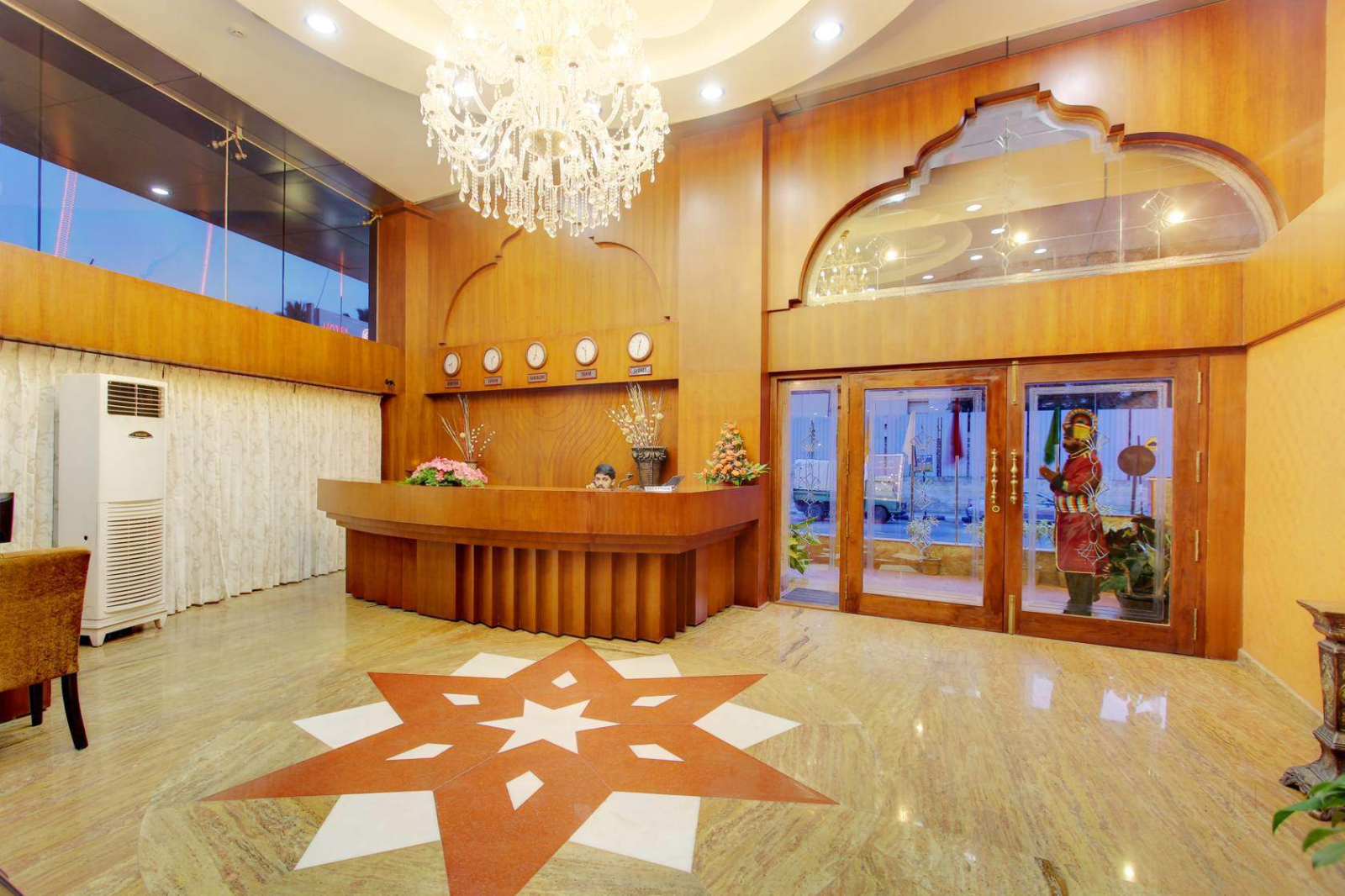
Suppose the floor of a hotel is made up of mirror polished Kota stone. Also, there is a large crystal chandelier attached at the ceiling of the hotel. Consider the floor of the hotel as a plane having equation x - 2y + 2z = 3 and crystal chandelier at the point (3, -2, 1).

Based on the above information, answer the following questions.
  1. The d.r'.s of the perpendicular from the point (3, -2, 1) to the plane x - 2y + 2z = 3, is:
  1. < 1, 2, 2 >
  2. < 1, -2, 2 >
  3. < 2, 1, 2 >
  4. < 2, -1, 2 >
  1. The length of the perpendicular from the point (3, -2, 1) to the plane x - 2y + 2z = 3, is:
  1. $\frac{2}{3}\text{units}$
  2. 3 units
  3. 2 units
  4. None of these
  1. The equation of the perpendicular from the point (3, -2, 1) to the plane x - 2y + 2z = 3, is:
  1. $\frac{\text{x}-3}{1}=\frac{\text{y}-2}{-2}=\frac{\text{z}-1}{2}$

  2. $\frac{\text{x}-3}{1}=\frac{\text{y}+2}{-2}=\frac{\text{z}-1}{2}$

  3. $\frac{\text{x}+3}{1}=\frac{\text{y}+2}{-2}=\frac{\text{z}-1}{2}$

  4. None of these
  1. The equation of plane parallel to the plane x - 2y + 2z = 3, which is at a unit distance from the point (3, -2, 1) is:
  1. x - 2y + 2z = 0
  2. x - 2y + 2z = 6
  3. x - 2y + 2z = 12
  4. Both (b) and (c)
  1. The image of the point (3, -2, 1) in the given plane is:
  1. $\Big(\frac{5}{3},\frac{2}{3},\frac{-5}{3}\Big)$

  2. $\Big(\frac{-5}{3},\frac{-2}{3},\frac{5}{3}\Big)$

  3. $\Big(\frac{-5}{3},\frac{2}{3},\frac{5}{3}\Big)$

  4. None of these
On her birthday, Seema decided to donate some money to the children of an orphanage home. If there were 8 children less, everyone would have got $₹ 10$ more. However, if there were 16 children more, everyone would have got ₹10 less. Let the number of children be $\mathrm{x}$ and the amount distributed by Seema for one child be y (in ₹)

Image

(i) Represent given information in matrix algebra.

(ii) Find the adjoint of Matrix containing information about of number of children and amount she paid?

(iii) Find the number of children who were given some money by Seema?

OR

How much amount does Seema spend in distributing the money to all the students of the Orphanage?

A relation R on a set A is said to be an equivalence relation on A iff it is:
  1. Reflexive i.e., $(\text{a, a})\in\ \text{R} \ \forall \ \text{a}\in\text{A}.$
  2. Symmetric i.e., $(\text{a, b})\in\ \text{R} \Rightarrow \text{(b, a) } \in\text{R}\ \forall \ \text{a, b}\in\text{A}.$
  3. Transitive i.e., $(\text{a, b})\in\ \text{R} \ \text{and}\ \text{(b, c) } \in\text{R}\Rightarrow\text{(a, c)}\in\text{R}\ \forall \ \text{a, b, c}\in\text{A}.$
Based on the above information, answer the following questions.
  1. If the relation R = {(1, 1), (1, 2), (1, 3), (2, 2), (2, 3), (3, 1), (3, 2), (3, 3)} defined on the set A = {1, 2, 3}, then R is:
  1. Reflexive
  2. Symmetric
  3. Transitive
  4. Equivalence
  1. If the relation R = {(1, 2), (2, 1), (1, 3), (3, 1)} defined on the set A = {1, 2, 3}, then R is:
  1. Reflexive
  2. Symmetric
  3. Transitive
  4. Equivalence
  1. If the relation R on the set N of all natural numbers defined as R = {(x, y): y = x + 5 and x < 4}, then R is:
  1. Reflexive
  2. Symmetric
  3. Transitive
  4. Equivalence
  1. If the relation R on the set A = {1, 2, 3, ........., 13, 14} defined as R = {(x, y): 3x - y = O}, then R is:
  1. Reflexive
  2. Symmetric
  3. Transitive
  4. Equivalence
  1. If the relation R on the set A = {I, 2, 3} defined as R = {(1, 1), (1, 2), (1, 3), (2, 1), (2, 2), (2, 3), (3, 1), (3, 2), (3, 3)}, then R is:
  1. Reflexive only
  2. Symmetric only
  3. Transitive only
  4. Equivalence
Suman was doing a project on a school survey, on the average number of hours spent on study by students selected at random. At the end of survey, Suman prepared the following report related to the data. Let X denotes the average number of hours spent on study by students. The probability that X can take the values x, has the following form, where k is some unknown constant.

$\text{P(X}=\text{x})\begin{cases}0.2,\text{if x}= 0\\\text{kx},\text{if}\text{ x}=1\text{ or }2\\\text{k}(6-\text{x}),\text{if}\text{ x}=3\text{ or }4\\0,\text{odherwise}\end{cases}$

Based on the above information, answer the following questions.

  1. Find the value of k.
  1. 0.1
  2. 0.2
  3. 0.3
  4. 0.05
  1. What is the probability that the average study time of students is not more than 1 hour?
  1. 0.4
  2. 0.3
  3. 0.5
  4. 0.1
  1. What is the probability that the average study time of students is at least 3 hours?
  1. 0.5
  2. 0.9
  3. 0.8
  4. 0.1
  1. What is the probability that the average study time of students is exactly 2 hours?
  1. 0.4
  2. 0.5
  3. 0.7
  4. 0.2
  1. What is the probability that the average study time of students is at least 1 hour?
  1. 0.2
  2. 0.4
  3. 0.8
  4. 0.6 
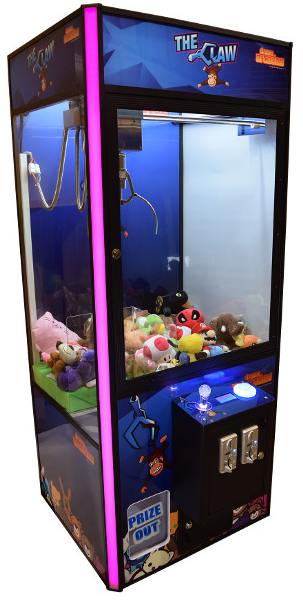
In a play zone, Aastha is playing crane game. It has 12 blue balls, 8 red balls, 10 yellow balls and 5 green balls. If Aastha draws two balls one after the other without replacement, then answer the following questions.

  1. What is the probability that the first ball is blue and the second ball is green?
  1. $\frac{5}{119}$

  2. $\frac{12}{119}$

  3. $\frac{6}{119}$

  4. $\frac{15}{119}$

  1. What is the probability that the first ball is yellow and the second ball is red?
  1. $\frac{16}{119}$

  2. $\frac{8}{119}$

  3. $\frac{24}{119}$

  4. None of these.

  1. What is the probability that both the balls are red?
  1. $\frac{4}{85}$

  2. $\frac{24}{595}$

  3. $\frac{12}{119}$

  4. $\frac{64}{119}$

  1. What is the probability that the first ball is green and the second ball is not yellow?
  1. $\frac{10}{119}$

  2. $\frac{6}{85}$

  3. $\frac{12}{119}$

  4. None of these.

  1. What is the probability that both the balls are not blue?
  1. $\frac{6}{595}$
  2. $\frac{12}{85}$

  3. $\frac{15}{17}$

  4. $\frac{253}{595}$
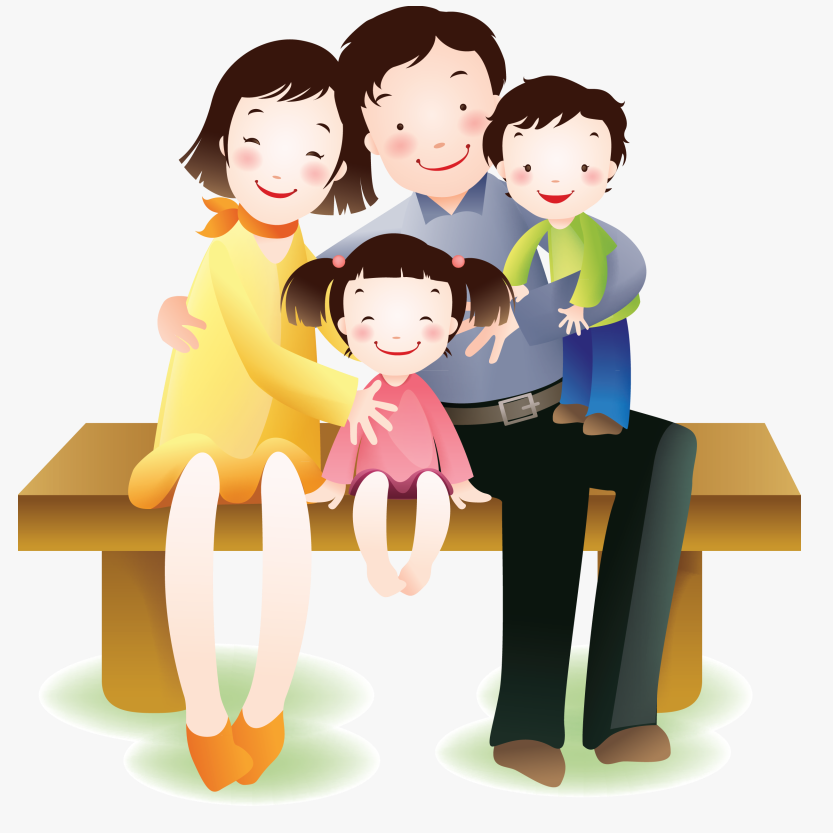
 In a wedding ceremony, consists of father, mother, daughter and son line up at random for a family photograph, as shown in figure.

Based on the above information, answer the following questions.

  1. Find the probability that daughter is at one end, given that father and mother are in the middle.
  1. $1$

  2. $\frac{1}{2}$

  3. $\frac{1}{3}$

  4. $\frac{2}{3}$
  1. Find the probability that mother is at right end, given that son and daughter are together.
  1. $\frac{1}{2}$

  2. $\frac{1}{3}$

  3. $\frac{1}{4}$

  4. $0$
  1. Find the probability that father and mother are in the middle, given that son is at right end.
  1. $\frac{1}{4}$

  2. $\frac{1}{2}$

  3. $\frac{1}{3}$

  4. $\frac{2}{3}$

  1. Find the probability that father and son are standing together, given that mother and daughter are standing together.
  1. $0$

  2. $1$

  3. $\frac{1}{2}$

  4. $\frac{2}{3}$

  1. Find the probability that father and mother are on either of the ends, given that son is at second position from the right end.
  1. $\frac{1}{3}$

  2. $\frac{2}{3}$

  3. $\frac{1}{4}$

  4. $\frac{2}{5}$  

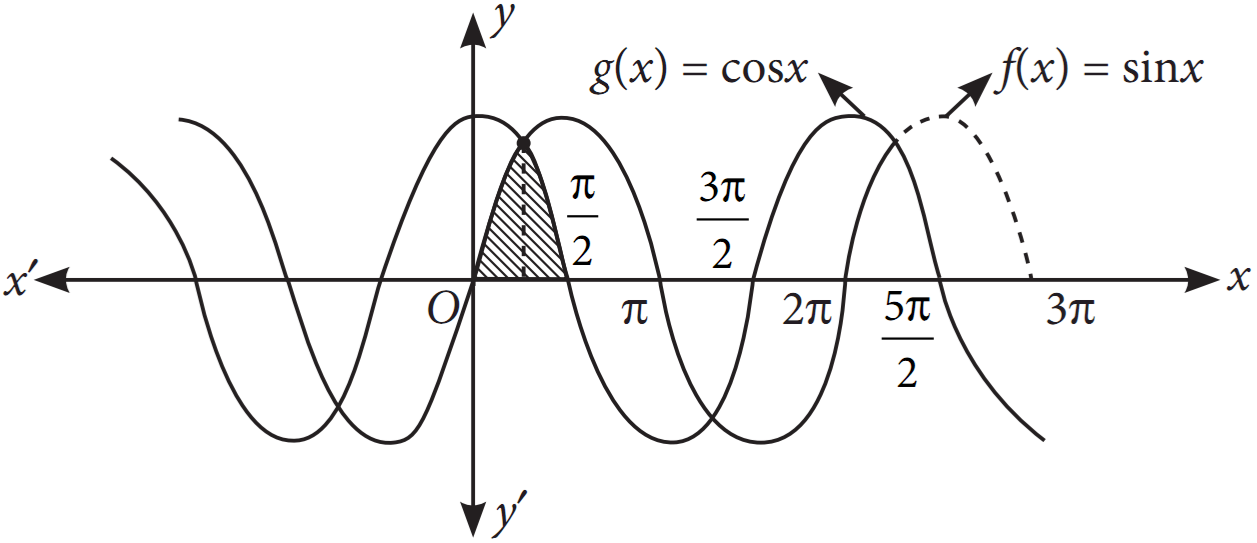
Graphs of two function $\text{f}(\text{x})=\text{sin}\text{ x}$ and $\text{(g)}\text{x}=\text{cos}\text{ x}$ is given below:

Based on the above information, answer the following questions.
  1. In $(0, \pi)$, the curves $\text{f}(\text{x})=\text{sin}\text{ x}$ and $\text{g}\text{ (x)}=\text{cos}\text{ x}$ at $\text{x}=$ 
    1. $\frac{\pi}{2}$
    2. $\frac{\pi}{3}$
    3. $\frac{\pi}{4}$
    4. ${\pi}$
  2. Value of $\int\limits_{0}^{\frac{\pi}{4}}\text{sin}\text{ x}\text{ dx}$ is.
    1. $1-\frac{1}{\sqrt{2}}$
    2. $1+\frac{1}{\sqrt{2}}$
    3. $2-\frac{1}{\sqrt{2}}$
    4. $2+\frac{1}{\sqrt{2}}$
  1. Value of $\int\limits_\frac{\pi}{4}^{\frac{\pi}{2}}\text{cos}\text{ x}\text{ dx}$ is.
    1. $1+\frac{1}{\sqrt{2}}$
    2. $1-\frac{1}{\sqrt{2}}$
    3. $2-\sqrt{2}$
    4. $2+\sqrt{2}$
  2. Value of $\int\limits_{0}^{\pi}\text{sin}\text{ x}\text{ dx}$ is.
  1. 0
  2. 1
  3. 2
  4. -2
  1. Value of $\int\limits_{0}^\frac{\pi}{2}\text{sin}\text{ x}\text{ dx}$ is.
  1. 0
  2. 1
  3. 3
  4. 4