Question
Short note on: Maltose

Answer

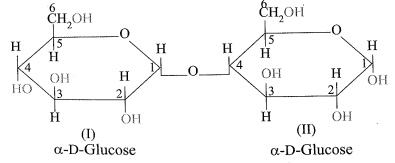
$\rightarrow$ Maltose is composed of two $a-D-$glucose.
$\rightarrow$
Image
$\rightarrow$ In maltose $C_1$ of one glucose $(I)$ is linked to $C_4$ of another glucose unit $(II).$
$\rightarrow$ The free aldehyde group can be produced at $C_1$ of second glucose in solution and it shows reducing properties so, it is a reducing sugar.
Image

Need a full question paper?

Generate a complete, print-ready paper with questions like this in minutes — across 16+ boards, with answer keys.

Start Generating Free

Similar questions

  1. Describe the following giving suitable examples:
  1. Cannizzaro reaction.
  2. Aldol condensation.
  1. Give a chemical test to distinguish between ethanal and propanal.
'Stability of a crystal is reflected in the magnitude of its melting points'. Comment. Collect melting points of solid water, ethyl alcohol, diethyl ether and methane from a data book. What can you say about the intermolecular forces between these molecules?
Write chemical reaction to affect the following transformation.
(ii) Acetone to propane
What is carbonyl group? Give information about the functional groups containing carbonyl group with their structures.
Why is it advantageous to roast a sulphide ore to the oxide before reduction?
How would you account for the following situations?
  1. The transition metals generally form coloured compounds.
  2. With $3d^4$​​​​​​​ configuration, $Cr^{2+}$ acts as a reducing agent but $Mn^{3+}$​​​​​​​ acts as an oxidising agent. (Atomic Numbers, $Cr = 24, Mn = 25$).
  3. The actinoids exhibit a larger number of oxidation states than the corresponding lanthanoids.
Explain Equilibrium constant for Daniell by nernst equation and calculate it's value
Explain with chemical reactions, the formation of anhydrides and esters from carboxylic acids.
Heptane and Octane form an ideal solution. At $373\ K$, the vapour pressures of the two liquid components are $105.2$ kPa and $46.8$ kPa respectively. What will be the vapour pressure of a mixture of $26.0\ g$ of heptane and $35\ g$ of octane?
Give reasons for the following observations:
  1. Leather gets hardened after tanning.
  2. Lyophilic sol is more stable than lyophobic sol.
  3. It is necessary to remove CO when ammonia is prepared by Haber's process.