Question
What is carbonyl group? Give information about the functional groups containing carbonyl group with their structures.
Answer

$\rightarrow$ Carbonyl group: "The organic compunds in which carbon$-$oxygen double bond $(>C=O)$ containing functional group is present is called carbonyl compounds and $>C=O$ group is known as carbonyl group.'
Functional groups containing carbonyl group:
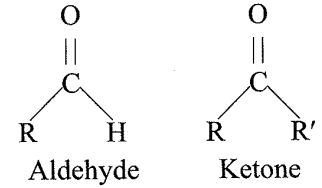
$\rightarrow$ Aldehydes and ketones: In aldehydes, the carbonyl group is bonded to a carbon and hydrogen while in the ketone, it is bonded to two carbon atoms.
Image
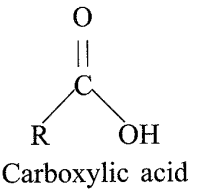
$\rightarrow$ Carboxylic acids: The carbonyl compounds in which carbon of carbonyl group is bonded to carbon or hydrogen and oxygen of hydroxyl moiety $(-OH)$ are known as carboxylic acid.
Image
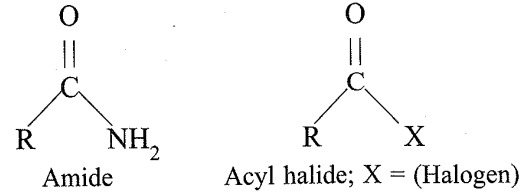
$\rightarrow$ Amides and acyl halides: The carbonyl compounds in which carbon of carbonyl group is bonded to carbon or hydrogen and nitrogen of $-NH_2,$ moiety or to halogen are called amides and acyl halides respectively.
Image
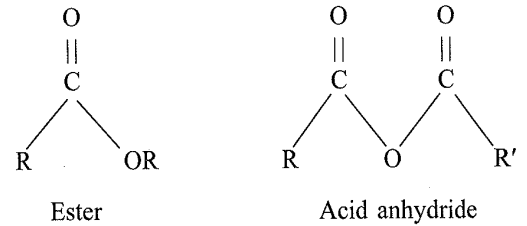
$\rightarrow$ Esters and anhydrides: The compounds in which carbonyl carbon is bonded to a carbon or hydrogen and oxygen of alkoxy moiety $(-OR \ ')$ and carbon of acyl moiety $(-COR \ ')$ are known as esters and anhydrides respectively.
Image

Need a full question paper?

Generate a complete, print-ready paper with questions like this in minutes — across 16+ boards, with answer keys.

Start Generating Free

Similar questions

The well known mineral fluorite is chemically calcium fluoride. It is known that in one unit cell of this mineral there are $4 \mathrm{Ca}^{2+}$ ions and $8 \mathrm{F}^{-}$ions and that $\mathrm{Ca}^{2+}$ ions are arranged in a fcc lattice. The $\mathrm{F}^{-}$ions fill all the tetrahedral holes in the face centred cubic lattice of $\mathrm{Ca}^{2+}$ ions. The edge of the unit cell is $5.46 \times 10^{-8} \mathrm{~cm}$ in length. The density of the solid is $3.18 \mathrm{~g} \mathrm{~cm}^{-3}$. Use this information to calculate Avogadro's number $($Molar mass of $\mathrm{CaF}_2=78.08 \mathrm{~g} \mathrm{~mol}^{-1} ).$
Nalorphene $(C_{19}H_{21}NO_3)$, similar to morphine, is used to combat withdrawal symptoms in narcotic users. Dose of nalorphene generally given is $1.5$ mg. Calculate the mass of $1.5 – 10^{–3}$ m aqueous solution required for the above dose.
The electrical resistance of a column of 0.05 M KOH solution of diameter 1 cm and length 45·5 cm is 4.55 $\times$ 103 ohm. Calculate its molar conductivity.
Write down the IUPAC name for the following complex and indicate the oxidation state, electronic configuration and coordination number. Also give stereochemistry and magnetic moment of the complex:
$CrCl_3(py)_3$
Explain:
  1. The basis of similarities and differences between metallic and ionic crystals.
  2. Ionic solids are hard and brittle.
For the reaction
$2NO_{(g)} + Cl_{2(g)} \rightarrow 2 NOCl_{(g)}$
The following data were collected. All the measurements were taken at $263K$:
Experiment. No. Initial $[NO] (M)$ Initial $[Cl_2] (M)$ Initial rate of disappearance of $Cl_2$(M/min)
$1$ $0.15$ $0.15$ $0.60$
$2$ $0.15$ $0.30$ $1.20$
$3$ $0.30$ $0.15$ $2.40$
$4$ $0.25$ $0.25$ ?
  1. Write the expression for rate law.
  2. Calculate the value of rate constant and specify its units.
  3. What is the initial rate of disappearance of $Cl_2$ in exp. $4$?
Ortho and para nitrophenols are more acidic than phenol. Draw the resonance structures of the corresponding phenoxide ions.
How would you account for the following:
The $\mathrm{E}^{\circ}$ value for the $\mathrm{Mn}^{3+} / \mathrm{Mn}^{2+}$ couple is much more positive than that for $\mathrm{Cr}^{3+} / \mathrm{Cr}^{2+}$ couple or $\mathrm{Fe}^{3+} / \mathrm{Fe}^{2+}$ couple.
Write a note on DDT.
How are xenon fluorides $XeF_2,\ XeF_4$ and $XeF_6$ obtained?