Question
Short note on: Sucrose.

Answer

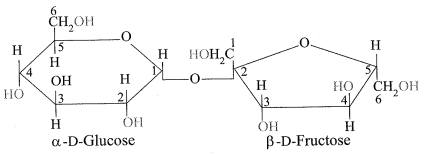
One of the common disaccharides is sucrose which on hydrolysis gives equimolar mixture of D-(+)glucose and D-(-)fructose.
Image
These two monosaccharides are held together by a glycosidic linkage between $C _1$ of $\alpha- D$ Glucose and $C _2$ of $\beta-D$ fructose.
Since the reducing groups of glucose and fructose are involved in glycosidic bond formation, sucrose is a non reducing sugar.
Image
Sucrose is dextrorotatory but after hydrolysis gives dextrorotatory glucose and laevorotatory fructose.
Since the laevorotation of fructose (-92.4°) is more than dextrorotation of glucose (+52.5°) the mixture is laevorotatory.
Thus, hydrolysis of sucrose brings about a change in the sign of rotation, from dextro (+)
to laevo (-) and the product is named as invert sugar.

Need a full question paper?

Generate a complete, print-ready paper with questions like this in minutes — across 16+ boards, with answer keys.

Start Generating Free

Similar questions

Explain reaction of nitrous acid with primary aliphatic Amine and Primary aromatic amine.
For a reaction, the energy of activation is zero. What is the value of rate constant at 300K, if k = 1.6 × 10⁶ s –1 at 280K? [R = 8.31J K–1 mol–1].
How would you account for the following:
Transition metals sometimes exhibit very low oxidation state such as +1 and 0.
How does acetone reacts with HCN and NaHSO3?
The reaction, N2 (g) + O2 (g) $\rightleftharpoons$ 2NO(g) contributes to air pollution whenever a fuel is burnt in air at a high temperature. At 1500K, equilibrium constantKfor it is 1.0 x 10⁻⁵. Suppose in a case [N2] = 0.80 mol L–1 and [O2] = 0.20 mol L–1 before any reaction occurs. Calculate the equilibrium concentrations of the reactants and the product after the mixture has been heated to 1500 K.
State reasons for the following:
  1. pKb value for aniline is more than that for methylamine.
  2. Ethylamine is soluble in water whereas aniline is not soluble in water.
  3. Primary amines have higher boiling points than tertiary amines.
  1. The cell in which the following reaction occurs:

2 Fe3+ (aq) + 2 I- (aq) $\longrightarrow$ 2 Fe2+ (aq) + I2(s)

has $\text{E}^0_{\text{cell}}$ = 0·236 V at 298 K. Calculate the standard Gibbs energy of the cell reaction. (Given : 1 F = 96,500 C mol-1)

  1. How many electrons flow through a metallic wire if a current of 0·5 A is passed for 2 hours? (Given : 1 F = 96,500 C mol-1)
The rate of a particular reaction triples when temperature changes from 50°C to 100°C. Calculate the activation energy of the reaction.

[log 3 = 0.4771; R = 8.314 JK-1 mol-1].

[Ti(H2O)]3+ is coloured while [Sc(H2O)6]3+ is colourless.
Explain Finkelstein and Swarts reaction. ### Explain preparation of haloalkane by halogen exchange method.