Question
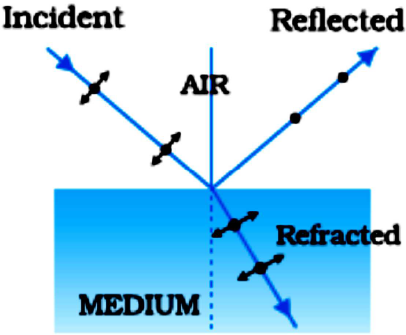
  1. Show, giving a suitable diagram, how unpolarized light can be polarised by reflection.
  2. Two polaroids $P_1$ and $P_2$ are placed with their pass axes perpendicular to each other. Unpolarised light of intensity $I_0$ is incident on $P_1 A$ third polaroid $P_3$ is kept in between $P_1$ and $P_2$ such that its pass axis makes an angle of $60^{\circ}$ with that of $P_1$. Determine the intensity of light transmitted through $P_1, P_2$ and $P_3$.
Answer

  1. When unpolarised light is incident on the boundary between two transparent media, the reflected light gets plane polarized with its electric vector perpendicular to the plane of incidence.

The polarization is complete when the reflected and refracted rays are at right angles to each other. This condition occurs for an angle of incidence, $i_p,$ where tan $i_p = \mu$
  1. Intensity of light through $\text{P}_1=\frac{I_0}{2}$
Intensity of light through $\text{P}_2=\frac{I_0}{2}\cos^260$
$\frac{I_0}{2}.\bigg(\frac{1}{2}\bigg)^2=\frac{I_0}{8}$
Intensity of light through $ \text{P}_3=\frac{I_0}{8}\cos^230=\frac{I_0}{8}\times\bigg(\frac{\sqrt{3}}{2}\bigg)^2=\frac{3I_0}{32}$

Need a full question paper?

Generate a complete, print-ready paper with questions like this in minutes — across 16+ boards, with answer keys.

Start Generating Free

Similar questions

An ideal gas $\Big(\frac{\text{C}_\text{P}}{\text{C}_\text{V}}=\gamma\Big)$ is taken through a process in which the pressure and the volume vary as $p = aV^b$. Find the value of b for which the specific heat capacity in the process is zero.
  1. State the condition under which a charged particle moving with velocity v goes undeflected in a magnetic field B.
  2. An electron, after being accelerated through a potential difference of 104 V, enters a uniform magnetic field of 0.04 T, perpendicular to its direction of motion. Calculate the radius of curvature of its trajectory.
An $\alpha-$ particle collides with nucleus after passing through the potential $V$ volt. Prove that distance of closest approach of particle of atomic number $Z$ to the nucleus will be $14.4( Z / V ) \ \mathring A $.
$($Given that : $1 / 4 \pi \varepsilon_0=9.0 \times 10^9$ Newton $-$ meter $^2 /$ Coulomb $^2$ and $e=1.6 \times 10^{-19}$ Coulomb$)$
You have learnt that plane and convex mirrors produce virtual images of objects. Can they produce real images under some circumstances? Explain.
Figure shows a potentiometer circuit for comparison of two resistances. The balance point with a standard resistor $\text{R}=10.0\ \Omega$ is found to be 58.3 cm, while that with the unknown resistance X is 68.5 cm. Determine the value of X. What might you do if you failed to find a balance point with the given cell of emf $\varepsilon?$
Describe the working principle of a moving coil galvanometer. Why is it necessary to use (i) a radial magnetic field and (ii) a cylindrical soft iron core in a galvanometer? Write the expression for current sensitivity of the galvanometer.
Can a galvanometer as such be used for measuring the current? Explain.
Write the expression for the force on a charge moving in a magnetic field.Use this expression to define the SI unit of magnetic field.
Explain barrier potential of $p-n$ junction.
Let $A_1A_2A_3 A_4 A_5 A_6 A_1$ be a regular hexagon. Write the x-components of the vectors represented by the six sides taken in order. Use the fact that the resultant of these six vectors is zero, to prove that$\cos0+\cos\frac{\pi}{3}+\cos\frac{2\pi}{3}+\cos\frac{3\pi}{3}+\cos\frac{4\pi}{3}+\cos\frac{5\pi}{3}=0.$
Use the known cosine values to verify the result.
What is Global Positioning System? Explain its working principle in brief.