Question
Show that $4\sqrt{2}$ is an irrational number.

Answer

Let us assume that $4\sqrt{2}$ is a rational number .
So, we can find co-prime integers $‘a’$ and $‘b’ (b \neq 0)$ such that
$4 \sqrt{ } 2=\frac{a}{b}$
$\therefore \sqrt{ } 2=\frac{a}{4 b}$
Since, $a$ and $b$ are integers, $\frac{a}{4 b}$ is a rational number and so $\sqrt{ 2}$ is a rational number.
Alternate Proof:
Let us assume that $4\sqrt{2}$ is a rational number.
So, we can find co-prime integers $‘a’$ and $‘b’ (b \neq 0)$ such that
$ 4 \sqrt{2}=\frac{a}{b}$
$\therefore b(4 \sqrt{2})=a$
$\therefore 32 b^2=a^2$
$\therefore b^2=\frac{a^2}{32}$
Since, 32 divides $a^2$, so 32 divides 'a' as well.
So, we write $a=32 c$, where c is an integer.
$\therefore a ^2=(32 c )^2 \ldots$ [Squaring both the sides]
$\therefore 32 b^2=32 \times 32 c ^2 \ldots[$ [From(i) $]$
$\therefore b^2=32 c ^2$
$\therefore c^2=\frac{b^2}{32}$
Since, 32 divides $b ^2$, so 32 divides ' b '.
$\therefore 32$ divides both a and b .
a and b have at least 32 as a common factor.
But this contradicts the fact that a and b have no common factor other than 1.
$\therefore$ Our assumption that $4 \sqrt{ } 2$ is a rational number is wrong.
$\therefore 4 \sqrt{ } 2$ is an irrational number.

Need a full question paper?

Generate a complete, print-ready paper with questions like this in minutes — across 16+ boards, with answer keys.
Start Generating Free

Similar questions

In square ABCD, P and Q are mid-point of AB and CD respectively. If AB = 8cm and PQand BD intersect at O, then find area of $(\triangle\text{OPB}).$
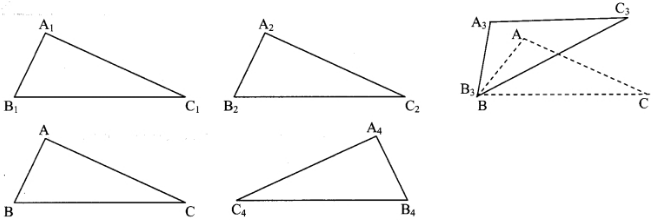
Check the congruence of triangles.
Image
Prove that the line segments joining the midpoints of opposite sides of a quadrilateral bisect each other.
In a hostel there are 125 students, out of which 80 drink tea, 60 drink coffee and 20 drink tea and coffee both. Find the number of students who do not drink tea or coffee.
The denominator of a fraction is 1 less than twice its numerator. If 1 is added to numerator and denominator respectively, the ratio of numerator to denominator is 3 : 5. Find the fraction.
The diagonals of a cyclic quadrilateral are at right angles. Prove that the perpendicular from the point of their intersection on any side when produced backwards, bisects the opposite side.
In the given figure, ABC is an equilateral triangle; PQ || AC and AC is produced to R such that CR = BP. Prove that QR bisects PC.
ABCD is a parallelogram. G is a point on AB such that AG = 2GB and E is point on DC such that CE = 2DE and F is the point of BC such that BF = 2FC. Prove that:
  1. $\text{ar}(\text{ADEG})=\text{ar}(\text{GBCE})$
  2. $\text{ar}{(\triangle\text{EGB}})=\frac{1}{6}\text{ar}(\text{ABCD})$
  3. $\text{ar}(\triangle\text{EFC})=\frac{1}{2}\text{ar}(\triangle\text{EBF})$
  4. $\text{ar}(\triangle\text{EBG})=\text{ar}(\triangle\text{EFC})$
  5. Find what portion of the parallelogram is the area of $\triangle\text{EFG}.$
1500 families with 2 children were selected randomly, and the following data were recorded:
No of girls in a family
0
1
2
No of girls
211
814
475
If a family is chosen at random, compute the probability that it has:
  1. No girl.
  2. 1 girl.
  3. 2 girls.
  4. At most one girl.
  5. More girls than boys.
Answer the questions with the help of figure given below
.
i. State the points which are equidistant from point B.
ii. Write a pair of points equidistant from point iii. Find d(U,V), d(P,C), d(V,B), d(U, L).