AreaAreas of Parallelograms and Triangles — Maths STD 9 — Question
Gujarat BoardEnglish MediumSTD 9MathsAreaAreas of Parallelograms and Triangles3 Marks
Question
Show that a diagonal divides a parallelogram into two triangles of equal area.
✓
Answer
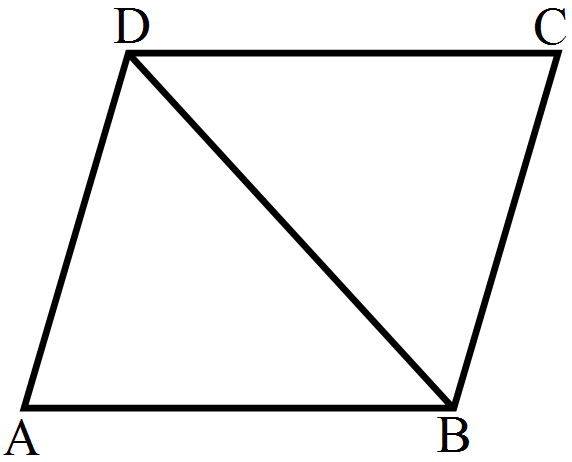
Let $ABCD$ be a parallelogram and $BD$ be its diagonal.
To prove: $\text{ar}(\triangle\text{ABD})=\text{ar}(\triangle\text{CDB})$
Proof: In $\triangle\text{ABD}$ and $\triangle\text{CDB},$
we have : $AB = CD [$Opposite sides of a parallelogram$] AD = CB [$Opposite sides of a parallelogram$] BD = DB [$Common$]$
i. e., $\triangle\text{ABD}\cong\triangle\text{CDB} [SSS$ criteria$]$
$\therefore\ \text{ar}(\triangle\text{ABD})=\text{ar}(\triangle\text{CDB})$
Need a full question paper?
Generate a complete, print-ready paper with questions like this in minutes — across 16+ boards, with answer keys.