Question
Show that a liquid at rest exerts a force perpendicular to the surface of the container at every point.

Answer

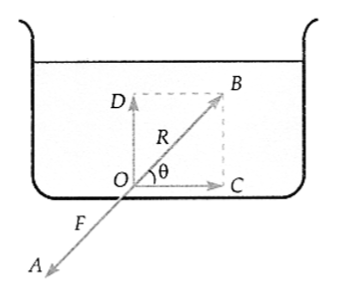
Consider a liquid contained in a vessel in the equilibrium state of rest. As shown in Fig., suppose the liquid exerts a force F on the bottom surface in an inclined direction OA. The surface exerts an equal reaction R to water along OB.
Image
The reaction R along OB has two rectangular components:
i. Tangential component, $OC = R \cos \theta$
ii. Normal component, $OD = R \sin \theta$
Since a liquid cannot resist any tangential force, the liquid near O should begin to flow along OC . But the liquid is at rest, the force along OC must be zero.
$
\therefore R \cos \theta=0
$
As $R \neq 0$, so $\cos \theta=0$ or $\theta=90^{\circ}$
Hence a liquid always exerts a force perpendicular to the surface of the container at every point.

Need a full question paper?

Generate a complete, print-ready paper with questions like this in minutes — across 16+ boards, with answer keys.
Start Generating Free

Similar questions

Consider the situation of the previous question from a frame moving with a speed v0 parallel to the initial velocity of the block.
  1. What are the initial and final kinetic energies?
  2. What is the work done by the kinetic friction?
When we stir a liquid vigorously, it becomes warm. Is it a reversible process?
The count rate from a radioactive sample falls from $4.0 \times 10^6$ per second to $1.0 \times 10^6$ per second in 20 hours. What will be the count rate 100 hours after the beginning?
Two planets have masses in the ratio $1 : 10$ and radii in the ratio $2 : 5$. Compare:
  1. Their densities.
  2. The acceleration due to gravity on their surface.
  3. Escape velocities from their surfaces.
  4. The periods of revolutions of satellites near to their surfaces.
In long jump, does it matter how high you jump? What factors determine the span of the jump?
The maximum tension in the string of an oscillating pendulum is double of the minimum tension. Find the angular amplitude.
A $400 kg$ satellite is in a circular orbit of radius $2 R_E$ about the Earth. How much energy is required to transfer it to a circular orbit of radius $4 R_E$ ? What are the changes in the kinetic and potential energies?
A man can swim at the rate of $5km/ h$ in still water. A river $1km$ wide flows at the rate of $3km/ h$. A swimmer wishes to cross the river straight.
  1. Along what direction must he strike?
  2. What should be his resultant velocity?
  3. How much time he would take to cross?
The radius of curvature of a concave mirror, measured by a spherometer is given by: $\text{R}=\frac{\text{l}^2}{6\text{h}}+\frac{\text{h}}{2}$ The value of l and h are 4.0cm and 0.065cm respectively where l is measured by a metre scale and h by the spherometer. Find the relative error in the measurement of R.
On complete combustion a litre of petrol gives off heat equivalent to $3 \times 107J$. In a test drive a car weighing $1200kg$. including the mass of driver, runs $15km$ per litre while moving with a uniform speed on a straight track. Assuming that friction offered by the road surface and air to be uniform, calculate the force of friction acting on the car during the test drive, if the efficiency of the car engine were $0.5$