Question
Show that currents in two long, straight, parallel wires exert forces on each other. Derive the expression for the force per unit length on each conductor.
Answer

Case I: Both wires carry current in the same direction.
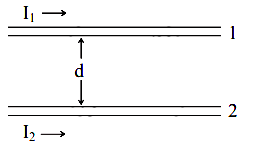
i. Consider two long parallel wires separated by distance $d$ and carrying current $I _1$ and $I _2$ respectively same direction as same as shown in the figure below:

Two long parallel wires, distance $d$ apart
ii. The magnetic field at the second wire due to the current $I_1$ in the first one, according to Biot - Savart's law is $B =\frac{\mu_0 I _1}{2 \pi d } \ldots$..(1)
iii. By the right-hand rule, the direction of this field is into the plane of the paper.
iv. Force on the wire 2 , because of the current $I_2$ and the magnetic field $B$ due to current in wire 1, applying Lorentz force law is,
$
F = I _2\left(\frac{\mu_0 I _1}{2 \pi d }\right) \int dl \ldots(2)
$
The direction of this force is towards wire 1, i.e., it will be an attractive force.
$v$. Force of attraction per unit length of the wire will be $\frac{ F }{ L }=\frac{\mu_0}{2 \pi} \frac{ I _1 I _2}{ d } \ldots$...(3)
Case II: Two wires carry current in opposite direction.
Force is of repulsive nature between antiparallel currents and the magnitude of the force of repulsion per unit length is, $\left|\frac{ F }{ L }\right|=\frac{\mu_0}{2 \pi} \frac{ I _1 I _2}{ d }$

Need a full question paper?

Generate a complete, print-ready paper with questions like this in minutes — across 16+ boards, with answer keys.

Start Generating Free

Similar questions

Explain how a moving$-$coil galvanometer is converted into an ammeter. Derive the necessary formula.
What is special about a radial magnetic field ? Why is it useful in a moving coil galvanometer ?
Describe the phenomenon of surface tension, giving four examples.
The period of oscillation of a simple pendulum increases by $20 \%$ when the length of the pendulum is increased by $44 cm$. Find its
(i) initial length
(ii) initial period of oscillation at a place where $g$ is $9.8 m / s ^2$.
A thin rod of uniform cross section is made up of two sections made of wood and steel. The wooden section has length $50 \mathrm{~cm}$ and mass $0.6 \mathrm{~kg}$. The steel section has length $30 \mathrm{~cm}$ and mass $3 \mathrm{~kg}$. Find the moment of inertia of the rod about a transverse axis passing through the junction of the two sections.
What is diffraction of light? How does it differ from interference? What are Fraunhoffer and Fresnel diffractions?
What are forced vibrations and resonance? Show that only odd harmonics are present in an air column vibrating in a pipe closed at one end.
Name two materials that have negative magnetic susceptibility.
Define the dark current of the photodiode. What are the advantages and disadvantages of a photodiode?
State the law of efflux. Derive an expression for the speed of efflux for a tank discharging through an opening at a depth $h$ below the liquid surface. Hence or otherwise show that the speed of efflux for an open tank is $\sqrt{2 g h}$.