Question
Show that for a particle performing linear simple harmonic motion, the average kinetic energy of any period of oscillation is equal to the average potential energy of the same period.

Answer

Suppose a particle of mass performs simple harmonic motion for time period T. At the instant when time is measured from the mean position, the displacement of the particle is
$y=a \sin \omega t\ldots\ldots (1)$
We know that
$\begin{aligned}v & =\text { Velocity of particle } \\& =\frac{d y}{d t}=\frac{d}{d t}(a \sin \omega t) \\v & =a \omega \cos \omega t \ldots\ldots(2) \\KE, E_k & =\frac{1}{2} m v^2=\frac{1}{2} m(a \omega \cos \omega t)^2 \\& =\frac{1}{2} m a^2 \omega^2 \cos ^2 \omega t \\\text { P.E., } E_p & =\frac{1}{2} ky^2=\frac{1}{2} k(a \sin \omega t)^2 \\E_p & =\frac{1}{2} ka^2 \sin ^2 \omega t \\& =\frac{1}{2} m \omega^2 a^2 \sin ^2 \omega t \\\left(E_k\right)_{a v} & =\text {Average kinetic energy of one cycle} \\& =\frac{1}{T} \int_0^{T} E_k d t \\& =\frac{1}{T} \int_0^{T}\left(\frac{1}{2} m a^2 \omega^2 \cos { }^2 \omega t\right) d t\end{aligned}$
$\begin{aligned}& =\frac{1}{2 T} m a^2 \omega^2 \int_0^{T} \cos ^2 \omega t d t \\& =\frac{1}{2 T} m a^2 \omega^2 \int_0^{T}\left(\frac{1+\cos 2 \omega t}{2}\right) d t \\& =\frac{1}{4 T} m a^2 \omega^2\left[\int_0^{T} 1 \cdot d t+\int_0^{T} \cos 2 \omega t d t\right] \\& =\frac{1}{4 T} m a^2 \omega^2\left[(T-0)+\left(\frac{\sin 2 \omega t}{2 \omega}\right)_0^{T}\right] \\& =\frac{ma^2 \omega^2}{4 T}\left[T+\frac{1}{2 \omega}\left(\sin \frac{4 \pi}{T} \times T-\sin 0\right)\right] \\& =\frac{ma^2 \omega^2}{4 T}\left[T+\frac{1}{2 \omega}(0-0)\right] \\\therefore \sin n \pi & =0, n=0,1,2 \ldots \\\left(E_i\right)_{a v} & =\frac{1}{4} ma^2 \omega^2\ldots\ldots (3)\end{aligned}$
Average potential energy one cycle
$\begin{array}{l}\left(E_{p}\right)_{a v}=\frac{1}{T} \int_0^{T} E_{p} \cdot d t \text { given by } \\\left(E_{p}\right)_{av}=\frac{1}{T} \int_0^{T} \frac{1}{2} m \omega^2 a^2 \sin ^2 \omega t d t \\=\frac{m \omega^2 a^2}{2 T} \int_0^{T} \sin ^2 \omega t d t \\=\frac{m \omega^2 a^2}{2 T} \int_0^T\left(\frac{1-\cos 2 \omega t}{2}\right) d t \\\because \cos 2 \theta=1-2 \sin ^2 \theta \\=\frac{1}{4 T} m \omega^2 a^2\left[\int_0^{T} 1 . d t-\int_0^{T} \cos 2 \cos d t\right] \\=\frac{1}{4 T} m \omega^2 a^2\left[(T-0)-\left(\frac{\sin 2 \omega t}{2 \omega}\right)_0^{T}\right] \\\left(E_{p}\right)_{a v}=\frac{1}{4} m a^2 \omega^2\ldots\ldots (4)\end{array}$
Thus, from equation (3) and (4) we see that the average K.E. over one oscillation time period is and during the same period the average P.E. is equiralent to.

Need a full question paper?

Generate a complete, print-ready paper with questions like this in minutes — across 16+ boards, with answer keys.

Start Generating Free

Similar questions

Three sources of sound $\mathrm{S}_1, \mathrm{~S}_2$ and $\mathrm{S}_3$ of equal intensity are placed in a straight line with $\mathrm{S}_1 \mathrm{~S}_2=\mathrm{S}_2 \mathrm{~S}_3$ figure. At a point P , far away from the sources, the wave coming from S is $120^{\circ}$ ahead in phase of that from $\mathrm{S}_1$. Also, the wave coming from $\mathrm{S}_3$ is $120^{\circ}$ ahead of that from $\mathrm{S}_2$. What would be the resultant intensity of sound at P ?
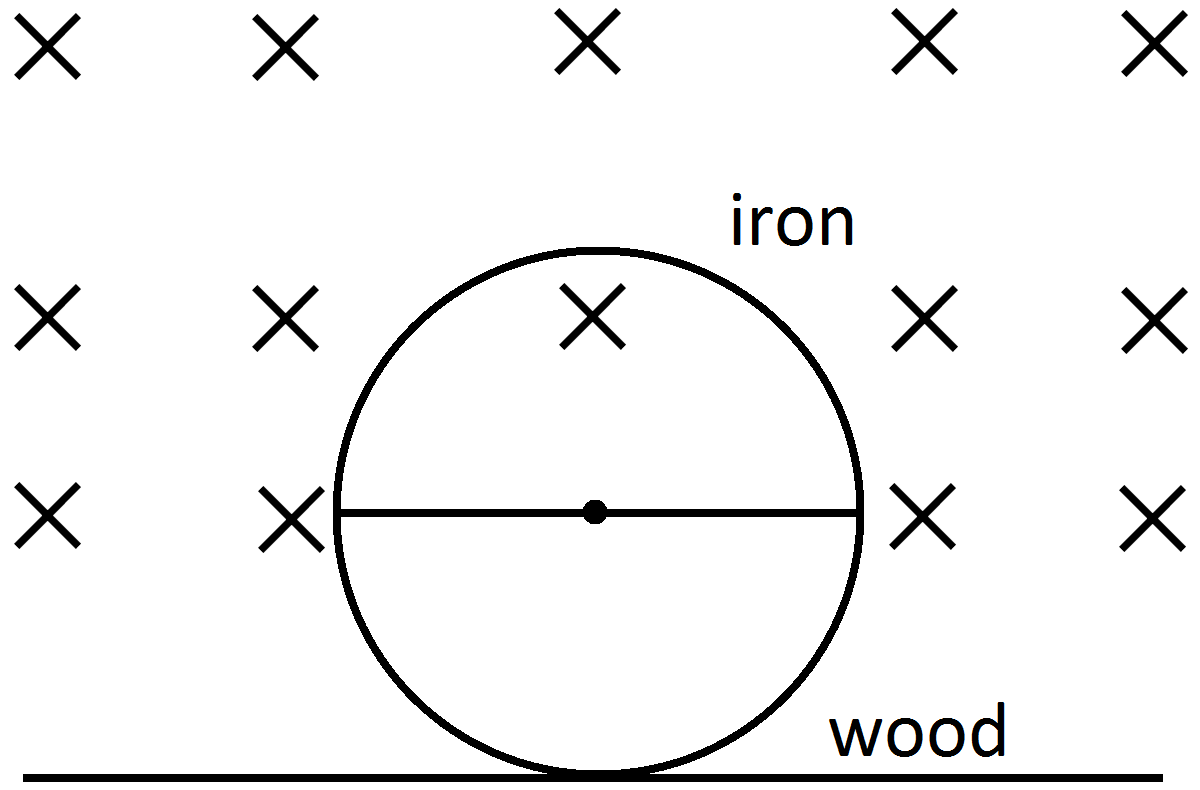
Figure shows a circular wheel of radius 10.0cm whose upper half, shown dark in the figure, is made of iron and the lower half of wood. The two junctions are joined by an iron rod. A uniform magnetic field B of magnitude $2.00 \times 10^{-4} T$ exists in the space above the central line as suggested by the figure. The wheel is set into pure rolling on the horizontal surface. If it takes 2.00 seconds for the iron part to come down and the wooden part to go up, find the average emf induced during this period.
A mass of 2kg is suspended with thread AB Thread CD of the same type is attached to the other end of 2kg mass. Lower thread is pulled gradually, harder and harder in the downward directon so as to apply force on AB. Which of the threads will break and why?
A diatomic gas is suddenly compressed to 1/4 of its initial volume. Find the ratio of final and initial pressure $(\gamma = 1.5)$.
A spring balance reads forces in Newtons. The scale is 20cm long and read from 0 to 60N. Find potential energy of spring when the scale reads 20N.
Establish that work done is the product of the displacement and the force in the direction of displacement.
A boy is standing on a platform which is free to rotate about its axis. The boy holds an open umbrella in his hand. The axis of the umbrella coincides with that of the platform. The moment of inertia of ''the platform plus the boy system'' is $3.0 \times 10^{-3}kg-m^2$ and that of the umbrella is $2.0 \times 10^3kg-m^2$. The boy starts spinning the umbrella about the axis at an angular speed of $2.0rev/s$ with respect to himself. Find the angular velocity imparted to the platform.
Two spheres of the same external radius and made of the same material are heated to the same temperature one of them is hollow and the other is a solid sphere. Whose temperature will fall faster when cooled?
An aeroplane travelling at a speed of 5000km/ hr tilts at an angle of 30° as it makes a turn. What is the radius of the curve?
An electric current of 2.0A passes through a wire of resistance $25\Omega$. How much heat will be developed in 1minute?