Question
Two spheres of the same external radius and made of the same material are heated to the same temperature one of them is hollow and the other is a solid sphere. Whose temperature will fall faster when cooled?

Answer

Both have the same external area. For this reason the rate of cooling will be the same but the rate of fall of temperature is inversely proportional to the mass. Therefore the temperature of hollow sphere will fall faster than that of a solid sphere.

Need a full question paper?

Generate a complete, print-ready paper with questions like this in minutes — across 16+ boards, with answer keys.
Start Generating Free

Similar questions

Find the number of molecules of an ideal gas in a volume of $1.000cm^3a$ at STP.
The voice of a person, who has inhaled helium, has a remarkably high pitch. Explain on the basis of resonant vibration of vocal cord filled with air and with helium.
Name some technologies and related principles.
The wave $y_1=a \sin (\omega t-k x)$ is superimposed by another wave $y_2=a \sin (\omega t+k x)$ then find the ampli-tude of the resultant wave and also explain what are the condition for the amplitude to be maximum and minimum?
Three particles of mass m each are placed at the three corners of an equilateral triangle of side a. Find the work which should be done on this system to increase the sides of the triangle to 2a.
Write the order of following intervals in seconds:
  1. Time between two heart beats.
  2. Time of earth's revolution.
  3. Time of earth's rotation.
  4. Human life.
Two identical blocks of mass 2 kg move towards each other with a uniform speed ( $2 m / s$ ) on a frictionless horizontal plane. They collide with each other and get attached to each other and comes to a state of rest. Calculate the work done by external forces and internal forces on the system of both the particles.
A nucleus is at rest in the laboratory frame of reference. Show that if it disintegrates into two smaller nuclei, the products must be emitted in opposite directions.
The distance of a galaxy is of the order of $10^{25}m$. Calculate the order of magnitude of time taken by light to reach us from the galaxy.
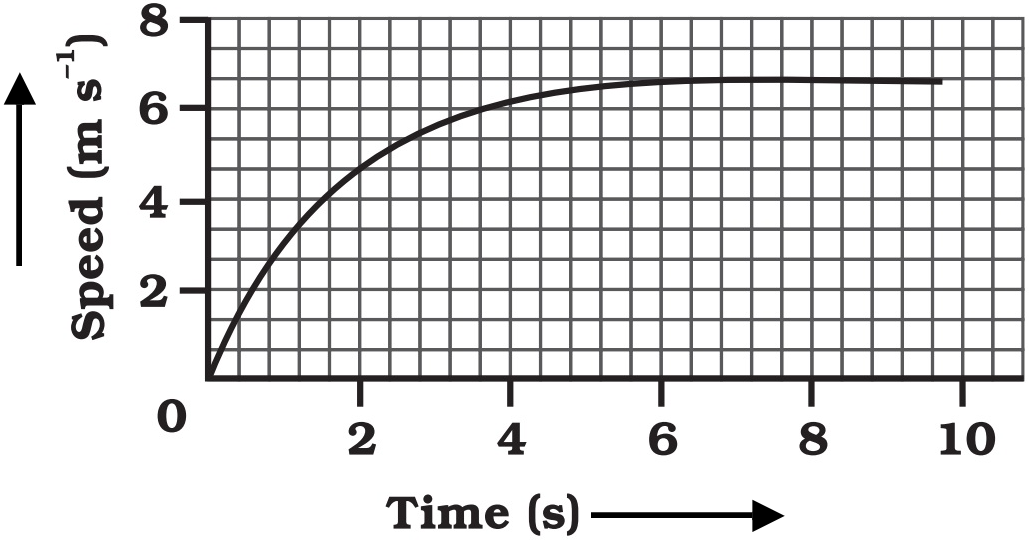
The speed$-$time graph for a car is shown in figure below.
  1. Find how far the car travels in the first $4s?$ Shade the area on the graph that represents the distance travelled by the car during the period.
  2. Which part of the graph represent uniform motion of the car?